
Maximize your score with these resources:
- Albert.io AP® Physics C: Mechanics question banks
- Free AP® Physics C: Mechanics cheat sheets
- Free AP® Physics C: Mechanics score calculator
The period of a spring depends on mass and stiffness. The period of a pendulum depends on length and gravity — not on mass. Understanding why these formulas are structured the way they are, not just memorizing them, is what separates students who get full credit on oscillation FRQs from those who make avoidable errors. This article covers Topic 7.2: Frequency and Period of SHM (Learning Objective 7.2.A) from AP® Physics C: Mechanics.
The Restoring Force and Hooke’s Law
Every oscillator returns to equilibrium because a restoring force opposes displacement. For a spring:
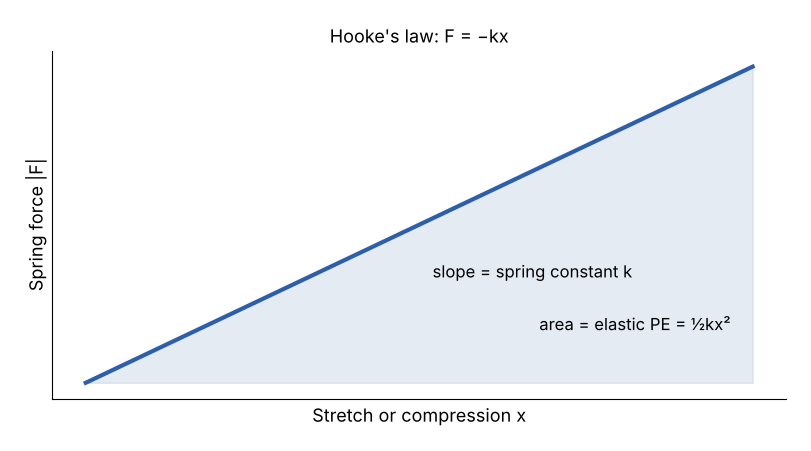
The negative sign is non-negotiable: the force always points toward equilibrium (opposite to displacement). k is the spring constant (N/m) — higher k means a stiffer spring that pushes back harder for the same displacement.
For the AP exam, you need two derived results:
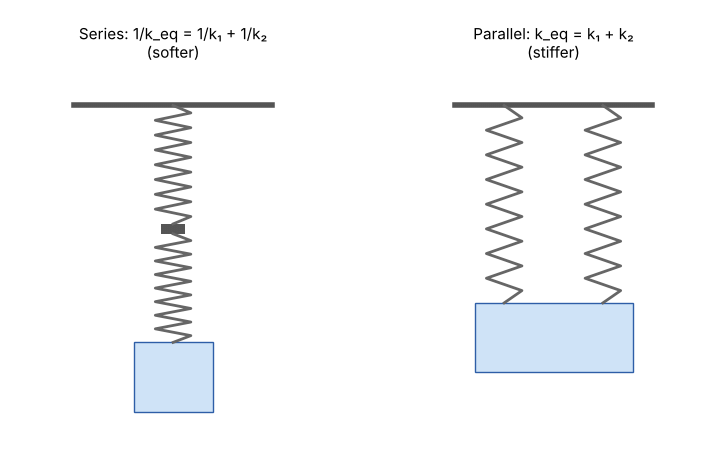
- Springs in parallel: When two springs act on the same mass with the same displacement, their forces add. Effective spring constant: \(k_{eq} = k_1 + k_2\). Stiffer total → faster oscillation.
- Springs in series: The compliance (reciprocal of stiffness) adds. Effective spring constant: \(\frac{1}{k_{eq}} = \frac{1}{k_1} + \frac{1}{k_2}\). Softer total → slower oscillation.
Always identify how springs are connected before choosing the formula. Parallel springs share the same displacement; series springs share the same force but have different displacements.
Spring-Mass Systems and the Period Formula
When you displace a mass from equilibrium and release it, the restoring force \(F = -kx\) combined with Newton’s second law \(F = ma\) gives:
This is the equation for simple harmonic motion (SHM). Its solution is \(x(t) = A\cos(\omega t + \phi)\) with angular frequency \(\omega = \sqrt{k/m}\). The period follows directly:
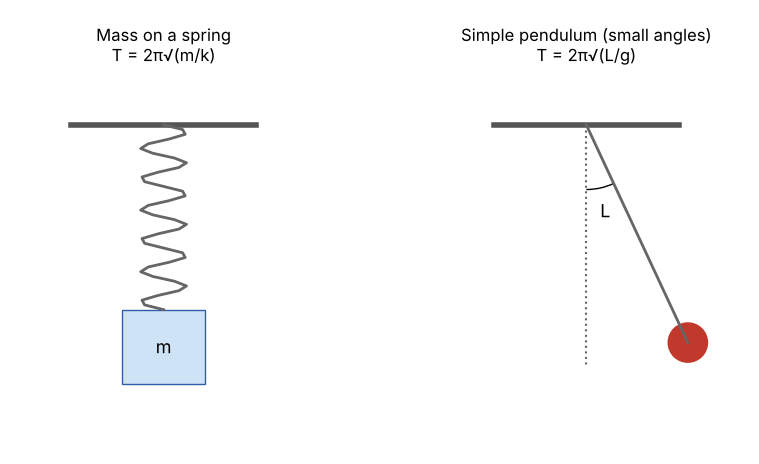
\(T = \frac{2\pi}{\omega} = 2\pi\sqrt{\frac{m}{k}}\)Three things to internalize about this formula:
- Period increases with mass (as √m): Doubling mass increases period by factor √2 ≈ 1.41, not by factor 2.
- Period decreases with stiffness (as 1/√k): Quadrupling k halves the period.
- Amplitude has zero effect on period: Whether you pull 1 cm or 10 cm, the period is identical. This is the defining property of SHM — isochronism.
Energy in SHM: total mechanical energy is \(E = \frac{1}{2}kA^2\). Maximum velocity: \(v_{max} = A\omega = A\sqrt{k/m}\).
Simple Pendulums and Small-Angle Approximation
A simple pendulum is a point mass suspended by a string of length L. The restoring torque is \(\tau = -mgL\sin\theta\). For small angles (θ < 15°), the small-angle approximation gives sinθ ≈ θ, linearizing the equation of motion:
This is SHM with \(\omega = \sqrt{g/L}\), so:
\(T = 2\pi\sqrt{\frac{L}{g}}\)The most testable results:
- Mass cancels completely: A 1 kg and a 10 kg bob on the same string have identical periods.
- Period ∝ √L: Doubling length increases period by √2. A pendulum 4 times as long has twice the period.
- Period ∝ 1/√g: On the Moon (g ≈ 1.6 m/s²), the period is √(9.8/1.6) ≈ 2.5 times longer.
- Amplitude independence (for small angles only): For amplitudes greater than ~15°, the true period becomes amplitude-dependent and longer than the formula predicts.
| Change | Effect on Period | Why |
|---|---|---|
| Double the length | ×√2 (≈ 1.41× longer) | T ∝ √L |
| Double the mass of the bob | No change | Mass cancels in equation of motion |
| Take pendulum to Moon | ≈ 2.5× longer | T ∝ 1/√g; g_moon ≈ g/6 |
| Double the amplitude (small-angle regime) | No change | SHM is isochronous for small angles |
| Large amplitude (> 15°) | Slightly longer than formula | sinθ < θ for large θ — weaker restoring force |
Physical Pendulums and Rotational Inertia
A physical (compound) pendulum is any rigid body oscillating about a fixed pivot — not a point mass. The period formula generalizes the simple pendulum:
\(T = 2\pi\sqrt{\frac{I}{mgd}}\)where I is the moment of inertia about the pivot, m is total mass, and d is the distance from pivot to center of mass.
To solve physical pendulum problems:
- Find d: Identify the center of mass of the object. For a uniform rod of length L pivoted at one end, d = L/2.
- Find I using the parallel axis theorem: I = I_cm + md². For a uniform rod: I_cm = ML²/12, d = L/2, so I = ML²/3.
- Substitute into the formula.
Torsional Pendulums
A torsional pendulum oscillates by twisting rather than swinging. A restoring torque (from a twisted wire or rod) brings the object back:
\(\tau = -\kappa\theta\)The period is \(T = 2\pi\sqrt{\frac{I}{\kappa}}\). This is structurally identical to the spring-mass formula: I plays the role of mass, κ plays the role of k.
Comparing All Oscillator Types
| System | Restoring Agent | Period Formula | Inertia Term | Stiffness Term |
|---|---|---|---|---|
| Spring-mass | Spring force F = −kx | \(2\pi\sqrt{m/k}\) | m (mass) | k (spring constant) |
| Simple pendulum | Gravity component (small angle) | \(2\pi\sqrt{L/g}\) | L (length) | g (gravitational acceleration) |
| Physical pendulum | Gravitational torque (small angle) | \(2\pi\sqrt{I/(mgd)}\) | I (moment of inertia) | mgd (gravitational torque scale) |
| Torsional pendulum | Torsional torque τ = −κθ | \(2\pi\sqrt{I/\kappa}\) | I (moment of inertia) | κ (torsional constant) |
All periods have the form \(T = 2\pi\sqrt{\text{inertia}/\text{stiffness}}\). Increase inertia → slower oscillation. Increase stiffness → faster oscillation. This one principle unifies every oscillation problem on the AP exam.
Test-Taking Strategies
Mnemonic: MISA
Use MISA to anchor the four most-tested oscillation facts:
| Letter | Concept | What to Remember |
|---|---|---|
| M | Mass cancels in pendulums | T = 2π√(L/g) has no m — it cancelled, not because mass is zero |
| I | Isochronous — amplitude doesn’t affect T | In true SHM, pulling 1 cm or 10 cm gives the same period |
| S | Stiffness denominates the period formula | Higher k or higher g → shorter period; stiffer = faster |
| A | All oscillators share T = 2π√(inertia/stiffness) | One master formula covers springs, pendulums, physical pendulums, torsional |
Cross-Topic Connections
Energy (Unit 3) + 7.2: Spring SHM energy is fully determined by amplitude: E = ½kA². FRQs frequently ask you to find maximum speed (v_max = A√(k/m)) or PE at a specific displacement.
Rotational inertia (Topic 5.4) + 7.2: Physical pendulum and torsional pendulum problems directly require moment of inertia calculations. Expect to apply the parallel axis theorem before plugging into the period formula.
Differential equations + 7.2: AP® Physics C asks you to derive the SHM condition from Newton’s second law. Write F = ma, substitute F = −kx, obtain \(\ddot{x} = −(k/m)x\), identify ω² = k/m, and conclude T = 2π/ω.
Common Question Formats
- Find the period with modified conditions: Given an initial system, predict how doubling mass, quadrupling k, or changing length affects T. Use the √(ratio) rule.
- Find maximum velocity: Set ½kA² = ½mv² and solve. Or use v_max = Aω.
- Physical pendulum FRQ: Identify d and I (often via parallel axis theorem), substitute into T = 2π√(I/mgd).
- Compare pendulum on different planets: Period scales as 1/√g. If g_new = 4g, period is halved.
Frequent Student Mistakes
- Assuming period ∝ mass (not √mass): Doubling mass doubles the period is one of the most common errors. Period scales as √m — a sublinear relationship.
- Thinking amplitude affects period in SHM: Amplitude affects energy and maximum velocity, not period.
- Forgetting mass cancels in simple pendulums: The formula T = 2π√(L/g) has no m — it cancelled during the derivation.
- Using d = L instead of d = L/2 for a physical pendulum rod: The center of mass of a uniform rod is at L/2, not L.
- Applying the period formula for large angles: For θ > 15°, sinθ ≠ θ, so the formula underestimates the period. State the small-angle approximation explicitly.
Test-Day Shortcuts
- Ratio method for comparisons: Write T₁/T₂ = √(m₁/m₂) × √(k₂/k₁) for springs, or T₁/T₂ = √(L₁/L₂) × √(g₂/g₁) for pendulums. Faster and avoids arithmetic errors.
- Recognize the oscillator type in 5 seconds: Mass on a spring → spring-mass. Hanging mass on a string → simple pendulum. Rigid body pivoting → physical pendulum. Disk on a twisted wire → torsional pendulum.
Time Management
Oscillation FRQs are formula-intensive but logically linear once you identify the system. Spend the first 30 seconds identifying the oscillator type and writing the appropriate formula. Multi-part FRQs typically build (period → max velocity → energy → modified system), so getting part (a) right is essential. Budget about 3 minutes per part.
Check for Understanding
Think you’ve got it? Complete the quiz below to make sure. Download your results at the end.