
Maximize your score with these resources:
- Albert.io AP® US Government question banks
- Free AP® US Government cheat sheets
- Free AP® US Government score calculator
Affirmative action has been one of the most legally contested and politically divisive civil rights policies in modern American history. Whether race-conscious or gender-conscious admissions, hiring, or contracting measures are constitutional has occupied Supreme Court dockets for over 45 years, with the Court’s interpretation shifting dramatically as its composition changed. This article covers Topic 3.13: Affirmative Action (Learning Objective PRD-2.D), which is part of Unit 3: Civil Liberties and Civil Rights (13-18% exam weight on the AP® US Government and Politics exam).
You’ll encounter affirmative action on the AP exam in several ways: MCQs asking you to identify the constitutional standard applied to race-conscious policies, FRQs requiring you to compare competing arguments about equal protection, and stimulus-based questions that reference landmark Supreme Court cases. This article will equip you with the legal standards, case law, and competing policy arguments you need to answer those questions accurately.
What Affirmative Action Is (and Isn’t)
Affirmative action is a policy designed to remedy the effects of past discrimination by giving preferences to members of historically disadvantaged groups in admissions, hiring, contracting, or other decisions. The key word is “preference” — affirmative action policies consider race, ethnicity, gender, or national origin as one factor among many, aiming to increase the representation of underrepresented groups.
It’s crucial to understand what affirmative action is NOT:
- Not a quota system. A quota sets aside a fixed number or percentage of positions for a particular group. The Supreme Court has consistently struck down rigid quotas as unconstitutional, even when designed to remedy discrimination.
- Not automatic admission or hiring. Affirmative action considers group membership as one factor in a holistic review; it does not guarantee admission or hire to any individual.
- Not just race-based. Affirmative action can also apply to gender, national origin, veterans’ status, or socioeconomic disadvantage, depending on the policy.
- Not a permanent solution. Courts have treated affirmative action as a temporary remedy, requiring periodic review and eventual discontinuation once the goal of remedying discrimination is achieved.
Understanding these distinctions is essential for AP exam success. Many exam questions test whether you can identify a policy as a “quota” (unconstitutional) versus “affirmative action” (constitutionally permissible, with limits).
The Constitutional Standard: Strict Scrutiny and Compelling Government Interest
When a law or policy explicitly classifies people by race, the Supreme Court applies strict scrutiny — the highest level of constitutional review. Under strict scrutiny, a race-conscious policy is constitutional only if the government can show two things:
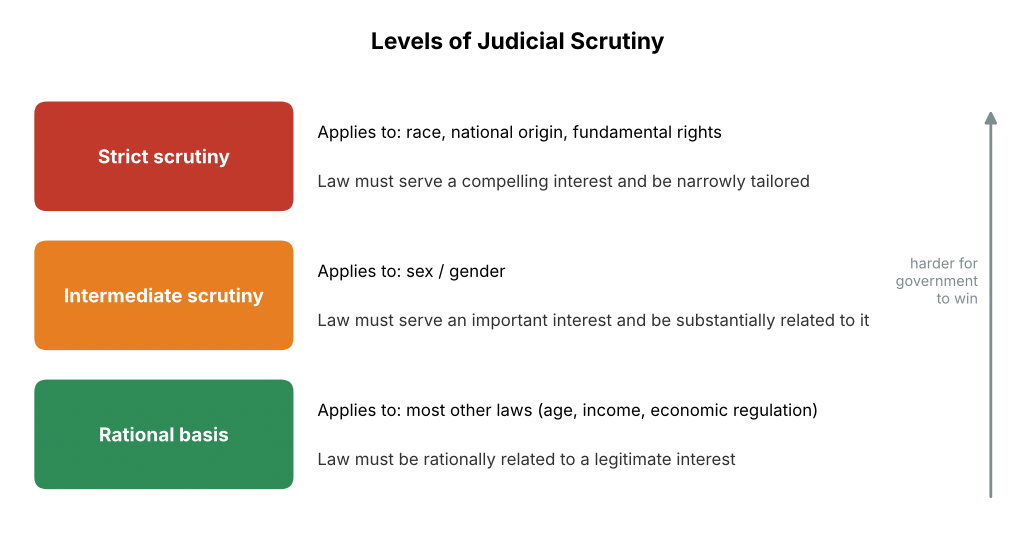
- A compelling government interest. The government must have a pressing, legitimate reason for the race-conscious policy — not just a preference or convenience.
- Narrow tailoring. The policy must be carefully designed to achieve that interest with as little racial classification as possible. The government cannot use broader means when narrower ones would work.
This standard emerged from the Supreme Court’s civil rights jurisprudence in cases like Loving v. Virginia (1967), which struck down anti-miscegenation laws. The Court applied it to affirmative action beginning with Regents of the University of California v. Bakke (1978), and it has remained the controlling standard through the most recent cases.
What counts as a “compelling government interest” has been the central battleground in affirmative action cases. Let’s examine how the Court’s answer to this question has evolved.
The Major Affirmative Action Cases: A Shifting Judicial Landscape
| Case | Year | Context | Ruling | Compelling Interest? |
|---|---|---|---|---|
| Regents v. Bakke | 1978 | Medical school admissions with racial quota | Struck down rigid quota; upheld race as one factor | Achieving educational diversity is compelling; remedying general societal discrimination is not |
| Grutter v. Bollinger | 2003 | Law school admissions with holistic race consideration | Upheld race-conscious admissions | Student body diversity and cross-racial understanding are compelling |
| Fisher v. UT Austin (Fisher I) | 2013 | Race-conscious admissions at public university | Remanded; required stricter narrow-tailoring review | Compelling interest exists, but university must prove its policy achieves it |
| Fisher v. UT Austin (Fisher II) | 2016 | Same case, after remand | Upheld UT Austin’s admissions program | Educational diversity remains compelling; this program was narrowly tailored |
| Students for Fair Admissions v. Harvard | 2023 | Race-conscious admissions at private university | Struck down race-conscious admissions at both Harvard and UNC | Educational diversity is NOT compelling; using race as a factor violates Equal Protection |
Why this table matters: Notice how the Court’s definition of “compelling interest” narrowed over 45 years. In 1978 and 2003, the Court accepted educational diversity as a legitimate reason for race-conscious admissions. By 2023, the Court explicitly rejected this, holding that universities cannot constitutionally consider race at all. This shift reflects the Court’s changing composition and its interpretation of the Equal Protection Clause. For the AP exam, you must know not just what each case decided, but how the Court’s reasoning changed.
Regents v. Bakke (1978): The Quota Ban and the “Plus Factor” Model
Regents v. Bakke was the first major affirmative action case. UC Davis Medical School had reserved 16 of 100 seats for minority applicants. Allan Bakke, a white applicant, was rejected in two consecutive years, even though his test scores exceeded those of some admitted minority applicants. He sued, claiming the quota violated the Equal Protection Clause.
The Court fractured — no single majority opinion — but Justice Lewis Powell’s opinion became the controlling standard. Powell held:
- Rigid quotas are unconstitutional because they reserve seats solely on the basis of race.
- Race CAN be considered as one factor in a holistic review process (the “plus factor” model).
- Achieving a diverse student body is a compelling government interest.
- The university must prove its use of race is narrowly tailored to achieve that interest.
This ruling created a delicate constitutional balance: universities could consider race to promote diversity, but only if they did so carefully and not through rigid numerical targets.
Grutter v. Bollinger (2003): The Diversity Rationale Strengthened
For 20 years, Grutter was the controlling precedent on affirmative action in higher education. The University of Michigan Law School used race as one of many factors in admissions, aiming to enroll a “critical mass” of underrepresented minorities. Grutter, a white applicant, was denied admission and sued.
The Supreme Court upheld the law school’s program 5-4. The majority affirmed:
- Achieving student body diversity is a compelling government interest because it enhances classroom discussion, improves critical thinking, and prepares students for a diverse society and workforce.
- Universities have institutional autonomy to define their educational mission, including the role of diversity.
- The policy was narrowly tailored: race was one factor among many, and the university did not employ quotas or numerical targets.
- Affirmative action in higher education should be subject to periodic review and should eventually expire — Justice O’Connor wrote that 25 years “seems reasonable” for the constitutionality of race-conscious admissions.
Grutter lasted almost exactly 20 years before being overruled in 2023. This is critical context for understanding the 2023 decision.
Fisher v. UT Austin (2013, 2016): Scrutiny Tightens
When Fisher I reached the Supreme Court in 2013, the Court had shifted more conservative. The majority found a procedural problem: UT Austin hadn’t adequately explained why its affirmative action program was necessary to achieve diversity, given that Texas’s “Top 10 Percent” law (admitting the top 10% of high school graduates) already increased minority enrollment.
Fisher I didn’t overturn Grutter, but it raised the evidentiary bar. Universities now had to prove that their race-conscious policies actually served a compelling interest and were narrowly tailored — not just assert that diversity was important.
When the case returned as Fisher II in 2016, UT Austin presented detailed evidence that its modest use of race (as one factor in admissions) was necessary because race-neutral alternatives (like the Top 10% rule) had plateaued. The Court, in a 4-3 decision with Justice Kennedy writing the majority opinion, upheld UT’s program. But the decision was narrow and heavily conditional on the university’s burden of proof.
Students for Fair Admissions v. Harvard (2023): The Affirmative Action Ban
In June 2023, Chief Justice John Roberts issued a 6-3 majority opinion striking down race-conscious admissions at both Harvard University and the University of North Carolina. This decision effectively overruled Grutter and fundamentally rewrote affirmative action law.
The Court’s reasoning:
- Race-consciousness violates the Equal Protection Clause. The 14th Amendment protects individuals, not groups. Using race as a factor in admissions, even to remedy past discrimination or achieve diversity, discriminates against individuals on the basis of race.
- Educational diversity is not a compelling interest. The Court explicitly rejected the Grutter rationale, holding that “eliminating racial discrimination means eliminating all of it.”
- Historical discrimination cannot justify present racial preferences. While past discrimination may justify race-conscious remedies in narrow contexts (remedying the effects of the government’s own discrimination, like in segregated schools), it does not justify university admissions preferences decades later.
- Universities can consider how race affected an applicant’s life experiences, but not use race as a plus factor. Schools can still discuss an applicant’s experience as a member of a racial minority (e.g., discrimination faced), but cannot factor in race itself as an advantage.
Why this decision matters: The 2023 ruling represents the broadest attack on affirmative action in 45 years. It eliminated the distinction between permissible affirmative action and impermissible discrimination, holding that using race as a factor in university admissions violates the Equal Protection Clause. For AP exam purposes, you need to know that this represents a fundamental shift in constitutional doctrine, not merely a narrow ruling about specific policies.
The Arguments For and Against Affirmative Action
The affirmative action debate involves fundamentally different views about how to interpret equal protection and remedy discrimination.
Arguments Supporting Affirmative Action
- Remedying systemic discrimination. Centuries of slavery, segregation, and discriminatory laws created structural disadvantages that persist today. Affirmative action is a tool to undo those effects and create a level playing field.
- Achieving educational and workplace diversity. Diverse environments improve learning, decision-making, and preparation for a pluralistic society. This requires affirmative action because discrimination and historical barriers mean minority candidates are underrepresented.
- Correcting implicit bias. Even without explicit discrimination, implicit racial bias in admissions and hiring decisions favors majority-group applicants. Affirmative action counteracts this unconscious bias.
- Group-based harm requires group-based remedies. Discrimination has harmed racial groups as groups, not just individuals. Therefore, remedies should address groups, not just individuals.
- Actual equality requires considering historical context. True equal protection means recognizing that applicants begin from different starting points due to past discrimination. A “color-blind” policy ignores these real inequalities.
Arguments Against Affirmative Action
- It discriminates against individuals on the basis of race. Rejecting or hiring someone partly because of their race treats that person as a member of a racial group, not as an individual. This is the very vice the Equal Protection Clause prohibits.
- It harms innocent parties. White applicants or Asian applicants who had no role in historical discrimination are disadvantaged. Collective punishment of present-day individuals for past wrongs is unjust.
- It’s constitutionally impermissible. The 14th Amendment’s Equal Protection Clause should be “color-blind” — the government should not classify or treat people differently based on race, period.
- It stigmatizes beneficiaries. Affirmative action creates the impression that minority beneficiaries are less qualified, which undermines their credentials and self-respect.
- Race-neutral alternatives are available. Class-based affirmative action, recruitment programs, or removing barriers to access can increase diversity without explicitly using race.
- Affirmative action helps the wrong group. Beneficiaries are often from middle-class minority backgrounds, not the most disadvantaged groups. If the goal is remedying discrimination, more targeted approaches are fairer.
Why both matter for the exam: AP Government questions often ask you to explain and compare these competing perspectives, sometimes through FRQs that provide a scenario and ask you to defend both sides. You must understand both arguments well enough to present each fairly, not strawman or dismiss either one.
Affirmative Action vs. Other Equal Protection Doctrines
To answer AP questions correctly, you must understand how affirmative action fits into broader equal protection law. Here’s the key distinction:
| Policy Type | Definition | Standard Applied | Constitutional Status (Pre-2023) | Constitutional Status (2023+) |
|---|---|---|---|---|
| Racial discrimination / segregation | Government restricts opportunities based on race (e.g., “whites only” schools, discriminatory hiring) | Strict scrutiny | Unconstitutional | Unconstitutional |
| Affirmative action (holistic race consideration) | Government gives preferences to historically disadvantaged racial groups in admissions or hiring | Strict scrutiny | Permissible IF narrowly tailored to achieve educational diversity or remedy specific discrimination | Unconstitutional; violates Equal Protection Clause |
| Race-conscious remedies (narrow contexts) | Government corrects its own discriminatory conduct (e.g., court-ordered desegregation in schools the government segregated) | Strict scrutiny with deference to remedy | Permissible | Still likely permissible in very narrow contexts of remedying government’s own recent discrimination |
| Quotas | Government sets aside fixed numbers or percentages of positions for a racial group | Strict scrutiny | Unconstitutional (always) | Unconstitutional |
Why this table matters: The Supreme Court has always distinguished between policies that discriminate TO HARM a group (unconstitutional) and policies that prefer a group to remedy past discrimination. From 1978-2023, that distinction held: discrimination to harm was unconstitutional, but affirmative action to remedy was (sometimes) constitutional. The 2023 decision collapsed that distinction, holding that ANY race-conscious policy violates the Equal Protection Clause. Understanding this evolution is essential for contextualizing exam questions.
Test-Taking Strategies
Mnemonic Devices and Memory Shortcuts
The “Four Corners” of affirmative action law: Remember the four key judicial tests by the phrase “CORN” (Compelling interest, Overrule or Overturn, Remedy or Rationale, Narrow tailoring).
- C — Compelling government interest: Is the government’s reason pressing and legitimate?
- O — Overrule or Overturn: Which precedents does this decision overturn? (2023 overruled Grutter.)
- R — Remedy or rationale: Is the Court focused on remedying discrimination or on another rationale like diversity?
- N — Narrow tailoring: Is the policy designed to achieve the goal with minimal racial classification?
Timeline shortcut: Remember “78-03-13-23” for the four major cases: Bakke (1978), Grutter (2003), Fisher I (2013), and the 2023 ban. Each case reflected a more conservative Court.
Cross-Topic Connections
Affirmative action connects directly to several other Unit 3 topics on the AP exam:
- Selective Incorporation (Topic 3.7): Affirmative action questions rely on understanding that equal protection also binds the federal government through the 5th Amendment’s Due Process Clause, a “reverse incorporation” that is distinct from selective incorporation of the Bill of Rights against the states. Know the distinction between state discrimination (14th Amendment) and federal discrimination (Bolling v. Sharpe, applying EPC to the federal government).
- Equal Protection Standards (Topic 3.10): Affirmative action is the primary example of strict scrutiny applied to race. Be ready to contrast strict scrutiny (race) with intermediate scrutiny (gender) and rational basis (other classifications).
- Social Movements and Civil Rights (Topic 3.10): Affirmative action emerged from the Civil Rights Movement. Exam questions may ask how the movement’s goals led to these policies, or how modern affirmative action debates reflect ongoing tensions about equality.
Common Question Formats
Multiple-choice format 1: Case identification. “A university admits students using a holistic review process that considers race as one factor among many. Which Supreme Court case best supports the constitutionality of this policy?” (Pre-2023: Grutter or Fisher II. Post-2023: trick question; now unconstitutional.)
Multiple-choice format 2: Standard identification. “Under the current Supreme Court precedent, race-conscious admissions policies are subject to which level of constitutional scrutiny?” Answer: Strict scrutiny (because race is a suspect classification), and they must now fail strict scrutiny.
FRQ format 1: Argument analysis. “Explain the Court’s reasoning in Students for Fair Admissions v. Harvard (2023) for striking down race-conscious admissions.” Expect: individual rights focus, rejection of diversity rationale, Equal Protection Clause interpretation.
FRQ format 2: Comparative argument. “Explain the difference between the Court’s treatment of affirmative action in Grutter v. Bollinger (2003) and Students for Fair Admissions v. Harvard (2023). How did the Court’s reasoning about the purpose and limits of affirmative action change?” This is the most likely essay question on this topic.
Frequent Student Mistakes
Mistake 1: Confusing affirmative action with quotas. Students sometimes say “The Supreme Court banned affirmative action quotas” when the actual case law is more nuanced. Bakke banned rigid quotas but permitted race as one factor. 2023’s ruling went further, banning race-consciousness entirely. Don’t conflate the two.
Mistake 2: Assuming all race-conscious policies are “affirmative action.” Court-ordered desegregation remedies (fixing the government’s own segregation) are race-conscious but aren’t “affirmative action” in the college admissions sense. The 2023 ruling affected admissions/hiring; it’s less clear whether it affects narrow remedial contexts.
Mistake 3: Not knowing the 2023 ruling overturned Grutter. If your study materials are from before June 2023, they say affirmative action in higher education is constitutional. It’s now not. Make sure you’re using current materials.
Mistake 4: Treating “diversity” as a legally compelling interest. Pre-2023, diversity was the primary rationale. In 2023, the Court explicitly rejected it. Don’t argue that diversity alone justifies race-conscious policies under current law.
Test-Day Shortcuts
On MCQs asking about affirmative action’s constitutionality: First, check the date the question assumes. If it’s set before June 2023, the answer might be different than current law. If the question says “under current precedent,” assume 2023 applies: race-conscious admissions are unconstitutional.
On MCQs about “compelling interests”: Pre-2023, “educational diversity” was compelling. Post-2023, it’s not. This is a high-yield distinction for eliminating wrong answers.
On FRQs comparing Grutter and 2023’s ruling: Don’t just list what each case decided. Explain WHY the Court changed (composition shift), what the competing constitutional theories are (color-blindness vs. remedial race-consciousness), and what the practical consequences are.
Time Management Tips
On an FRQ about affirmative action: Spend 30 seconds clarifying in your mind whether the question asks about pre-2023 or current law. This prevents wasted points arguing outdated precedent. If the prompt is ambiguous, address both: “Historically, the Court in Grutter upheld… However, the current law as of 2023 is…”
If pressed for time on an essay: Prioritize Students for Fair Admissions v. Harvard (2023) and Grutter v. Bollinger (2003). These are the two most consequential cases for exam purposes. Bakke and Fisher matter for understanding the evolution, but 2023 is now the law.
Check for Understanding
Think you’ve got it? Complete the quiz below to make sure. Download your results at the end.