

Maximize your score with these resources:
- Albert.io AP® US Government question banks
- Free AP® US Government cheat sheets
- Free AP® US Government score calculator
Imagine it’s 1954. A Southern state has laws requiring separate schools for Black and white students, laws supported by most white voters in that state. But the Supreme Court says the Constitution forbids segregation—that minority rights trump majority preference. How can nine unelected judges override the will of millions of voters? Yet how can you call a system democratic if the majority can tyrannize the minority? This is Topic 3.12: Balancing Minority and Majority Rights (Learning Objective PRD-2.C)—one of the most fundamental tensions in American democracy. The exam tests whether you understand how institutions protect minorities while respecting democratic legitimacy.
You’ll learn the countermajoritarian difficulty, how the 14th Amendment extends protections, which rights courts treat as fundamental, and how institutions function as guardrails against majority tyranny.
The Countermajoritarian Difficulty and the Core Problem
The countermajoritarian difficulty is the central paradox of constitutional democracy: In a system based on majority rule, how can a Constitution override majority preferences? When 65% of Americans support a policy, but the Constitution (as interpreted by judges) forbids it, who wins?
The Framers’ answer was structural. They didn’t trust majority rule alone to protect fundamental freedoms, so they created multiple barriers:
- Constitutional limits — The Constitution establishes a floor of rights that majorities cannot vote away. Free speech, religious liberty, and due process are protected from democratic override.
- Separated powers — No single majority can easily dominate. You need majorities in the House, Senate, the presidency, and (for many changes) state legislatures and courts.
- Judicial review — Courts can strike down laws that violate the Constitution, even if those laws have popular support. This is the most countermajoritarian power.
- Federalism — States can protect their own minorities in ways the national government cannot, and vice versa.
The Bill of Rights, the 14th Amendment, and Incorporated Protections
The Constitution’s first strategy for protecting minorities was the Bill of Rights (1791)—the first ten amendments limiting federal power. Freedoms like speech, religion, assembly, and due process were so fundamental that the Framers wanted explicit shields against federal majorities infringing them.
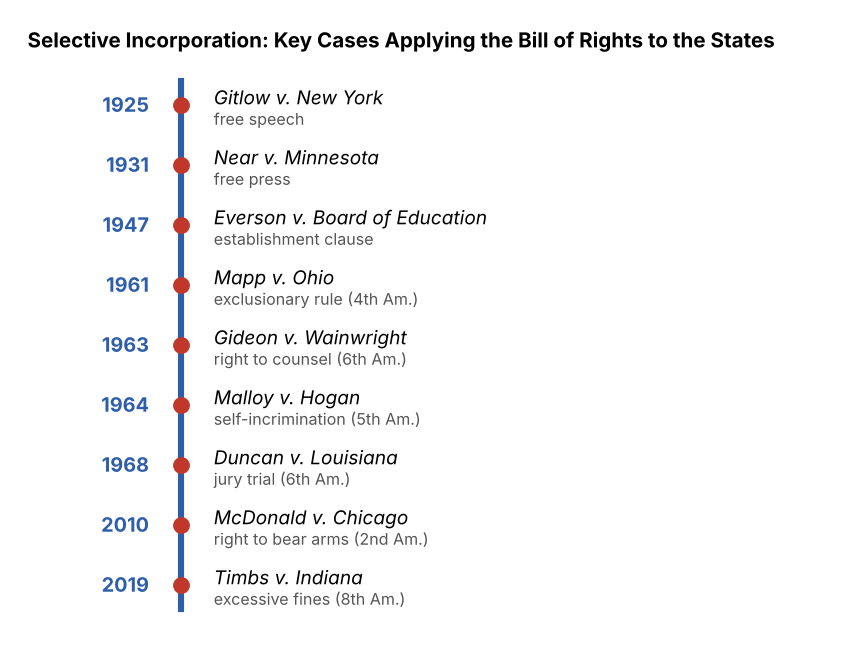
But the Bill of Rights only constrained the federal government. State majorities could still violate these rights. This changed after the Civil War with the 14th Amendment (1868), which forbade states from abridging privileges or immunities, depriving anyone of due process, or denying equal protection of the laws.
| Amendment / Doctrine | What It Does | Historical Context | Exam Relevance |
|---|---|---|---|
| Bill of Rights (1-10, 1791) | Limits federal government power. Protects speech, religion, press, assembly, petition, due process, rights of the accused. | Added to ratify the Constitution after states feared federal overreach. Applied only to federal level. | Questions about federal censorship, federal search-and-seizure, federal trials. Madison proposed these to address Antifederalist concerns. |
| 14th Amendment: Due Process Clause (1868) | Extends due process protections to state governments. States cannot deprive people of “life, liberty, or property without due process of law.” | Reconstruction response to Southern states violating freedmen’s rights. Gradually used to “incorporate” most Bill of Rights protections against states. | Questions about state laws infringing fundamental rights, selective incorporation doctrine, whether a right is fundamental enough to apply to states. |
| 14th Amendment: Equal Protection Clause | States cannot deny equal protection. Courts scrutinize laws that discriminate based on race, gender, and other classifications. | Intended to protect freedmen. Enabled civil rights cases (Brown v. Board, Loving v. Virginia). Still shaping disputes over affirmative action, voting rights, LGBTQ+ rights. | Questions about strict scrutiny, discriminatory intent, whether a law violates equal protection. Reference specific cases. |
The key doctrine is incorporation—the process by which most Bill of Rights protections have been applied to the states through the 14th Amendment’s Due Process Clause. The Second Amendment right to bear arms and the First Amendment right to free speech are incorporated. But the Third Amendment is not. The exam tests whether you understand why some rights are incorporated and others aren’t.
Judicial Review and the Countermajoritarian Power
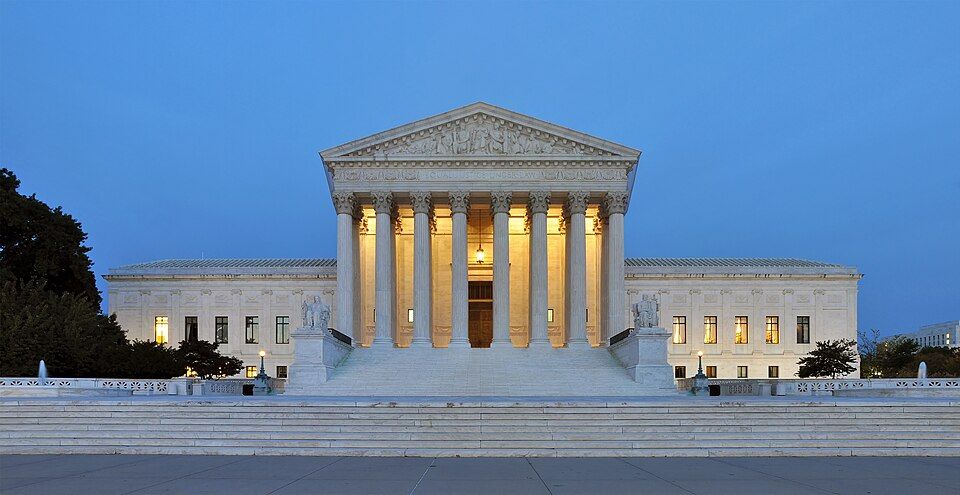
The most powerful mechanism for protecting minorities is judicial review—the power of courts to strike down laws as unconstitutional. Marbury v. Madison established that the Supreme Court, not elected majorities, has the final say on constitutional meaning. This power is purely countermajoritarian.
Judicial review works by applying tests of constitutional scrutiny:
- Strict scrutiny — Used for laws infringing fundamental rights or discriminating based on race, national origin, or religion. The law must serve a compelling interest and be narrowly tailored to achieve that interest. Almost always fails. Example: A state banning a particular religion would face strict scrutiny and likely be struck down.
- Intermediate scrutiny — Used for gender discrimination and some free speech cases. The law must serve an important interest and be substantially related to that interest. Sometimes passes. Example: A law that classifies by sex might survive intermediate scrutiny if it is substantially related to an important government interest.
- Rational basis review — The most deferential standard. The law needs a rational relationship to a legitimate interest. Almost always passes. Used for economic regulations and classifications not involving fundamental rights or suspect classes.
Why this matters: If a law is challenged on constitutional grounds, which scrutiny level applies determines survival. Strict scrutiny is a near-absolute veto. Rational basis is a rubber stamp. The exam frequently tests whether you can identify which scrutiny level applies—that tells you the likely outcome.
Judicial review is controversial. Critics argue unelected judges shouldn’t override elected majorities. Defenders counter that constitutional rights are meaningless if majorities can vote them away. This tension—the legitimacy of judicial review—is central to the topic.
Institutional Checks on Majoritarian Power: The Senate Filibuster and Supermajority Rules
Beyond the courts, the Framers built other institutions to prevent majority tyranny. The Senate is the clearest example.
| Institutional Check | How It Protects Minorities | How It Works | Exam Angle |
|---|---|---|---|
| The Senate | Each state gets 2 senators regardless of population. Small states can block legislation. Requires consensus rather than raw majority. | Senators were originally appointed by state legislatures (17th Amendment changed this to direct election in 1913). This ensured state governments—minority interests—had a voice in federal law. | Questions about federalism, representation, why small states accepted the Constitution, the Senate’s purpose. |
| The Filibuster | Allows 41 senators to block legislation indefinitely (talk to prevent a vote). Forces coalition-building. Protects ideological minorities from 50-vote majorities. | Not constitutional; it’s a Senate rule that emerged over time. Requires 60 votes to end debate (cloture), not 51 to pass. Nuclear option (2013, 2017) reduced cloture requirements for some votes. | Questions about how the filibuster balances majority rule with minority veto. Debates over whether it’s a good check or an undemocratic obstruction. Reference legislation that was filibustered (civil rights bills in the 1960s, Supreme Court confirmations). |
| Constitutional Amendment Process | Requires 2/3 of both houses plus ratification by 3/4 of state legislatures. A small minority can block constitutional change. Protects fundamental structures from majoritarian revision. | Very difficult—only 27 amendments in 235+ years. Intentional. The Framers wanted the Constitution stable and not subject to frequent majoritarian revision. | Questions about why constitutional change is so difficult, whether that’s good or bad for democracy and minority rights, the amendment process’s role in protecting minority interests. |
These structures don’t directly protect individual rights the way courts do. But they create friction and force majorities to build coalitions. The Madisonian ideal: “If men were angels, no government would be necessary.” The Senate, the filibuster, and the amendment process are structural answers to majority tyranny.
When Can Majorities Override Minorities? The Hierarchy of Rights
This raises a difficult question: Are all minority interests equally protected? Can majorities legitimately outvote minorities?
The answer depends on what’s at stake. Courts distinguish between:
- Fundamental rights — Rights so central to liberty and dignity that majorities cannot infringe them. These include free speech, religious liberty, voting rights, and privacy (including some reproductive and intimate association rights). When a law infringes a fundamental right, it must survive strict scrutiny—nearly impossible.
- Quasi-fundamental rights and suspect classifications — Not as protected as fundamental rights, but get special judicial attention. Gender discrimination gets intermediate scrutiny. Some privileges get rational basis with sympathetic tone.
- Ordinary legislative matters — Economic regulations, tax policy, regulatory details. Majorities legislate freely here. Courts defer (rational basis review).
Key cases illustrate the boundaries:
- Brown v. Board of Education (1954) — Segregation violates equal protection. Race discrimination gets strict scrutiny. Government cannot segregate schools even if most voters support it. Minority rights are fundamental; majority preference cannot override.
- Loving v. Virginia (1967) — State bans on interracial marriage violate equal protection. Majority opposition to interracial relationships is irrelevant.
- Reed v. Reed (1971) — State law preferring men as executors violates equal protection. Majority preference for traditional gender roles is not sufficient justification.
- West Virginia State Board of Education v. Barnette (1943) — Students cannot be forced to salute the flag even if the school board votes for it. Conscience is fundamental. Majority rule has limits.
Civil Liberties vs. Civil Rights: Two Approaches to Minority Protection
The exam sometimes distinguishes between these two categories:
- Civil liberties — Individual freedoms from government interference (free speech, religious liberty, due process). Protected primarily through the Bill of Rights and judicial enforcement. Government shouldn’t infringe these rights. The majority has no authority to violate them.
- Civil rights — Equal treatment and non-discrimination (right to vote, freedom from racial discrimination, access to public accommodations). Protected primarily through the 14th Amendment, Congressional legislation (Civil Rights Act of 1964, Voting Rights Act of 1965), and enforcement agencies. All citizens deserve equal protection regardless of immutable characteristics.
Both protect minorities but through different constitutional mechanisms and political processes. A question might ask: “Which is a civil liberty rather than a civil right?” (Answer: Free speech or religious liberty.) “Which legislative act expanded civil rights?” (Answer: Civil Rights Act of 1964—banned discrimination in public accommodations.)
Test-Taking Strategies
Mnemonic devices and memory shortcuts: Remember the three scrutiny levels with FAIR:
- F — Fundamental rights → Strict scrutiny → Usually Fails
- A — Almost-fundamental (gender) → Advanced scrutiny → Almost splits
- I, R — Indifferent matters → Rational basis → Invincible (almost always passes)
For the core tension, use “MAJ-MIN conflict:” Majority rule vs. Minority rights. When you see a law with majority support but minority impact, think: How does the Constitution resolve it?
Cross-topic connections: This topic connects directly to:
- Topic 1.2: Types of Democracy — How representative democracy with constitutional limits protects minorities.
- Topic 1.1: Ideals of Democracy — The social contract and minority rights as a boundary.
- Topic 1.7: Relationship Between States and the Federal Government — How federalism protects minorities; the role of the 14th Amendment in limiting state power to discriminate.
- Topic 1.6: Principles of American Government — How separated powers create friction against majorities; the Senate as a check.
- Topic 3.10: Social Movements and Equal Protection — Real examples of minorities using courts and organizing to challenge majority preferences (civil rights movement, women’s rights movement).
Common question formats: A state passes a law the majority supports but that affects minorities. You identify why courts would strike it down (strict scrutiny, fundamental right, 14th Amendment). You analyze Supreme Court cases (Brown, Loving) and explain the countermajoritarian principle. You explain how the Senate filibuster or amendment process protects minorities through structural friction rather than rights-based protection. You contrast civil liberties (freedoms from interference) and civil rights (equal treatment). FRQs ask: “Explain how the Bill of Rights, judicial review, and the Senate filibuster each protect minorities from majority tyranny.”
Frequent student mistakes: First, students confuse “majority rule” with “unlimited majority rule.” The U.S. is not a pure democracy where 51% can do anything. The Constitution constrains majorities. Democracy is not the same as majority rule; American democracy is constitutional democracy—rule by process within constitutional limits.
Second, students think judicial review is “anti-democratic” because it strikes down popular laws. But the Constitution itself is democratic—it was ratified through a democratic process. Courts enforce the Constitution against majoritarian violation. This is democracy working as designed.
Third mistake: not distinguishing between what the Constitution permits and what’s wise policy. A law might pass rational basis review but still be unwise. On the exam, apply the right scrutiny level to answer constitutional questions.
Fourth mistake: forgetting the filibuster and amendment process are institutional checks, not constitutional rights. They’re structures that protect minorities through friction and supermajorities, not by striking down laws. Many students miss that they serve the same function as courts but through different means.
Test-day shortcuts: A law infringes a fundamental right? It’s almost certainly unconstitutional. Don’t overthink it. A state tries to override a federal constitutional right? The 14th Amendment applies. States can’t do it. A popular law being struck down? Yes—if it violates the Constitution. Courts can strike it down regardless of popularity. A filibuster question? It creates a supermajority requirement (60 votes). A minority blocks a majority. This is intentional—a structural check.
Time management tips: Most questions in this topic test straightforward concepts—scrutiny levels, constitutional amendments, key cases. Budget extra time only for complex scenarios. On FRQs, structure clearly: First, define countermajoritarian difficulty. Second, explain 2-3 mechanisms (Bill of Rights, judicial review, Senate filibuster). Third, apply to a specific example (Brown v. Board, a voting rights case). This framework earns most points.
Check for Understanding
Think you’ve got it? Complete the quiz below to make sure. Download your results at the end.