
Maximize your score with these resources:
- Albert.io AP® Biology question banks
- Free AP® Biology study guides
- Free AP® Biology score calculator
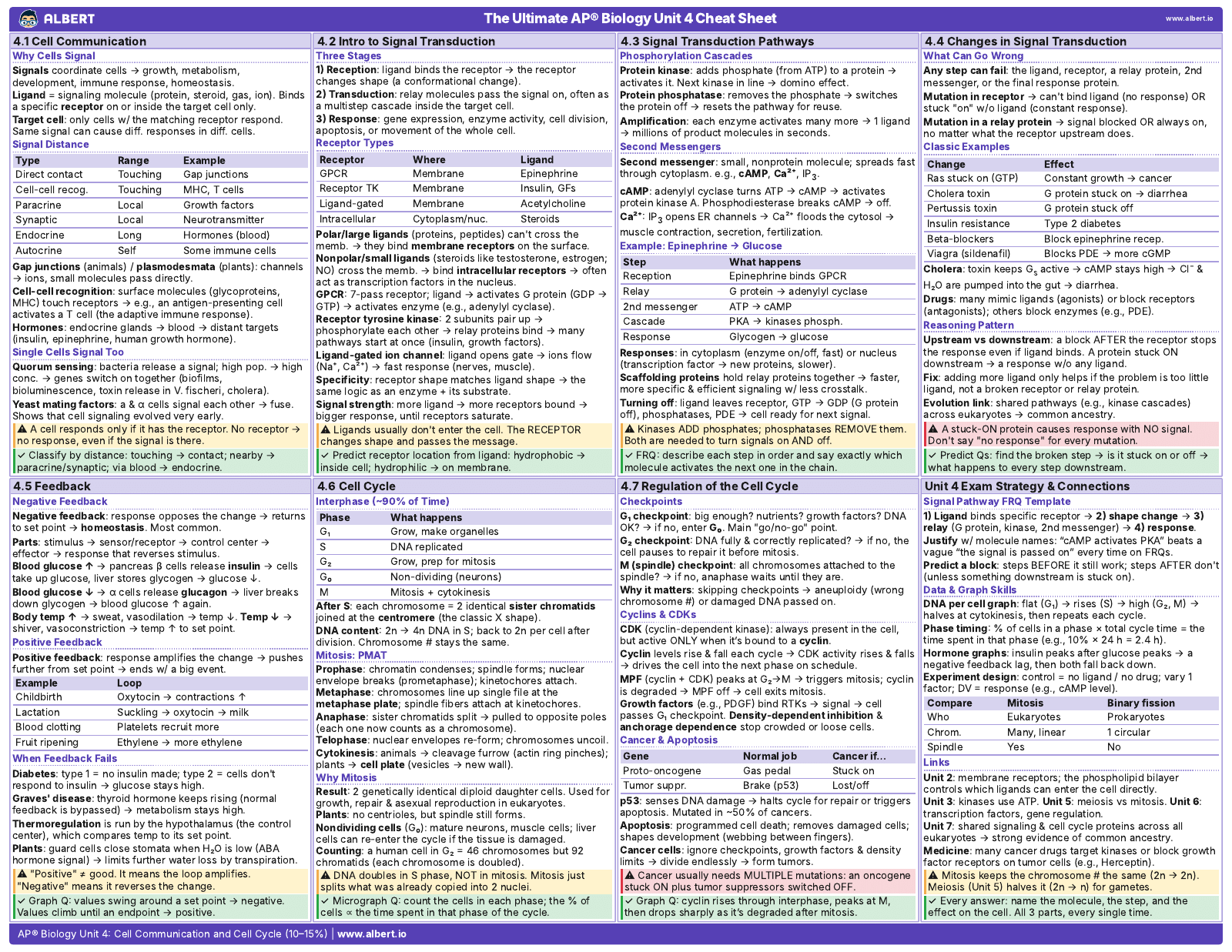
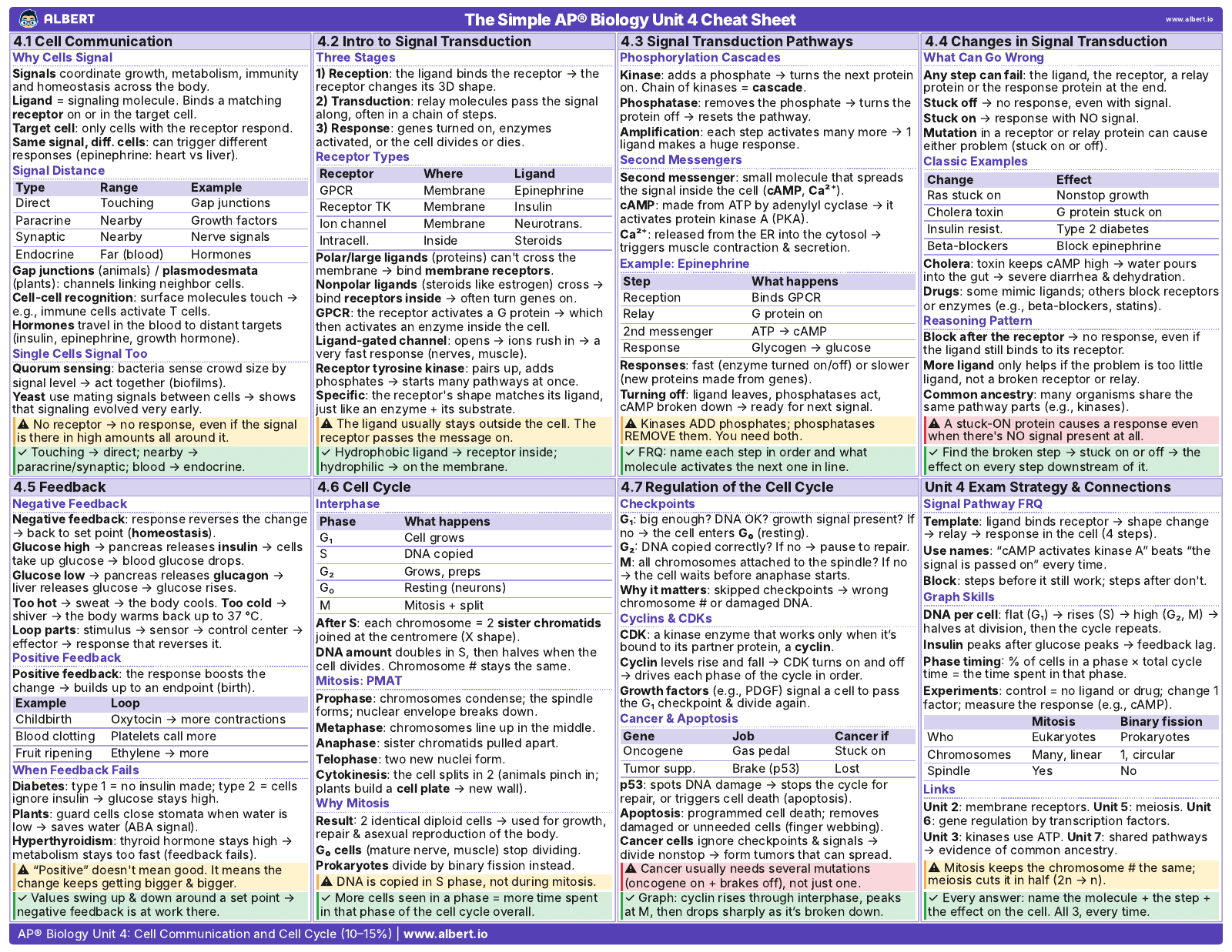
This AP Bio Unit 4 cheat sheet covers how cells send and receive signals, how feedback keeps the body stable, and how the cell cycle is run and regulated. Unit 4 makes up 10–15% of the AP® Biology exam. Download it below in Simple for a first pass or Ultimate for full detail.
Practice AP® Biology Unit 4 questions on Albert
What’s on the AP Bio Unit 4 Cheat Sheet?
Both versions use the same eight cards: cell communication, the basics of signal transduction, signaling pathways, what happens when pathways change, feedback, the cell cycle, cell cycle regulation, and exam strategy.
- Simple is for students learning the unit or reviewing for a class test. It covers the three stages of signaling, the main receptor types, negative vs positive feedback, the phases of mitosis, and the basics of checkpoints and cancer.
- Ultimate is for students aiming for a 4 or 5. It adds second messengers in detail, the epinephrine pathway step by step, toxins and drugs that change signaling, cyclins, CDKs and MPF, p53, and graph-reading tips for DNA content and cell cycle timing.
Start with Simple. Once you can walk through a signaling pathway and the cell cycle without notes, move to Ultimate.
AP® Biology Unit 4 at a Glance
Unit 4 connects the membranes from Unit 2 and the ATP from Unit 3 to how cells talk and divide. The AP® Biology Course and Exam Description splits it into seven topics.
| Topic | Name | Focus |
|---|---|---|
| 4.1 | Cell Communication | Signaling by contact, nearby and long-distance signals |
| 4.2 | Introduction to Signal Transduction | Reception, transduction, response; receptor types |
| 4.3 | Signal Transduction | Phosphorylation cascades and second messengers |
| 4.4 | Changes in Signal Transduction Pathways | Mutations, toxins and drugs that alter signaling |
| 4.5 | Feedback | Negative and positive feedback loops |
| 4.6 | Cell Cycle | Interphase, mitosis and cytokinesis |
| 4.7 | Regulation of Cell Cycle | Checkpoints, cyclins and CDKs, cancer, apoptosis |
At 10–15% of the score, plan on roughly 6 to 9 multiple-choice questions from this unit, and signaling pathways are a common FRQ setting.
Key Concepts in Unit 4: Cell Communication and Cell Cycle
How Cells Communicate (4.1)
Cells signal each other to coordinate growth, metabolism, immune responses and homeostasis. A signaling molecule, or ligand, binds a specific receptor on or in a target cell. Only cells with that receptor respond. Signals differ by how far they travel: direct contact through gap junctions or plasmodesmata, cell-to-cell recognition by surface molecules, local signals like growth factors and neurotransmitters, and hormones carried in the blood to distant cells.
Worked example: A hormone is injected into the bloodstream, and only liver and muscle cells change their activity. Every cell was exposed to the hormone, so the difference must be the receptor. Only liver and muscle cells have it.
Exam tip: Bacteria signal too. Quorum sensing lets a population detect its own density and switch on genes together, for example to form a biofilm.
Reception and Receptor Types (4.2)
Signal transduction has three stages. In reception, the ligand binds its receptor and the receptor changes shape. In transduction, relay molecules pass the signal along. In the response, the cell does something: switches genes on, activates enzymes, divides, or dies.
Where the receptor sits depends on the ligand. Large or polar ligands, like protein hormones, can’t cross the membrane, so they bind membrane receptors: G protein-coupled receptors, receptor tyrosine kinases, or ligand-gated ion channels. Small nonpolar ligands, like steroid hormones, pass through the membrane and bind receptors inside the cell, which often act directly on genes.
Worked example: Testosterone is a steroid made from cholesterol. A question asks where its receptor is. Because testosterone is nonpolar, it diffuses through the phospholipid bilayer, so its receptor is in the cytoplasm or nucleus. Insulin, a protein, binds a receptor on the membrane surface.
Exam tip: The ligand usually never enters the cell. The receptor’s shape change is what carries the message.
Signaling Pathways and Second Messengers (4.3)
Many pathways are phosphorylation cascades. A protein kinase adds a phosphate group from ATP to the next protein, switching it on, and that protein activates the next. Phosphatases remove the phosphates to switch the pathway off. Because each enzyme activates many copies of the next, a single ligand can produce a huge response. This is amplification.
Second messengers are small molecules that spread the signal inside the cell. The two most tested are cAMP and Ca²⁺.
Worked example: Epinephrine binds a G protein-coupled receptor on a liver cell. The receptor activates a G protein, which activates adenylyl cyclase. Adenylyl cyclase converts ATP into cAMP. cAMP activates protein kinase A, which starts a kinase cascade ending with the enzyme that breaks glycogen into glucose. Blood glucose rises, giving the body quick energy. The epinephrine never entered the cell.
Exam tip: In an FRQ, name each molecule and what it activates. “cAMP activates protein kinase A” earns credit that “the signal is passed on” does not.
When Signaling Changes (4.4)
A mutation, toxin or drug can affect any step. A part stuck off blocks the response even when the signal is present. A part stuck on causes a response with no signal at all.
Worked example: Cholera toxin changes a G protein so it can’t switch off. Intestinal cells keep making cAMP, which keeps chloride channels open. Chloride and water pour into the gut, causing severe diarrhea. Nothing is wrong with the receptor or the ligand; the problem is downstream, and it’s stuck on. Similarly, a mutated Ras protein stuck in its active form tells the cell to divide nonstop, a common step toward cancer.
Exam tip: Find the broken step, decide whether it’s stuck on or off, then trace the effect downstream. Adding more ligand only helps if the problem is too little ligand.
Feedback (4.5)
Negative feedback reverses a change and brings a value back to its set point. This is how the body maintains homeostasis. When blood glucose rises, the pancreas releases insulin, cells take up glucose, and glucose falls. When glucose drops, glucagon signals the liver to release glucose. Body temperature works the same way through sweating and shivering.
Positive feedback amplifies a change until some endpoint is reached. During childbirth, contractions trigger oxytocin release, which causes stronger contractions, until the baby is born. Blood clotting and fruit ripening with ethylene work the same way.
Worked example: A graph shows blood glucose and insulin over three hours after a meal. Glucose rises first, then insulin rises, then glucose falls back to its starting level, followed by insulin. The lag and the return to baseline mark negative feedback.
Exam tip: “Positive” doesn’t mean good. It means the loop makes the change bigger.
The Cell Cycle and Mitosis (4.6)
Interphase takes most of the cycle. In G₁ the cell grows, in S it copies its DNA, and in G₂ it prepares to divide. Cells that stop dividing, like mature neurons, sit in G₀. Mitosis then separates the copied chromosomes: in prophase chromosomes condense and the spindle forms, in metaphase they line up in the middle, in anaphase sister chromatids are pulled apart, and in telophase new nuclei form. Cytokinesis splits the cytoplasm, by a cleavage furrow in animals and a cell plate in plants.
Worked example: In an onion root tip slide, 180 of 200 cells are in interphase and 20 are in mitosis. If the full cycle takes 24 hours, interphase lasts 180/200 × 24 = 21.6 hours and mitosis lasts 20/200 × 24 = 2.4 hours. The share of cells in each phase matches the share of time spent there.
Exam tip: DNA is copied in S phase, not during mitosis. Mitosis keeps the chromosome number the same.
Regulating the Cell Cycle (4.7)
Checkpoints stop the cycle if something is wrong. The G₁ checkpoint checks cell size, nutrients, growth signals and DNA damage. The G₂ checkpoint checks DNA replication. The M checkpoint makes sure every chromosome is attached to the spindle before anaphase. Proteins called cyclins rise and fall during the cycle and switch on cyclin-dependent kinases (CDKs), which push the cell into the next phase.
Cancer happens when this control fails. Proto-oncogenes act like a gas pedal; when mutated to stay on, they drive constant division. Tumor suppressor genes like p53 act like brakes; when lost, damaged cells keep dividing. Apoptosis, programmed cell death, normally removes damaged cells.
Exam tip: Cancer usually needs several mutations, typically an oncogene stuck on plus tumor suppressors lost.
How Unit 4 Shows Up on the Exam
Multiple-choice sets often show a pathway diagram and ask what happens if one protein is blocked or overactive, or give a graph of hormone levels or DNA content per cell over time. Micrograph questions ask you to identify mitosis phases or calculate time in each phase.
On the free-response section, expect a question that describes a signaling experiment with a mutant receptor or an inhibitor drug. You’ll identify the variables and controls, predict the result, and justify it with the pathway steps. Scorers reward naming specific molecules and steps. See the AP® Biology exam page for the current format.
Common Mistakes in Unit 4
- Mistake: Saying a protein hormone enters the cell. Fix: It binds a membrane receptor. Only small nonpolar ligands like steroids cross the membrane.
- Mistake: Treating every mutation as “no response”. Fix: A protein stuck on causes a response even without a signal.
- Mistake: Calling positive feedback “good”. Fix: Positive feedback amplifies a change; negative feedback reverses it.
- Mistake: Saying DNA replicates during mitosis. Fix: It replicates in S phase of interphase.
- Mistake: Mixing up kinases and phosphatases. Fix: Kinases add phosphates; phosphatases remove them.
Frequently Asked Questions
Can I use this cheat sheet on the exam?
No. You can’t bring notes into the AP® Biology exam. The AP Bio Unit 4 cheat sheet is a study tool to review with and quiz yourself on before exam day.
Should I start with the Simple or Ultimate version?
Start with Simple if Unit 4 is new or you’re studying for a class test. Move to Ultimate once Simple feels easy, or if you’re aiming for a 5.
Do I need to memorize specific pathways?
Know one pathway well, like epinephrine and cAMP, so you can use it as a model. The exam usually gives you an unfamiliar pathway and asks you to reason through it.
How is the cell cycle tied to cancer?
Cancer cells ignore checkpoints and growth signals and keep dividing. Most cancers involve mutations in genes that control the cycle, such as Ras and p53.
How does Unit 4 connect to other units?
Receptors sit in the membranes from Unit 2, and kinases use the ATP from Unit 3. Mitosis sets up the comparison with meiosis in Unit 5, and transcription factors return in Unit 6.