
Maximize your score with these resources:
- Albert.io AP® Biology question banks
- Free AP® Biology study guides
- Free AP® Biology score calculator
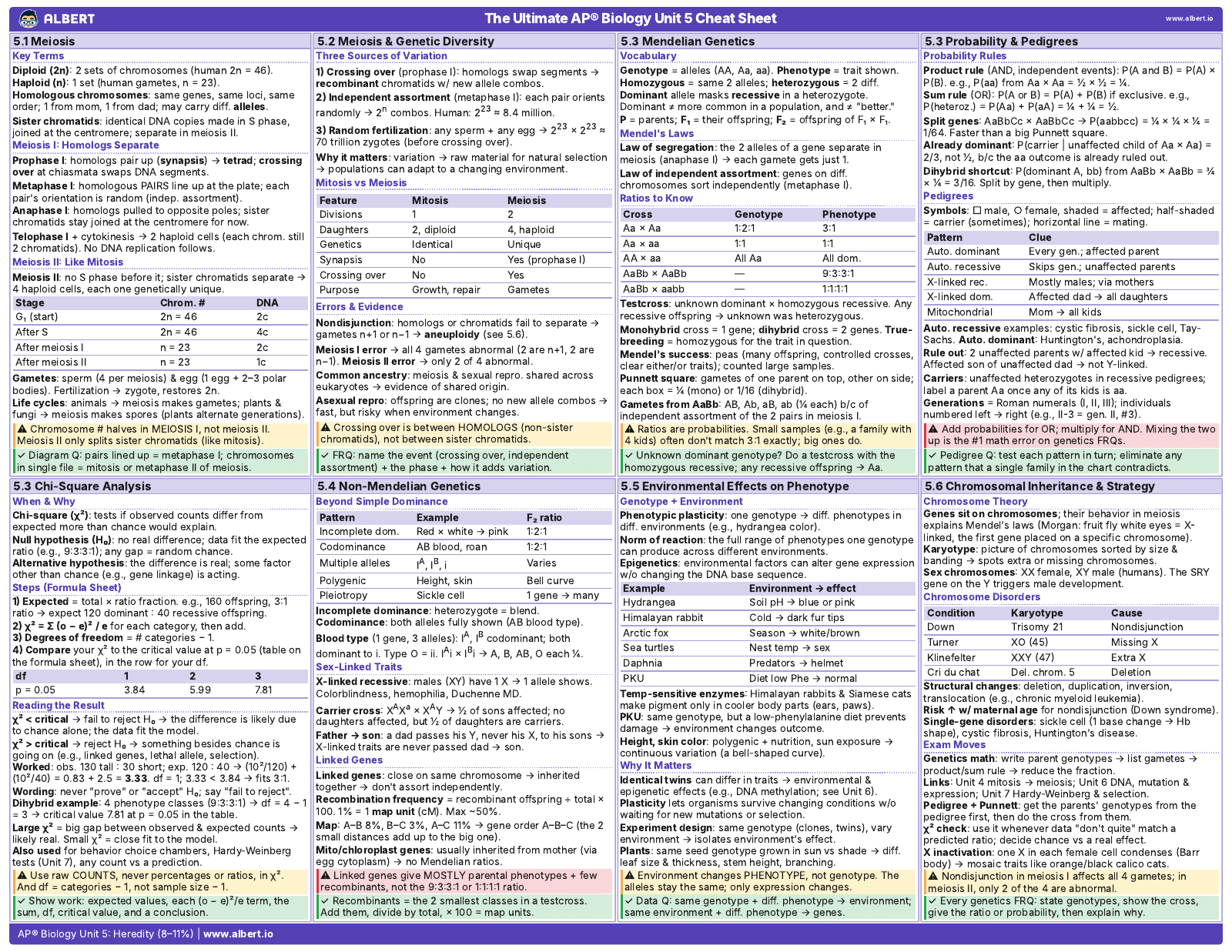
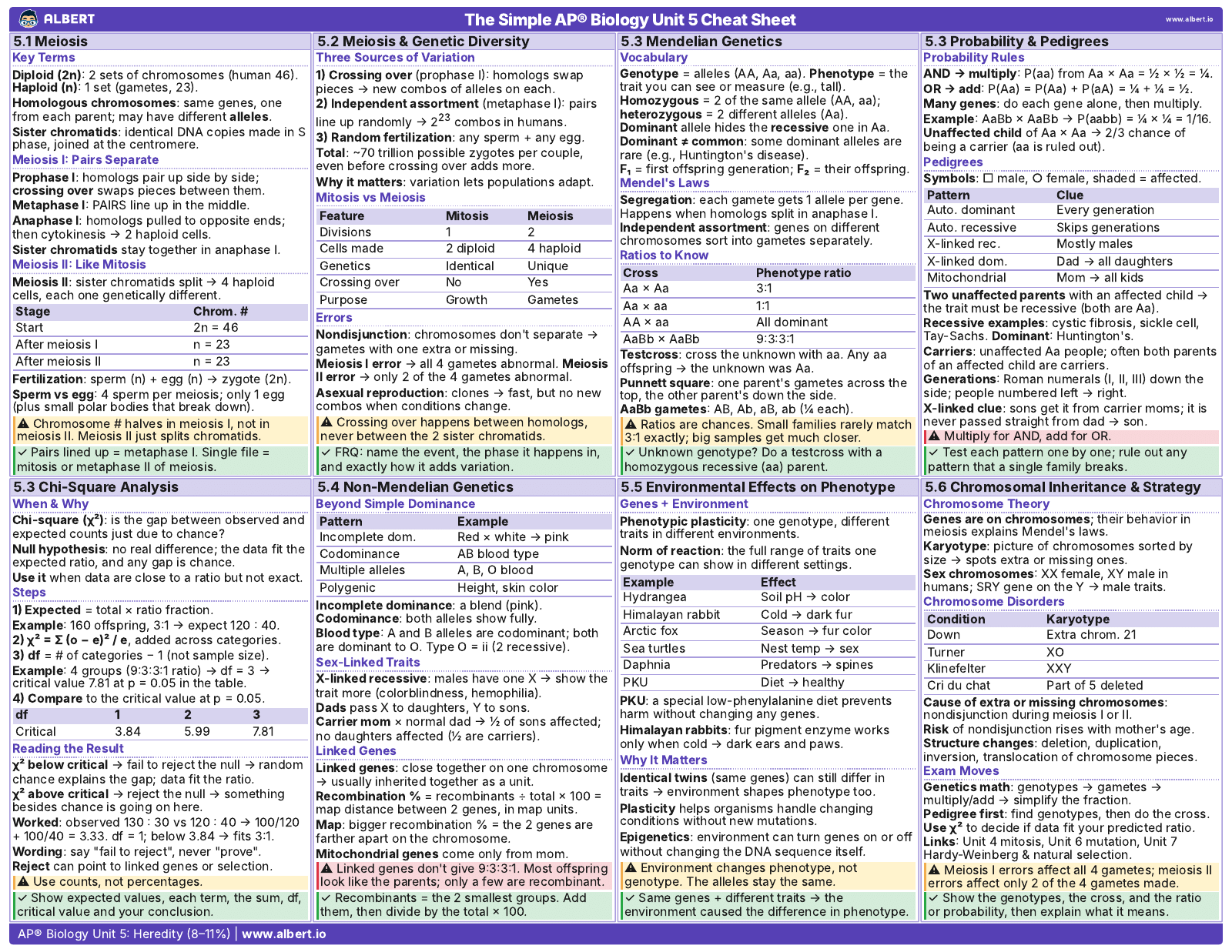
This AP Bio Unit 5 cheat sheet covers heredity: meiosis, where genetic variation comes from, Mendel’s laws, probability and pedigrees, chi-square, and the patterns that don’t follow Mendel. Unit 5 makes up 8–11% of the AP® Biology exam. Download it below in Simple for a first pass or Ultimate for full detail.
Practice AP® Biology Unit 5 questions on Albert
What’s on the AP Bio Unit 5 Cheat Sheet?
Both versions use the same eight cards: meiosis, meiosis and genetic diversity, Mendelian genetics, probability and pedigrees, chi-square analysis, non-Mendelian genetics, environmental effects on phenotype, and chromosomal inheritance with exam strategy.
- Simple is for students learning the unit or reviewing for a class test. It covers the stages of meiosis, the key ratios, the product and sum rules, how to read a pedigree, and the chi-square steps.
- Ultimate is for students aiming for a 4 or 5. It adds chromosome and DNA counts at each stage, the 2/3 carrier trick, a full chi-square worked example, linked genes and map units, X-linked crosses, and chromosome disorders with their causes.
Start with Simple and work every ratio until it’s automatic, then move to Ultimate.
AP® Biology Unit 5 at a Glance
Unit 5 builds on mitosis from Unit 4 and sets up gene expression in Unit 6 and population genetics in Unit 7. The AP® Biology Course and Exam Description splits it into six topics.
| Topic | Name | Focus |
|---|---|---|
| 5.1 | Meiosis | Making haploid gametes in two divisions |
| 5.2 | Meiosis and Genetic Diversity | Crossing over, independent assortment, random fertilization |
| 5.3 | Mendelian Genetics | Laws of inheritance, probability, pedigrees, chi-square |
| 5.4 | Non-Mendelian Genetics | Incomplete dominance, codominance, sex linkage, linked genes |
| 5.5 | Environmental Effects on Phenotype | How environment shapes traits |
| 5.6 | Chromosomal Inheritance | Genes on chromosomes, nondisjunction, chromosome disorders |
At 8–11% of the score, expect roughly 5 to 7 multiple-choice questions, and genetics problems often show up inside free-response questions.
Key Concepts in Unit 5: Heredity
Meiosis (5.1)
Meiosis turns one diploid cell into four haploid cells in two divisions. In meiosis I, homologous chromosomes pair up, cross over, line up as pairs, and separate, so each cell gets one of each pair. In meiosis II, sister chromatids separate, much like mitosis. Fertilization later joins two haploid gametes into a diploid zygote.
Worked example: A human cell starts with 46 chromosomes. After S phase it still has 46 chromosomes but twice the DNA. After meiosis I, each cell has 23 chromosomes, each still made of two chromatids. After meiosis II, each of the four cells has 23 single chromosomes. The chromosome number halved in meiosis I.
Exam tip: In a diagram, chromosomes lined up in pairs mean metaphase I. Single file means mitosis or metaphase II.
Sources of Genetic Variation (5.2)
Three events make each gamete and each offspring unique. Crossing over in prophase I swaps pieces between homologous chromosomes. Independent assortment in metaphase I lets each pair line up either way, giving 2²³, or about 8.4 million, combinations in humans. Random fertilization then pairs any sperm with any egg.
Worked example: An organism has 2n = 6, so it has three homologous pairs. Ignoring crossing over, the number of possible gametes is 2³ = 8. With random fertilization between two such parents, 8 × 8 = 64 combinations are possible.
Exam tip: Crossing over happens between homologous chromosomes (non-sister chromatids), not between sister chromatids.
Mendel’s Laws and Probability (5.3)
Mendel’s law of segregation says each gamete gets one allele of each gene, because homologs separate in meiosis. His law of independent assortment says genes on different chromosomes sort independently. Know the standard ratios: a monohybrid cross of two heterozygotes gives a 3:1 phenotype ratio, and a dihybrid cross gives 9:3:3:1.
Loading the punnett square calculator…
Two probability rules handle most problems. For “and”, multiply. For “or”, add.
Worked example: What is the chance that AaBbCc × AaBbCc produces an aabbcc offspring? Treat each gene separately: each has a ¼ chance of being homozygous recessive. Multiply: ¼ × ¼ × ¼ = 1/64. No 64-box Punnett square needed.
Exam tip: If a child of two Aa parents is known to be unaffected, the chance they are a carrier is 2/3, not ½, because the aa outcome is already ruled out.
Pedigrees and Chi-Square (5.3)
Pedigrees trace a trait through a family. A trait that skips generations and appears in children of unaffected parents is recessive. A trait in every generation, where every affected person has an affected parent, is likely dominant. X-linked recessive traits show up mostly in males and pass through carrier mothers.
Chi-square tests whether observed counts differ from expected counts by more than chance. The formula, χ² = Σ(o − e)²/e, and the critical value table are on the formula sheet.
Worked example: A cross predicted to give 3:1 produces 130 tall and 30 short plants out of 160. Expected counts are 120 and 40. χ² = (10²/120) + (10²/40) = 0.83 + 2.5 = 3.33. With two categories, df = 1, and the critical value at p = 0.05 is 3.84. Since 3.33 is less than 3.84, you fail to reject the null hypothesis: the data fit a 3:1 ratio.
Exam tip: Use raw counts, never percentages, and say “fail to reject”, never “prove”.
Non-Mendelian Patterns (5.4)
Many traits don’t follow simple dominance. In incomplete dominance, heterozygotes are a blend (red × white gives pink). In codominance, both alleles show fully, like AB blood type. Polygenic traits like height are controlled by many genes and vary continuously. X-linked genes show up more in males, who have only one X. Mitochondrial genes come only from the mother.
Linked genes sit close together on the same chromosome and are usually inherited together. Crossing over between them makes a few recombinant offspring.
Worked example: A testcross of a fruit fly heterozygous for two genes gives 420 and 410 flies with the parental combinations and 85 and 85 with new combinations. Recombination frequency = (85 + 85) ÷ 1,000 × 100 = 17%. The genes are linked and about 17 map units apart. Unlinked genes would have given roughly 250 of each.
Exam tip: In a testcross with linked genes, the two smallest groups are the recombinants.
Environment and Chromosomes (5.5–5.6)
The same genotype can produce different phenotypes in different environments. Hydrangea flower color depends on soil pH, Himalayan rabbits grow dark fur only on cold body parts, and sea turtle sex depends on nest temperature. Environment changes the phenotype, not the alleles.
Chromosome-level errors also affect inheritance. Nondisjunction, when chromosomes fail to separate in meiosis, produces gametes with an extra or missing chromosome. Fertilization with such a gamete causes conditions like Down syndrome (trisomy 21), Turner syndrome (XO) and Klinefelter syndrome (XXY).
Exam tip: Nondisjunction in meiosis I makes all four gametes abnormal; in meiosis II, only two.
How Unit 5 Shows Up on the Exam
Multiple-choice questions often give a pedigree, a cross result, or a meiosis diagram and ask you to identify the inheritance pattern, calculate a probability, or name the phase. Some questions ask you to calculate a chi-square value or a probability and pick the matching answer.
On the free-response section, genetics often appears as part of a larger question: a cross with unexpected results that you test with chi-square, or a pedigree you use to justify an inheritance pattern. Scorers reward showing genotypes, the cross, and the math. See the AP® Biology exam page for the current format.
A good habit for any genetics question: write the parents’ genotypes first, list the gametes each can make, then apply the product or sum rule. Reduce fractions at the end. When data don’t quite match a ratio, that’s your cue to run chi-square and decide whether chance explains the gap or something like linkage is at work.
Common Mistakes in Unit 5
- Mistake: Saying chromosome number halves in meiosis II. Fix: It halves in meiosis I when homologs separate.
- Mistake: Adding when you should multiply. Fix: “And” means multiply; “or” means add.
- Mistake: Using percentages in chi-square. Fix: Always use actual counts.
- Mistake: Assuming two genes will give 9:3:3:1. Fix: Linked genes give mostly parental types with few recombinants.
- Mistake: Saying dominant alleles are more common. Fix: Dominance describes how alleles interact, not how often they appear.
Frequently Asked Questions
Can I use this cheat sheet on the exam?
No. Notes aren’t allowed on the AP® Biology exam. The AP Bio Unit 5 cheat sheet is a study tool for reviewing and practicing before test day.
Should I start with the Simple or Ultimate version?
Start with Simple if Unit 5 is new or you have a class test. Move to Ultimate once Simple feels easy, or if you want a 5.
Is the chi-square formula given on the exam?
Yes. The formula sheet includes the chi-square formula and a table of critical values. You still need to set up expected values, pick the right degrees of freedom, and explain what the result means.
How do I tell if a pedigree is X-linked?
Look for a trait mostly in males that passes through unaffected carrier mothers. A father never passes an X-linked allele to his sons, only to his daughters, so an affected son gets the allele from his mother.
How does Unit 5 connect to other units?
Meiosis builds on mitosis from Unit 4. Mutations and gene expression come next in Unit 6. Allele frequencies and Hardy-Weinberg in Unit 7 use the same probability rules.