
Maximize your score with these resources:
- Albert.io AP® Calculus question banks
- Free AP® Calculus study guides
- Free AP® Calculus score calculator
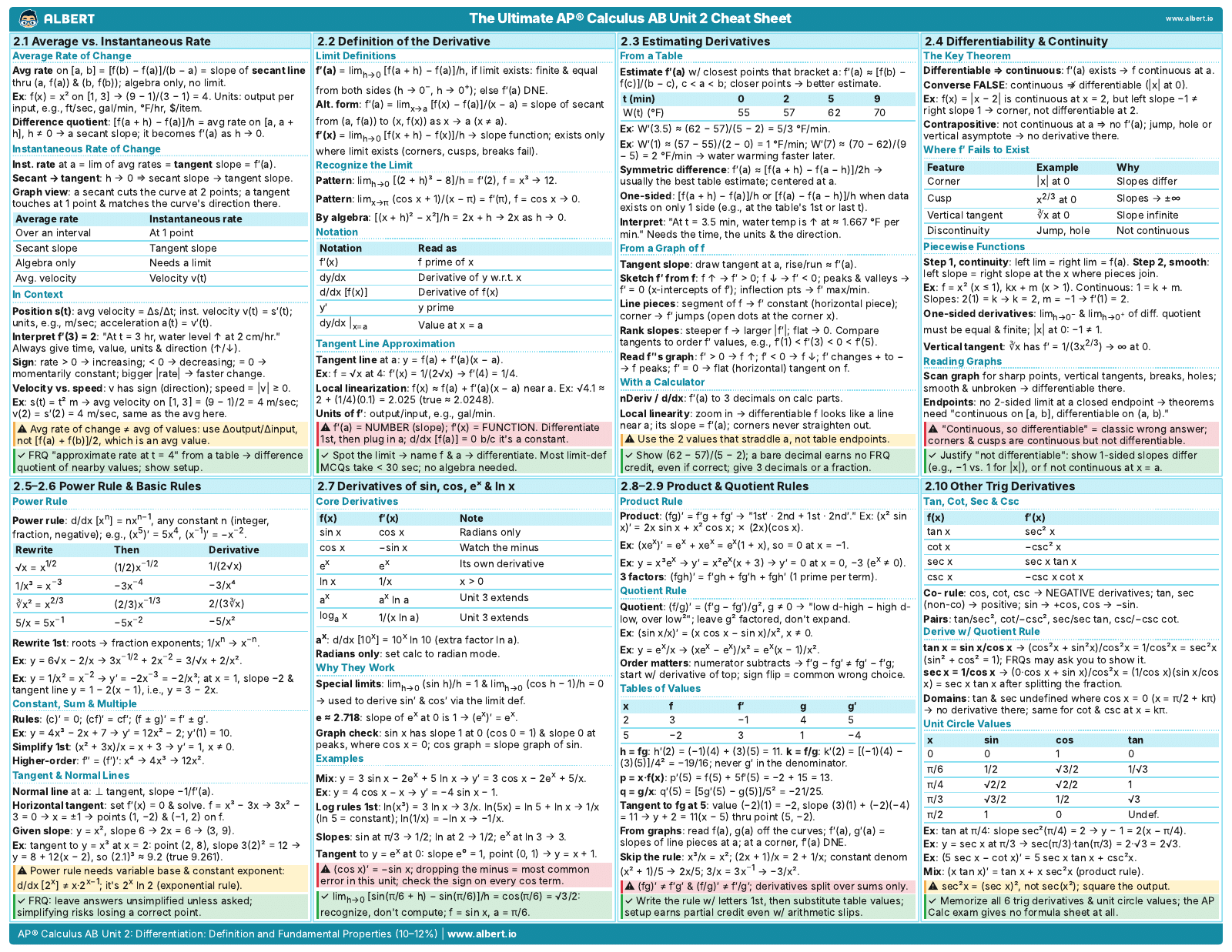
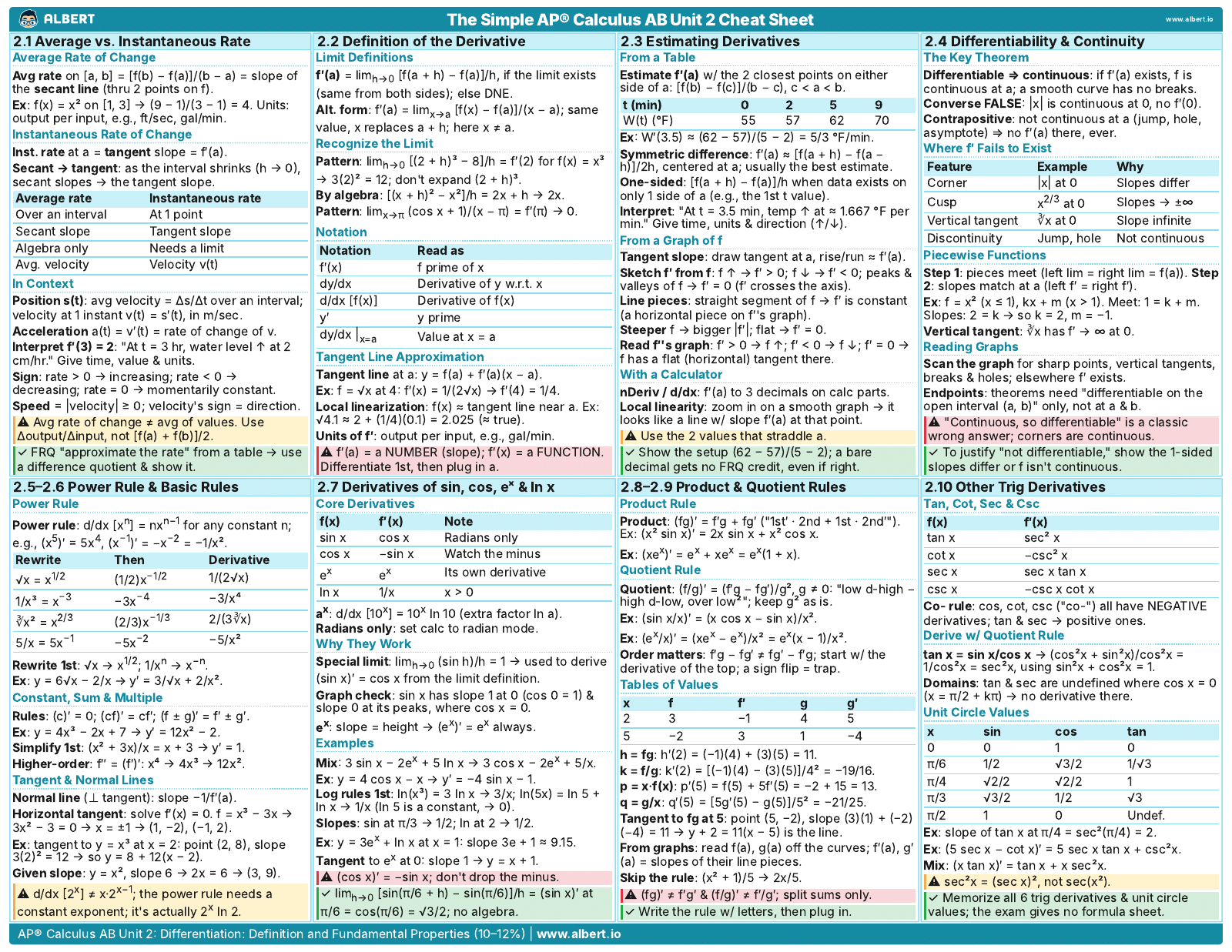
This AP Calc AB Unit 2 cheat sheet covers the definition of the derivative and the first set of derivative rules: rates of change, the limit definition, estimating derivatives, differentiability, and the power, product, quotient, and trig rules. Unit 2 makes up 10–12% of the AP® Calculus AB exam. Use the Simple version for a quick review or the Ultimate version for every rule, example, and trap.
Practice AP® Calculus AB Unit 2 questions on Albert
What’s on the AP Calc AB Unit 2 Cheat Sheet?
Both versions follow the ten topics in the College Board’s AP® Calculus AB Course and Exam Description, from 2.1 average and instantaneous rates of change through 2.10 the derivatives of tangent, cotangent, secant, and cosecant.
The Simple version keeps what you need to differentiate confidently: the limit definition, derivative notation, the power rule with rewriting tips, the core derivatives of sin x, cos x, ex, and ln x, and the product and quotient rules, each with a worked example.
The Ultimate version adds the skills the exam tests hardest: recognizing a limit as a derivative without expanding, estimating derivatives from tables with proper notation, deciding where a function isn’t differentiable, matching slopes on piecewise functions, using table values with the product and quotient rules, and deriving the trig derivatives yourself.
AP Calc AB Unit 2 at a Glance
Unit 2 is weighted at 10–12% of the exam, but every later unit depends on it. Derivative rules from this unit show up in nearly every free-response question, so mastering them early pays off across the whole test.
| Topic | Name | Focus |
|---|---|---|
| 2.1 | Average and Instantaneous Rates of Change | Secant vs. tangent slopes; rates in context. |
| 2.2 | Defining the Derivative and Notation | The limit definition; f′(x), dy/dx, and tangent lines. |
| 2.3 | Estimating Derivatives at a Point | Difference quotients from tables and graphs. |
| 2.4 | Differentiability and Continuity | Corners, cusps, vertical tangents, and discontinuities. |
| 2.5 | The Power Rule | Differentiating xn for any real n. |
| 2.6 | Constant, Sum, Difference, and Constant Multiple Rules | Differentiating term by term. |
| 2.7 | Derivatives of cos x, sin x, ex, and ln x | The core transcendental derivatives. |
| 2.8 | The Product Rule | Derivatives of products. |
| 2.9 | The Quotient Rule | Derivatives of quotients. |
| 2.10 | Derivatives of tan, cot, sec, and csc | The remaining trig derivatives. |
Key Concepts in Unit 2: Differentiation
Average vs. Instantaneous Rate of Change
The average rate of change of f on [a, b] is [f(b) − f(a)] / (b − a), the slope of the secant line between two points. The instantaneous rate of change at a point is the limit of those average rates as the interval shrinks to zero, which is the slope of the tangent line. In motion problems, average velocity is the change in position over the change in time, and instantaneous velocity is the derivative of position.
Worked example: For f(x) = x² on [1, 3], the average rate of change is (9 − 1)/(3 − 1) = 4. The instantaneous rate at x = 2 is f′(2) = 2(2) = 4 as well, which happens because x² is a parabola and 2 is the midpoint of the interval.
Exam tip: When you interpret a rate, include the time, the value, the units, and the direction: “At t = 3 hours, the water level is rising at 2 cm per hour.”
The Limit Definition of the Derivative
The derivative of f at x = a is f′(a) = limh→0 [f(a + h) − f(a)] / h, provided the limit exists. An equivalent form is limx→a [f(x) − f(a)] / (x − a). Replacing a with x gives the derivative function f′(x), which gives the slope at every point. Notation varies: f′(x), y′, dy/dx, and d/dx[f(x)] all mean the same thing.
Worked example: Evaluate limh→0 [(2 + h)³ − 8] / h. This is the limit definition for f(x) = x³ at a = 2, since 2³ = 8. So the limit equals f′(2) = 3(2)² = 12, with no algebra needed.
Exam tip: On multiple choice, identify f and a in a limit-definition expression, then just differentiate. Expanding the numerator wastes time.
Estimating Derivatives and Differentiability
From a table, estimate f′(a) with a difference quotient using the two data points closest to a on either side. From a graph, estimate the slope of the tangent line. A function is not differentiable at a corner, a cusp, a vertical tangent, or any discontinuity. Differentiability implies continuity, but continuity does not imply differentiability.
Worked example: A table gives W(2) = 57 and W(5) = 62. Then W′(3.5) ≈ (62 − 57)/(5 − 2) = 5/3 ≈ 1.667 degrees per minute. On an FRQ, write out the difference quotient, not just the decimal.
Exam tip: For a piecewise function to be differentiable where the pieces meet, it must be continuous there and the left and right slopes must match. Set up both equations.
The Power Rule and Basic Rules
The power rule, d/dx[xn] = nxn−1, works for any real exponent. Combine it with the constant rule (the derivative of a constant is 0), the constant multiple rule, and the sum and difference rules to differentiate any polynomial term by term. Rewrite roots as fractional exponents and move variables out of denominators before applying the rule.
Worked example: Differentiate y = 4√x − 3/x². Rewrite as y = 4x1/2 − 3x−2. Then y′ = 2x−1/2 + 6x−3, which can be written 2/√x + 6/x³.
Exam tip: The tangent line at x = a is y − f(a) = f′(a)(x − a). Get the point from f and the slope from f′; mixing them up is a common error.
Derivatives of sin x, cos x, ex, and ln x
Four derivatives anchor the rest of calculus: d/dx[sin x] = cos x, d/dx[cos x] = −sin x, d/dx[ex] = ex, and d/dx[ln x] = 1/x. The trig derivatives assume x is in radians. Use log properties to simplify before differentiating when you can.
Worked example: Find the tangent line to y = ex at x = 0. The point is (0, 1) and the slope is e⁰ = 1, so the tangent line is y = x + 1.
Exam tip: The negative sign in the derivative of cos x is the most frequently dropped sign in this unit. Check it every time.
The Product, Quotient, and Trig Rules
The product rule is (fg)′ = f′g + fg′, and the quotient rule is (f/g)′ = (f′g − fg′)/g². Order matters in the quotient rule because of the subtraction. These rules also produce the remaining trig derivatives: tan x has derivative sec² x, cot x has −csc² x, sec x has sec x tan x, and csc x has −csc x cot x.
Worked example: Suppose f(2) = 3, f′(2) = −1, g(2) = 4, and g′(2) = 5. If h = fg, then h′(2) = (−1)(4) + (3)(5) = 11. If k = f/g, then k′(2) = [(−1)(4) − (3)(5)]/4² = −19/16.
Exam tip: The derivative of a product is not the product of the derivatives. If a question gives you a table of values, it almost always wants the product or quotient rule.
How Unit 2 Shows Up on the Exam
The AP® Calculus AB exam has 42 multiple-choice questions in 1 hour 40 minutes (50% of the score) starting in May 2027: 29 without a calculator and 13 with a graphing calculator. It also has 6 free-response questions in 1 hour 30 minutes (50%), two with a calculator and four without.
Unit 2 skills appear throughout. Multiple-choice questions ask you to recognize limit definitions, find derivatives with the basic rules, compute tangent lines, and identify where a function is not differentiable. On the free-response section, you’ll estimate derivatives from tables, interpret derivatives in context with units, and apply the product and quotient rules inside larger problems. Show your setup: graders award points for the difference quotient or the rule applied, not just the final number.
Common Mistakes in Unit 2
- Dropping the negative in d/dx[cos x] = −sin x.
- Treating (fg)′ as f′g′ or (f/g)′ as f′/g′.
- Reversing the quotient rule numerator. It’s f′g − fg′, top derivative first.
- Assuming continuous means differentiable. Corners and cusps are continuous but not differentiable.
- Using the power rule on exponential functions. The derivative of 2x is not x · 2x−1.
Frequently Asked Questions
Can I use this cheat sheet on the AP® Calculus AB exam?
No. Notes and formula sheets aren’t allowed on the AP® Calculus AB exam, and none is provided. Use the cheat sheet to study and memorize the rules before test day.
Should I start with the Simple or the Ultimate version?
Start with Simple if you’re learning derivatives for the first time or need a quick refresher on the rules. Move to Ultimate once the rules are automatic, since it adds the limit-recognition, table, and differentiability skills that harder questions test.
How much of the AP Calc AB exam is Unit 2?
Unit 2 is weighted at 10–12% of the exam. Because every later unit uses these derivative rules, the skills from this unit support a much larger share of your score.
Do I need to memorize the derivative rules?
Yes. The exam does not give you a formula sheet, so you need to know the power, product, and quotient rules and the derivatives of sin, cos, tan, sec, csc, cot, ex, and ln x by heart. Practice them until you can apply them without stopping to think.