
Maximize your score with these resources:
- Albert.io AP® Precalculus question banks
- Free AP® Precalculus study guides
- Free AP® Precalculus score calculator
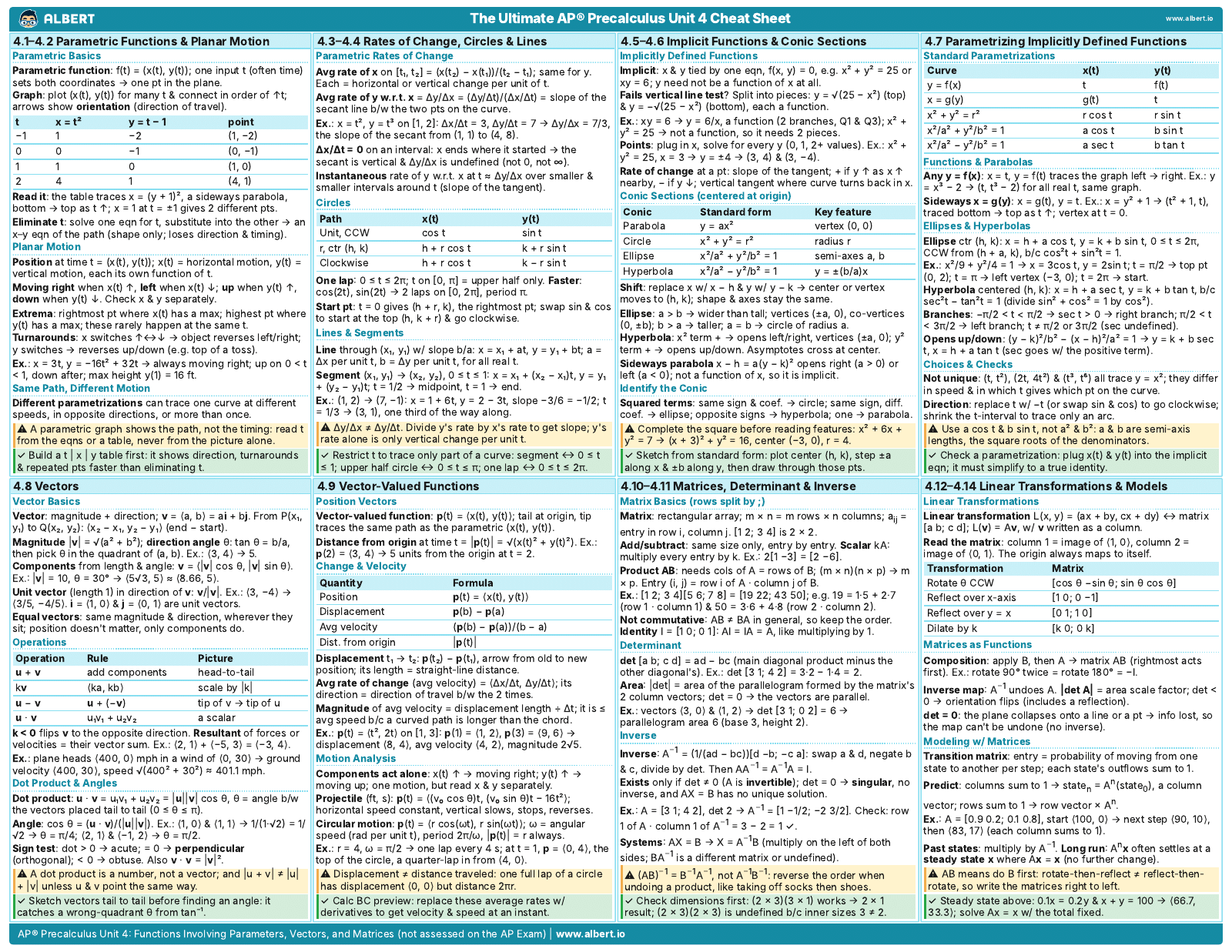
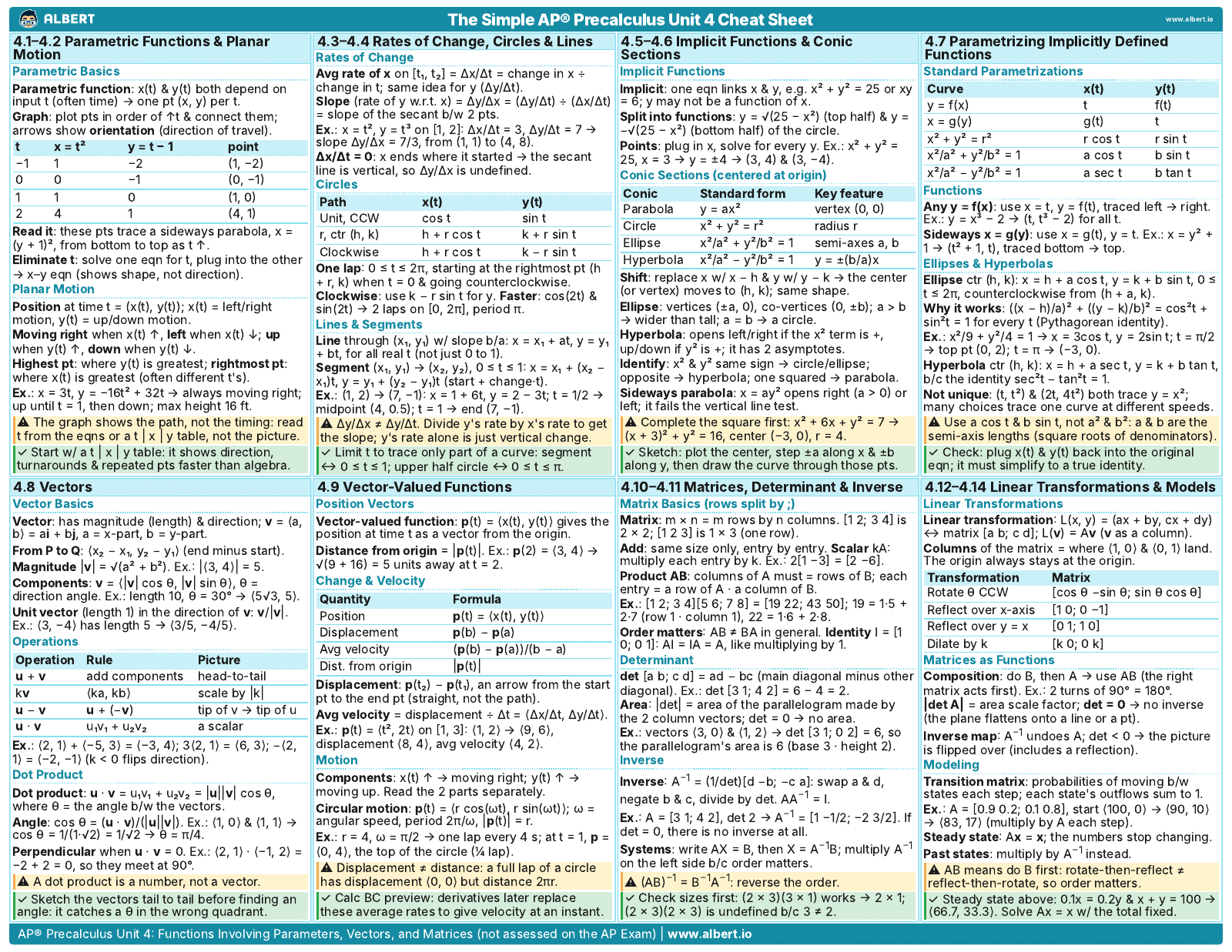
This AP Precalc Unit 4 cheat sheet covers parametric functions, implicitly defined curves and conic sections, vectors, vector-valued functions, and matrices on one printable page. Unit 4 is not assessed on the AP® Precalculus Exam, so its weight there is 0%, but many schools teach it and test it in class. Use the Simple version for a first pass and the Ultimate version for full depth.
Practice AP® Precalculus Unit 4 questions on Albert
What’s on the AP Precalc Unit 4 Cheat Sheet?
Both versions use the same eight cards, in the order the College Board AP® Precalculus course lists the topics: parametric functions and planar motion, parametric rates of change with circles and lines, implicit functions and conic sections, parametrizing implicit curves, vectors, vector-valued functions, matrices with determinants and inverses, and linear transformations with matrix models.
The Simple version is for students meeting this material for the first time. It keeps the core definitions, the standard parametrizations table, the vector operations table, the 2 × 2 determinant and inverse formulas, and one worked example per idea, with a few words of context the first time a term appears.
The Ultimate version is for a unit test or a final. It adds the reasoning that separates a careful answer from a careless one: why an undefined Δy/Δx means a vertical secant, how to pick the right branch of a hyperbola from the interval of t, why the magnitude of average velocity can be smaller than average speed, the order rule for (AB)−1, and how to find a steady state of a transition matrix. Neither version is a formula list. Each line tells you what to do with a fact, not only what the fact is.
AP® Precalculus Unit 4 at a Glance
Unit 4 has 14 topics. The College Board lists it in the course framework but does not assess it on the AP Exam, which covers Units 1 through 3 only. Use this table as your AP® Precalculus Unit 4 review checklist before a class test.
| Topic | Name | Focus |
|---|---|---|
| 4.1 | Parametric Functions | Graphing (x(t), y(t)) and reading its orientation |
| 4.2 | Parametric Functions Modeling Planar Motion | Horizontal and vertical motion as separate functions of time |
| 4.3 | Parametric Functions and Rates of Change | Average rates of x and y; slope as their ratio |
| 4.4 | Parametrically Defined Circles and Lines | Circles, lines, and segments in parametric form |
| 4.5 | Implicitly Defined Functions | Equations in x and y that are not functions of x |
| 4.6 | Conic Sections | Parabolas, ellipses, and hyperbolas in standard form |
| 4.7 | Parametrization of Implicitly Defined Functions | Writing conics with sine, cosine, secant, and tangent |
| 4.8 | Vectors | Components, magnitude, unit vectors, dot product |
| 4.9 | Vector-Valued Functions | Position vectors, displacement, average velocity |
| 4.10 | Matrices | Dimensions, products, and the determinant as area |
| 4.11 | The Inverse and Determinant of a Matrix | When a 2 × 2 inverse exists and how to find it |
| 4.12 | Linear Transformations and Matrices | Rotations, reflections, and dilations as matrices |
| 4.13 | Matrices as Functions | Composition, inverse transformations, area scaling |
| 4.14 | Matrices Modeling Contexts | Transition matrices and steady states |
Key Concepts in Unit 4: Functions Involving Parameters, Vectors, and Matrices
Parametric Functions and Planar Motion (4.1–4.4)
A parametric function gives x and y separately as functions of a third variable, usually time: f(t) = (x(t), y(t)). Each value of t produces one point in the plane, and plotting those points in order of increasing t traces a curve with a direction, called its orientation. That direction is information an ordinary graph of y = f(x) cannot carry.
Treat x(t) and y(t) as two motions happening at once. The object moves right when x(t) is increasing and up when y(t) is increasing, and you check each one on its own. The highest point comes where y(t) is greatest, which is usually a different time from when x(t) is greatest.
Worked example: a ball has x(t) = 3t and y(t) = −16t² + 32t, in feet and seconds. Since x(t) always increases, the ball always moves right. The vertical part is a downward parabola with vertex at t = 1, so the ball rises for 0 < t < 1 and falls afterward, with maximum height y(1) = 16 feet.
Rates work the same way. The average rate of change of y with respect to x between two times is (Δy/Δt) ÷ (Δx/Δt), the slope of the secant line between the two points. For x = t² and y = t³ on [1, 2], Δx/Δt = 3 and Δy/Δt = 7, so the slope is 7/3. Circles and lines have standard forms: x = h + r cos t, y = k + r sin t traces a circle counterclockwise from its rightmost point, and x = x₁ + (x₂ − x₁)t, y = y₁ + (y₂ − y₁)t on 0 ≤ t ≤ 1 traces the segment between two points.
Tip: build a small t | x | y table before anything else. It shows direction, turnarounds, and repeated points faster than eliminating t.
Implicit Functions, Conics, and Their Parametrizations (4.5–4.7)
An implicitly defined function relates x and y through one equation, such as x² + y² = 25, without solving for y. The circle fails the vertical line test, but you can split it into two functions, y = √(25 − x²) and y = −√(25 − x²). To find points, substitute a value of x and solve for every y: at x = 3, y = ±4.
The conic sections come next. A circle has x² and y² with the same coefficient, an ellipse x²/a² + y²/b² = 1 has the same sign but different denominators, a hyperbola x²/a² − y²/b² = 1 has opposite signs and asymptotes y = ±(b/a)x, and a parabola has only one squared variable. Replacing x with x − h and y with y − k moves the center to (h, k).
Worked example: x² + 6x + y² = 7 does not look like a circle until you complete the square. Adding 9 to both sides gives (x + 3)² + y² = 16, a circle with center (−3, 0) and radius 4.
Topic 4.7 turns these equations back into parametric form using identities. The ellipse becomes x = h + a cos t, y = k + b sin t, which works because cos²t + sin²t = 1. The hyperbola becomes x = h + a sec t, y = k + b tan t, because sec²t − tan²t = 1. For x²/9 + y²/4 = 1, that gives x = 3 cos t and y = 2 sin t, and t = π/2 lands on the top point (0, 2).
Tip: check any parametrization by substituting it into the original equation. If it does not simplify to a true identity, something is wrong.
Vectors and Vector-Valued Functions (4.8–4.9)
A vector has magnitude and direction and is written in components, v = ⟨a, b⟩. Its magnitude is √(a² + b²), and dividing a vector by its magnitude gives a unit vector in the same direction. You add vectors component by component, which matches placing them head to tail.
The dot product, u · v = u₁v₁ + u₂v₂, is a number, and it also equals |u||v| cos θ. That second form gives the angle between two vectors, and a dot product of 0 means the vectors are perpendicular. For example, ⟨2, 1⟩ · ⟨−1, 2⟩ = −2 + 2 = 0.
A vector-valued function p(t) = ⟨x(t), y(t)⟩ points from the origin to an object’s position at time t. Displacement from t₁ to t₂ is p(t₂) − p(t₁), and average velocity is that displacement divided by the elapsed time.
Worked example: for p(t) = ⟨t², 2t⟩ on [1, 3], p(1) = ⟨1, 2⟩ and p(3) = ⟨9, 6⟩. The displacement is ⟨8, 4⟩, so the average velocity is ⟨4, 2⟩ with magnitude 2√5 ≈ 4.47 units per unit of time.
Tip: displacement is not distance traveled. One full lap of a circle has displacement ⟨0, 0⟩ but distance 2πr.
Matrices, Determinants, and Inverses (4.10–4.11)
A matrix with m rows and n columns is m × n. You can multiply A by B only if the number of columns in A equals the number of rows in B, and each entry of AB is a row of A dotted with a column of B. Order matters: AB and BA are usually different.
The determinant of a 2 × 2 matrix [a b; c d] is ad − bc, and its absolute value is the area of the parallelogram formed by the two column vectors. The inverse is (1/(ad − bc)) times [d −b; −c a], and it exists only when the determinant is not 0.
Worked example: for A = [3 1; 4 2], det A = 3·2 − 1·4 = 2, so A−1 = (1/2)[2 −1; −4 3] = [1 −1/2; −2 3/2]. Multiplying A by this matrix gives the identity, which confirms the answer.
Tip: write the dimensions of both matrices side by side before multiplying. If the inner numbers do not match, the product is undefined.
Linear Transformations and Matrix Models (4.12–4.14)
A linear transformation L(x, y) = (ax + by, cx + dy) is the same thing as multiplying by the matrix [a b; c d]. The first column shows where ⟨1, 0⟩ lands and the second shows where ⟨0, 1⟩ lands, so you can build the matrix for a rotation, reflection, or dilation by tracking those two vectors. Rotating counterclockwise by θ uses [cos θ −sin θ; sin θ cos θ].
Applying B and then A is the single matrix AB, with the right-hand matrix acting first. The absolute value of the determinant is the factor by which areas scale, a negative determinant means the transformation flips orientation, and a determinant of 0 means the plane collapses onto a line, so the transformation cannot be undone.
Worked example: a transition matrix A = [0.9 0.2; 0.1 0.8] moves a population between two states, with each column summing to 1. Starting from ⟨100, 0⟩, one step gives ⟨90, 10⟩ and the next gives ⟨83, 17⟩. The steady state solves Ax = x: 0.1x = 0.2y with x + y = 100, so the long-run split is about ⟨66.7, 33.3⟩.
Tip: check whether your textbook’s transition matrix has columns or rows summing to 1. Columns mean you multiply the matrix by a column vector; rows mean you multiply a row vector by the matrix.
How Unit 4 Shows Up on the Exam
Unit 4 does not appear on the AP® Precalculus Exam. The College Board’s course framework includes it so schools can teach it, and the exam’s multiple-choice and free-response questions draw only on Units 1 through 3. That does not make it optional for you if your teacher covers it. Expect it on unit tests and finals, and expect questions that look like the AP free-response style: a table or graph of a parametric or vector function, followed by parts asking for a rate of change, a direction of motion, or an interpretation in context.
Graders on these tests reward the same habits the AP Exam rewards. Show the setup, such as the difference quotient for an average rate or the determinant before the inverse. Give units on rates and velocities. Explain direction with the sign of a rate, not a vague description. These topics also return later: parametric equations and vector-valued functions are part of AP® Calculus BC, and matrices and transformations are the start of linear algebra, so AP Precalc Unit 4 practice now saves time in those courses.
Common Mistakes in Unit 4
- Mistake: Treating Δy/Δt as the slope of a parametric curve. Fix: The slope is Δy/Δx, which equals (Δy/Δt) ÷ (Δx/Δt).
- Mistake: Using a² and b² as the coefficients when parametrizing an ellipse. Fix: Use a cos t and b sin t, where a and b are the square roots of the denominators.
- Mistake: Reporting a direction angle straight from a calculator’s inverse tangent. Fix: Check the quadrant of ⟨a, b⟩ and adjust by π if the vector points left.
- Mistake: Multiplying matrices in the order the transformations are described. Fix: “B, then A” is AB, because the right-hand matrix acts on the vector first.
- Mistake: Writing (AB)−1 = A−1B−1. Fix: Reverse the order: (AB)−1 = B−1A−1.
Frequently Asked Questions
Is AP® Precalculus Unit 4 on the AP Exam?
No. The AP® Precalculus Exam assesses Units 1, 2, and 3 only. Unit 4 is in the course framework for schools that choose to teach it, and many do, so it often counts toward your class grade.
Can I use this cheat sheet on the exam?
No. No reference sheet is allowed on the AP® Precalculus Exam, and most teachers do not allow one on unit tests either. This AP Precalc Unit 4 cheat sheet is a study tool: use it to review, quiz yourself, and spot gaps before a test.
Should I start with the Simple or the Ultimate version?
Start with Simple if you are learning these topics for the first time or need a quick reset before a quiz. Move to Ultimate once the basics feel solid, since it adds more examples, edge cases like hyperbola branches and singular matrices, and the reasoning teachers look for on free-response questions.
How does Unit 4 connect to AP® Calculus BC?
AP® Calculus BC uses parametric equations and vector-valued functions heavily. The average rates in this unit become derivatives there, so dy/dx = (dy/dt)/(dx/dt) and velocity vectors will feel familiar if you know the Unit 4 versions well.