
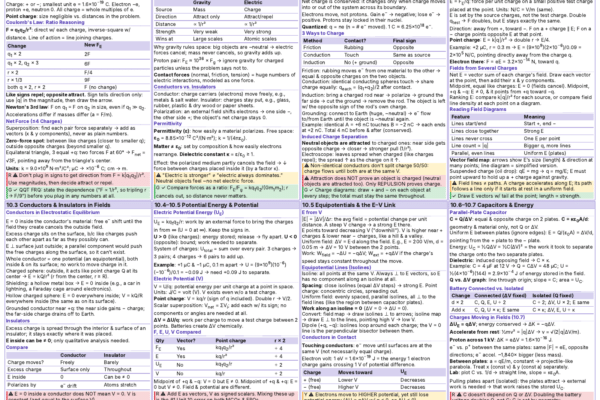
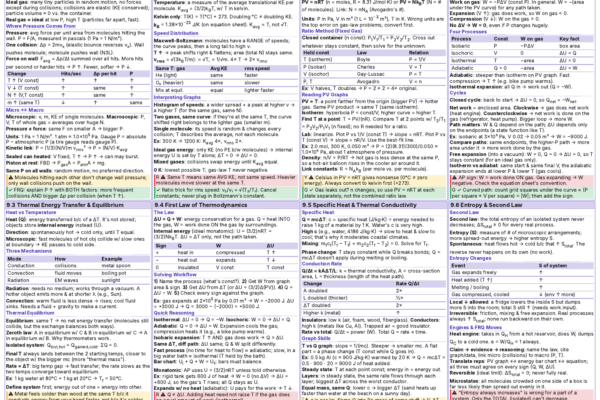

Ohm’s Law and Circuit Analysis: AP® Physics 2 Review
Ohm’s Law is the single most important equation in AP® Physics 2 circuits. Every circuit analysis — finding current, voltage drops, power, or resistance…

20+ free AP® Physics 2 study guides, organized by unit and written to the current College Board framework.
Ohm’s Law is the single most important equation in AP® Physics 2 circuits. Every circuit analysis — finding current, voltage drops, power, or resistance…
Kirchhoff’s Laws are the backbone of circuit analysis in AP® Physics 2. The junction rule and loop rule let you systematically find every current…
Resistance and resistivity are foundational to AP® Physics 2 circuits. They appear on nearly every exam — in Ohm’s Law calculations, material comparison questions,…
Capacitors show up throughout AP® Physics 2 — in circuit analysis, energy questions, and FRQ scenarios involving changing geometry or dielectrics. Mastering Topic 10.6…

Electric current is one of the foundational concepts in AP® Physics 2’s Unit 11, appearing in circuit analysis, Ohm’s Law, power calculations, and questions…

Electric field and electric potential are two of the most fundamental concepts in AP® Physics 2. You’ll encounter them throughout Unit 10 and revisit…
The Second Law of Thermodynamics shows up on nearly every AP® Physics 2 exam — as a heat engine calculation, an entropy question, or…

Electric charge is the foundation of everything in AP® Physics 2’s Unit 10. You can’t understand electric fields, potential, or circuits without a solid…
Specific heat and heat transfer form the backbone of AP® Physics 2 thermodynamics. Every calorimetry problem, every multi-step heating calculation, and every question about…

If a problem says “thermodynamics,” the First Law is your starting point — every single time. It tells you exactly what happens to a…
Every AP® Physics 2 thermodynamics problem starts with these two concepts — and students who mix them up lose points from the very first…

Temperature and pressure aren’t abstract numbers on a thermometer or gauge — they’re direct consequences of molecular motion. Topic 9.1 appears on nearly every…