
Maximize your score with these resources:
Security professionals share a vocabulary the way doctors share medical terms. They talk about adversaries and assets, likelihood and severity, controls that prevent and controls that detect. Without that language, it is hard to explain why a locked door, a password policy, and an antivirus program all belong in the same plan. Topic 2.1 is the course’s foundation topic. It gathers the core ideas you will use in every unit that follows: who attacks, how attacks unfold, how risk is measured and managed, and how layers of defense fit together.
This article covers Topic 2.1: Cyber Foundations in Unit 2, Securing Spaces. The topic asks you to identify social engineering attacks and types of adversaries, describe the phases of a cyberattack and the risk assessment process, identify risk management strategies and security controls, and explain defense in depth.
By the end, you should be able to:
- Identify seven social engineering techniques and five types of adversaries.
- Put the six phases of a cyberattack in order.
- Assess risk by likelihood and severity and choose avoid, transfer, mitigate, or accept.
- Classify security controls by principle, type, and function, and explain defense in depth.
Social Engineering Techniques and Adversaries
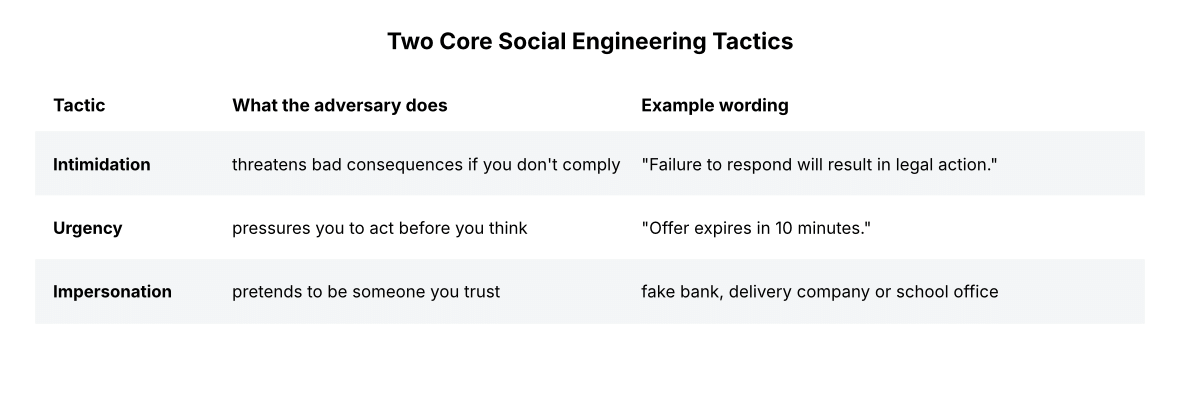
| Technique | Definition |
|---|---|
| Pretexting | Creating a believable reason to contact the target |
| Authority | Impersonating someone with power over the target, or relaying “their” instructions |
| Intimidation | Stating negative consequences if demands are not met |
| Consensus | Creating social pressure: “everyone else is doing it” |
| Scarcity | Creating a sense of limited availability |
| Familiarity | Pretending to be, or to know, someone close to the target |
| Urgency | Setting a deadline that demands quick action |
| Adversary | Key traits |
|---|---|
| Script kiddies | Low-skilled; use others’ tools without understanding them; greed or recognition |
| Hacktivists | Social, political, or personal causes; believe the goal justifies illegal methods |
| Insiders | Have legitimate credentials and access; may be recruited; greed or revenge |
| Cyberterrorists | Politics or beliefs; disrupt communities or nations, such as power grids or water plants |
| Transnational criminal organizations | Financial gain, mainly through ransomware and stealing intellectual property |
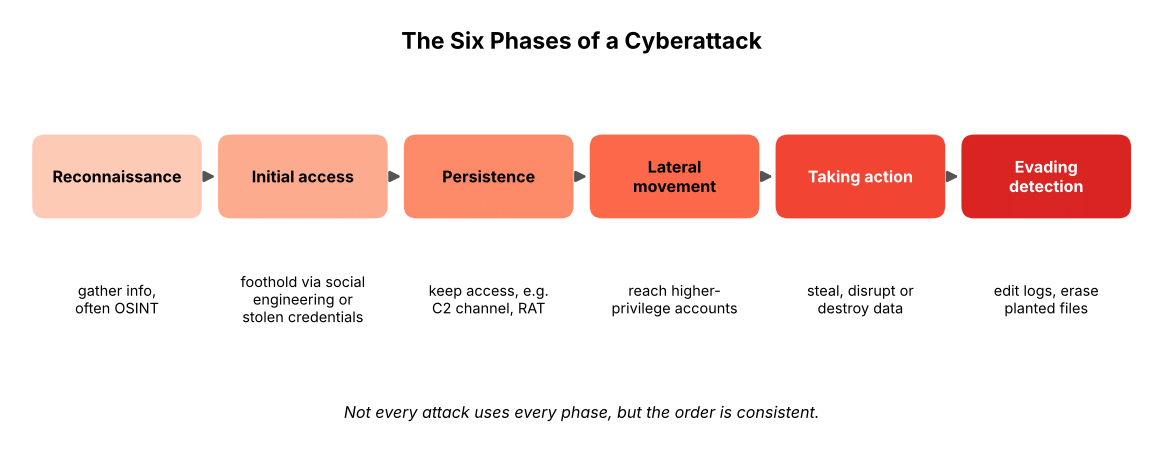
The Six Phases of a Cyberattack
Not every attack uses every phase, but the order is consistent:
- Reconnaissance: gather information, often from open source intelligence (OSINT), which is freely available.
- Initial access: establish a foothold, often through social engineering or weak or stolen credentials.
- Persistence: keep access, often with a command and control (C2) channel through malware like a remote access trojan (RAT) or rootkit.
- Lateral movement: escalate privileges by reaching accounts and computers with higher permissions.
- Taking action: collect and exfiltrate data, disrupt services, or destroy data.
- Evading detection: remove or edit log files and erase planted files.
Assessing and Managing Risk
Risk exists when a threat can exploit a vulnerability to compromise an asset, which is anything valuable: money, intellectual property, data, digital infrastructure, physical property, or reputation.
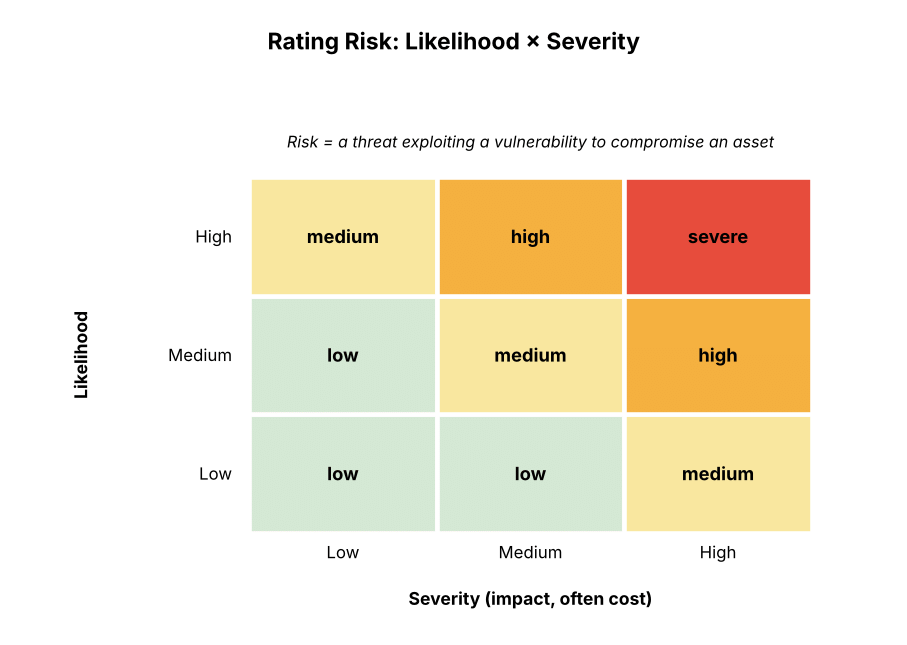
Risk assessment weighs two factors:
- Likelihood, driven by the target’s value, the skill needed to exploit the vulnerability, and the motivation and capability of likely adversaries.
- Severity, often measured in financial cost, including reputational and operational impacts.
Results can be quantitative (a 1 to 10 score or a dollar figure, such as a $10,000 annual risk) or qualitative (low, medium, high, severe). Documentation should list vulnerable assets and their value, likely threats, specific vulnerabilities and how they would be exploited, the severity and likelihood, and a final rating.
| Strategy | Meaning |
|---|---|
| Avoid | Stop the risky activity (impossible if it is central to the mission) |
| Transfer | Shift the burden to another party, such as an insurer |
| Mitigate | Add security controls to reduce likelihood or impact |
| Accept | Live with the residual risk left over, since absolute security is unattainable |
Organizations favor cost-effective controls, meaning those that cost less to install and maintain than the expected loss from an attack.
Security Controls and Defense in Depth
Every control supports at least one principle of the CIA triad: confidentiality (only authorized access), integrity (accurate, trustworthy data), and availability (accessible when needed).
| By type | Examples | By function | Examples |
|---|---|---|---|
| Physical | Locks, fences, cameras, bollards, guards | Preventative | Locks, encryption |
| Technical | Firewalls, anti-malware, encryption | Detective | Intrusion detection systems (IDS), cameras, SIEM systems |
| Managerial | Password policies, access reviews, incident response plans | Corrective | Patching, repairing a broken card reader, intrusion prevention systems (IPS) |
Defense in depth, or layered defense, combines many controls across human, physical, network, device, application, and data layers. Each threat can be met by its best-suited control, and if one layer is bypassed, another may still stop the adversary or limit the damage.
Why does this matter? A camera is a physical control by type and a detective control by function. Exam questions often ask for one classification or the other, so always check which one is being asked.
Test-Taking Strategies
Mnemonic Devices and Memory Shortcuts
Attack phases: “Really Intelligent People Learn To Evade”: Reconnaissance, Initial access, Persistence, Lateral movement, Taking action, Evading detection. Risk strategies: “ATMA”, Avoid, Transfer, Mitigate, Accept.
Cross-Topic Connections
- Topic 1.1: Understanding Social Engineering introduces intimidation and urgency.
- Topic 1.3: Best Practices for Public Networks classifies adversaries by skill and motivation.
- Topic 1.5: Leveraging AI in Cyber Defense shows detective and corrective controls powered by AI.
- AP® Computer Science Principles Topic 5.6: Safe Computing covers malware and personal security basics.
Common Question Formats
- An attack description asking which phase is underway.
- A control asking whether it is preventative, detective, or corrective.
- A risk scenario asking which management strategy fits.
Frequent Student Mistakes
- Confusing persistence (keeping access) with lateral movement (spreading and escalating).
- Calling buying insurance “mitigation.” It is risk transference.
- Mixing up control type (physical, technical, managerial) with control function.
Test-Day Shortcuts
For controls, ask two questions: “Where does it live?” for type, and “When does it act: before, during, or after an attack?” for function.
Time Management Tips
The AP Cybersecurity Exam on May 5, 2027, is fully digital in Bluebook, with 60 multiple-choice questions in 80 minutes. Vocabulary from this topic appears across all five units, so it pays to know these tables cold before tackling longer scenarios.
Check for Understanding
Think you’ve got it? Complete the quiz below to make sure. Download your results at the end.