
Maximize your score with these resources:
- Albert.io AP® Business with Personal Finance question banks
- Free AP® Business with Personal Finance score calculator
A pizza delivery chain’s owner asks one question every Monday: “How did we do last week?” Sales alone cannot answer it. Sales may be up because of a big catering order, while delivery times are slipping, customer complaints are rising, and ingredient costs are eating into profit. Good managers track a handful of carefully chosen numbers, compare them to a standard, and act when something drifts. Those numbers are key performance indicators. Topic 4.2 explains how businesses choose, track, and judge them.
This article covers Topic 4.2: Evaluating Performance Using KPIs in Unit 4, Management and Strategy. The topic asks you to describe key performance indicators, develop or interpret financial and nonfinancial KPIs, and explain how businesses use benchmarks.
By the end, you should be able to:
- Define a KPI and explain how managers choose which ones to track.
- Name financial, marketing and sales, and operations KPIs.
- Define a benchmark and distinguish internal from external benchmarks.
- Interpret KPI data against benchmarks and recommend a response.
What a KPI Is
A key performance indicator (KPI) is a data point that measures a business’s performance, including progress toward short- and long-term goals and how well its strategy is working.
Managers choose KPIs that connect to:
- The business’s stated mission and goals.
- Profitability.
- Its ability to stay competitive and viable over the long term.
KPIs vary by business and industry. An airline cares about on-time departures, while a subscription app cares about how many users cancel each month.
Mission matters too. A social enterprise that donates a meal for every bag of granola sold might track “meals donated per month” alongside profit, because both measure whether it is meeting its goals. A business that tracks dozens of numbers can lose focus, so managers usually pick a small set of KPIs that tie directly to what the business is trying to achieve right now.
Three Families of KPIs
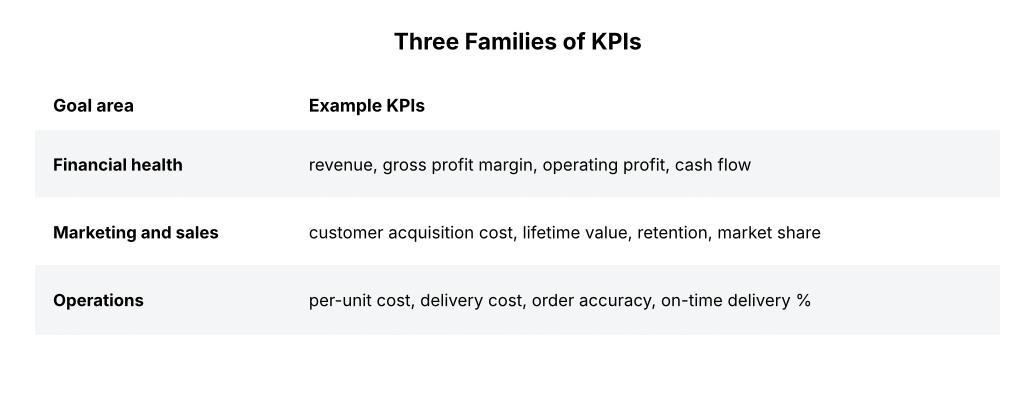
| Goal area | Example KPIs from the CED |
|---|---|
| Financial health | Revenue, gross profit, gross profit margin, operating profit, operating profit margin, COGS, operating expenses, cash flow |
| Marketing and sales | Customer acquisition cost, customer lifetime value, customer satisfaction ratings, customer retention data, total sales, market share |
| Operations | Per-unit cost, delivery cost, order accuracy, percentage of deliveries received on time |
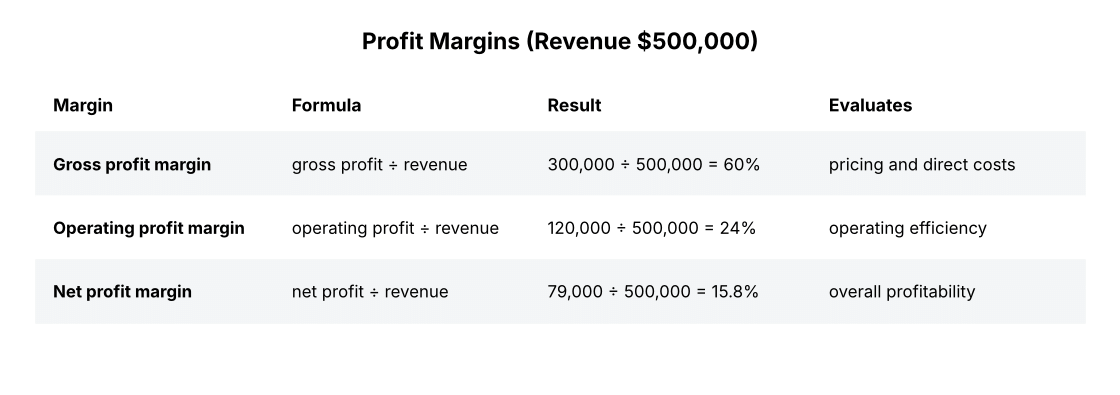
Notice how many of these come from earlier topics. CAC and lifetime value are from Topic 2.1, profit margins from Topic 3.6, and cash flow from Topic 3.8. Unit 4 pulls them together into one performance dashboard.
Benchmarks
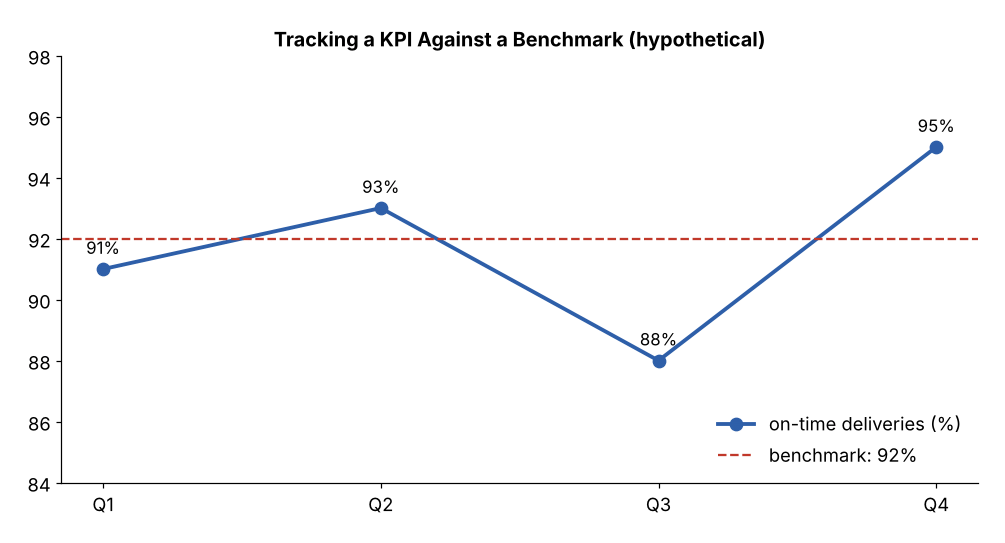
A benchmark is a reference point used to compare data to a standard. A KPI number means little until it is compared with something. Businesses compare KPI data with selected benchmarks to judge performance against a known standard, and then decide whether to stay the course or change tactics.
| Benchmark type | Based on | Example |
|---|---|---|
| Internal | The business’s own historical data | “Our on-time rate was 94% last year.” |
| External | Industry standards | “Similar delivery chains average 90% on time.” |
Worked Example: The Pizza Chain’s Dashboard
| KPI | This quarter | Benchmark | Verdict |
|---|---|---|---|
| Revenue | $420,000 | $400,000 last quarter | Above |
| Gross profit margin | 58% | 64% last quarter | Below |
| On-time deliveries | 86% | 90% industry average | Below |
| Customer satisfaction | 4.1 of 5 | 4.5 last quarter | Below |
- Revenue growth: \(\dfrac{420{,}000-400{,}000}{400{,}000}\times 100=5\%\). Good news on the surface.
- Margin warning: Gross margin fell 6 percentage points, so direct costs, such as ingredients, are rising faster than prices.
- Operations warning: Late deliveries are probably dragging down satisfaction.
- Recommendation: Renegotiate cheese and flour contracts or adjust prices to restore margin, and add drivers during peak hours to raise on-time deliveries. Track both KPIs next quarter to see if the changes work.
Why does this matter? Task 2 of Unit 4 in the Business Canvas Project asks you to identify KPIs and benchmarks for customer, market, operations, and finance goals. On the exam, a strong answer always pairs a KPI with a benchmark before judging it.
Test-Taking Strategies
Mnemonic Devices and Memory Shortcuts
Remember “Money, Market, Machine” for the three KPI families: financial, marketing and sales, and operations. And “no benchmark, no verdict.”
Cross-Topic Connections
- Topic 3.6: The Income Statement explains the profit and margin KPIs.
- Topic 2.1: Marketing to Customers defines customer acquisition cost and lifetime value.
- Topic 3.8: The Cash Flow Statement covers the cash flow KPI.
- Topic 4.1: Management and Leadership describes evaluating, the management function KPIs support.
Common Question Formats
- A business goal asking which KPI best measures progress toward it.
- A KPI table asking which area is underperforming against its benchmark.
- A question asking whether a benchmark is internal or external.
Frequent Student Mistakes
- Judging a KPI as good or bad without a benchmark.
- Calling market share an operations KPI. It is a marketing and sales KPI.
- Treating revenue growth as proof of success when margins are shrinking.
Test-Day Shortcuts
Match the KPI to the goal’s wording: “customers” points to marketing and sales KPIs, “delivery” or “cost per unit” to operations, and “profit” or “cash” to financial KPIs.
Time Management Tips
The AP Business with Personal Finance Exam on May 4, 2027, is fully digital in Bluebook. Free-response Question 3 asks you to interpret business data. Circle every number that falls short of its benchmark first, then build your explanation around those gaps.
Check for Understanding
Think you’ve got it? Complete the quiz below to make sure. Download your results at the end.