
Maximize your score with these resources:
- Albert.io AP® Business with Personal Finance question banks
- Free AP® Business with Personal Finance score calculator
Two restaurants on the same block serve similar food at similar prices. One has a staff that has stayed together for years, servers who remember regulars’ orders, and a kitchen that rarely makes mistakes. The other replaces half its staff every few months and gets reviews complaining about slow, careless service. The difference is usually not the menu. It is how the people are hired, trained, paid, and led. Topic 4.1 opens the management unit with the human side of running a business.
This article covers Topic 4.1: Management and Leadership in Unit 4, Management and Strategy. The topic asks you to describe the function of management, identify effective leadership and communication skills, explain why businesses need employees with varied competencies, and explain how businesses compensate, motivate, and retain employees.
By the end, you should be able to:
- Define management and its four functions.
- Identify key leadership and communication skills and explain why they matter.
- Explain why skilled, well-trained employees are essential to business viability.
- Compare work arrangements, compensation schemes, benefits, and retention strategies.
What Management Does
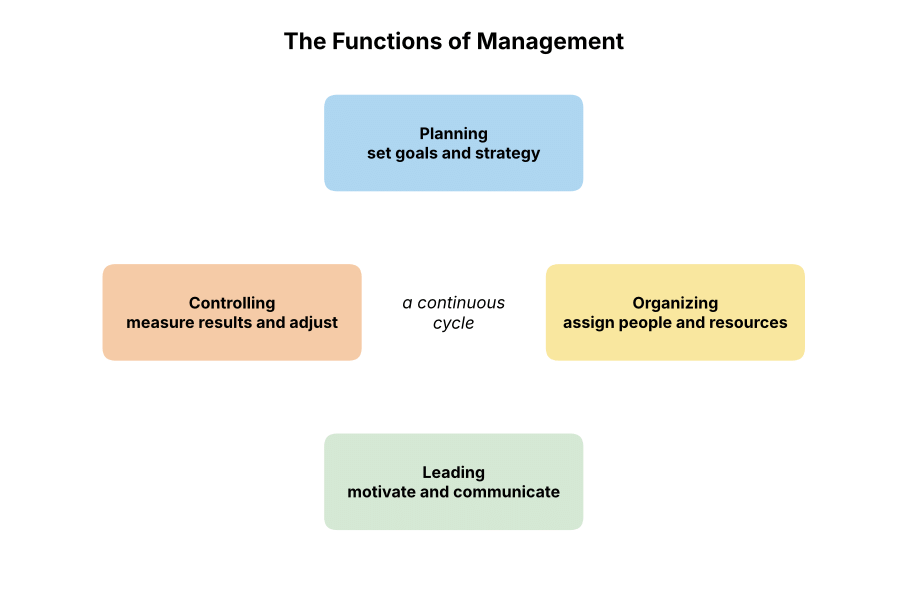
Management is the process of planning, organizing, leading, and evaluating how a business uses its human, financial, and physical resources to meet its goals. It includes managers at every level, from executive leaders to supervisors. Department managers coordinate employees so their work stays aligned with the business’s vision and mission.
Leadership and Communication Skills
Leaders work with many stakeholders: supervisors, colleagues, employees, lenders, investors, customers, and the public. That is why these skills are so valued.
| Key leadership skills | Key communication skills |
|---|---|
| Articulating the vision and mission | Expressing ideas clearly |
| Building productive teams | Communicating persuasively |
| Negotiating conflicts | Listening empathetically |
| Motivating people | Interpreting and responding to feedback |
Motivation pays off. According to the CED, motivated employees are more productive, more likely to stay, and more likely to build strong relationships with customers and coworkers.
Hiring and Developing Employees
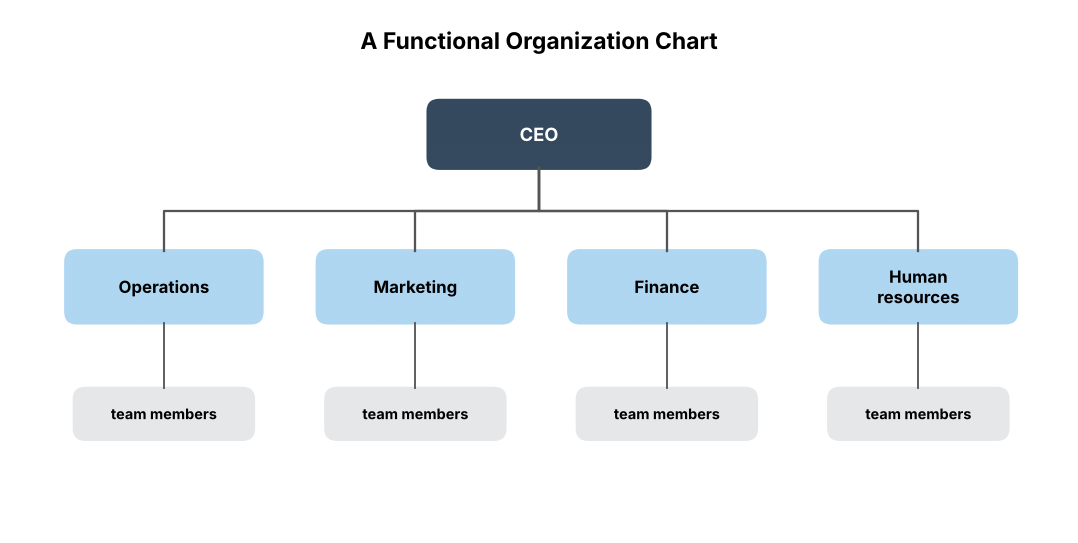
Employees do the day-to-day work: producing products, marketing, selling, and managing finances. Businesses need people with a variety of core competencies, experiences, and backgrounds because the tasks are so different, though tasks outside the core business may be outsourced.
Skilled employees are essential to viability. Poorly trained workers can create flawed products or poor service, costing customers, reputation, and revenue. Training options include postsecondary education, apprenticeships, on-the-job training, online training, and continuing education.
Paying, Motivating, and Keeping Employees
Work arrangements: full time, part time, temporary, or contract.
| Compensation scheme | How pay is set | Common example |
|---|---|---|
| Hourly wage | Pay per hour worked | Retail associate |
| Annual salary | Fixed yearly amount | Accountant |
| Commission | Percentage of sales made | Car salesperson |
| Piece rate | Pay per unit produced | Fruit picker paid per bin |
| Profit sharing | Share of the business’s profits | Employees at a firm that splits a portion of annual profit |
The scheme depends on the industry, the role, legal rules such as minimum wage, and how hard the business must compete for talent. Employers usually set pay based on education, skills, and productivity.
Benefits may include contributions to health insurance, retirement savings plans, health savings plans, disability insurance, educational reimbursement, and paid time off.
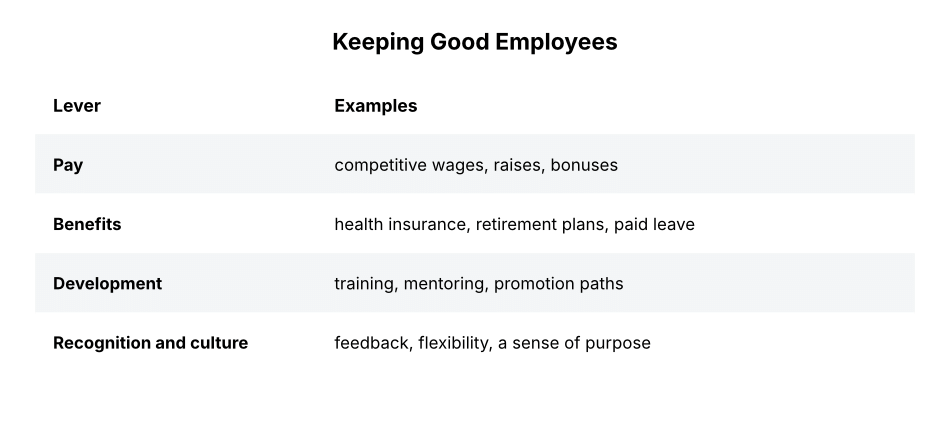
Retention: Keeping good employees is typically more cost-effective than recruiting and training new ones. Businesses use:
- Tangible incentives: raises, promotions, bonuses.
- Intangible incentives: autonomy, flexible hours or locations, recognition and rewards, flexible scheduling, and a positive workplace culture.
Worked Example: Fixing High Turnover
A bike repair shop loses three of its five mechanics in one year. Each replacement costs about $4,000 to recruit and train.
- Cost of turnover: \(3\times 4{,}000=\$12{,}000\) a year.
- Diagnosis: Exit interviews show mechanics left for higher pay and more predictable schedules.
- Plan: A $1,500 annual raise for each of five mechanics costs \(5\times 1{,}500=\$7{,}500\). Adding fixed weekly schedules and a “mechanic of the month” recognition costs little.
- Evaluation: If the plan keeps even two mechanics who would have left, it saves $8,000 in turnover costs, more than paying for the raises.
Why does this matter? This topic is also a personal finance link. When you compare job offers, the CED wants you to weigh pay scheme, benefits, and intangible perks, not just the hourly rate.
Test-Taking Strategies
Mnemonic Devices and Memory Shortcuts
Management is “P-O-L-E”: Plan, Organize, Lead, Evaluate. For pay schemes, “Hours, Salary, Sales, Pieces, Profits.”
Cross-Topic Connections
- Topic 1.7: Organization, Roles, and Responsibilities describes the HR department and outsourcing.
- Topic 1.5: Vision covers the vision and mission leaders must articulate.
- Topic 3.4: Business Expenses shows how wages and benefits appear as business costs.
- AP® Microeconomics Topic 5.1: Introduction to Factor Markets explains how wages are set in labor markets.
Common Question Formats
- A job description asking which compensation scheme fits best.
- A turnover problem asking which retention strategy is most cost-effective.
- A manager’s action asking which function of management it represents.
Frequent Student Mistakes
- Confusing commission (percent of sales) with piece rate (per unit produced).
- Ignoring intangible incentives. The CED lists autonomy, flexibility, and recognition.
- Assuming hiring new staff is cheaper than keeping current staff.
Test-Day Shortcuts
When a question asks how to reduce turnover, an answer that addresses the employees’ stated reason for leaving usually beats a generic one.
Time Management Tips
The AP Business with Personal Finance Exam on May 4, 2027, is fully digital in Bluebook. Unit 4 makes up 15 to 20% of the multiple-choice section and is central to free-response Question 4, which gets about 40 minutes including a 15-minute reading period.
Check for Understanding
Think you’ve got it? Complete the quiz below to make sure. Download your results at the end.