
Maximize your score with these resources:
- Albert.io AP® Business with Personal Finance question banks
- Free AP® Business with Personal Finance score calculator
The same pair of headphones might reach you four different ways. You could order it from the brand’s own website, buy it at a big-box electronics store, pick it up from an online marketplace, or try it on in the brand’s own flagship shop. Each route has a different cost for the business, a different experience for you, and a different number of companies taking a cut along the way. Topic 2.6 explains how businesses choose these routes, called marketing channels, and why the choice matters for profit and control.
This article covers Topic 2.6: Place and Channels in Unit 2, Marketing. The topic asks you to describe the types of marketing channels and to select and evaluate channels for a product.
By the end, you should be able to:
- Define place and marketing channels and connect them to the supply chain.
- Distinguish B2C from B2B channels and direct from indirect channels.
- Explain why some products are legally required to use specific channels.
- Evaluate the trade-offs of direct and indirect channels for a specific product.
Place and Marketing Channels
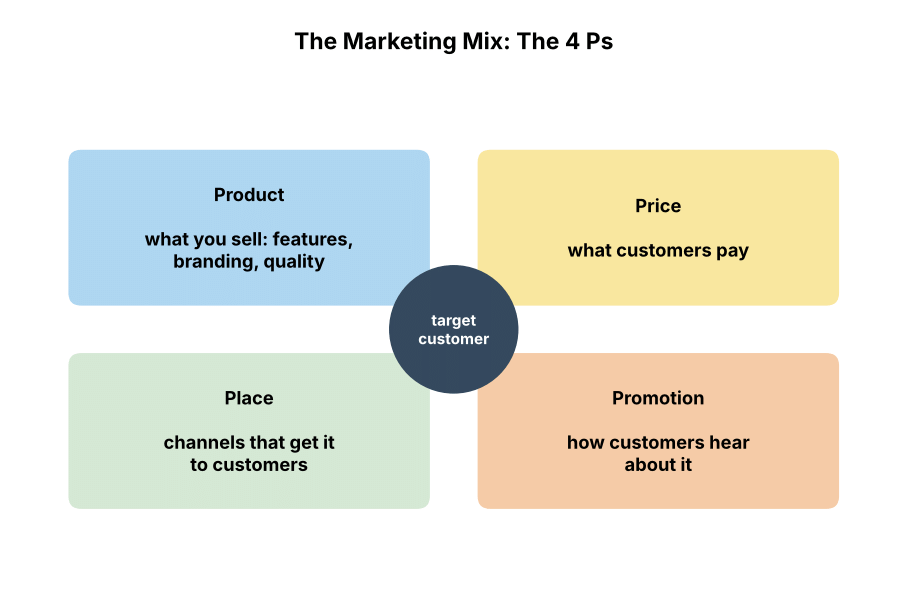
Place describes where and how customers access products, such as retail stores, company-owned stores, club memberships, or online.
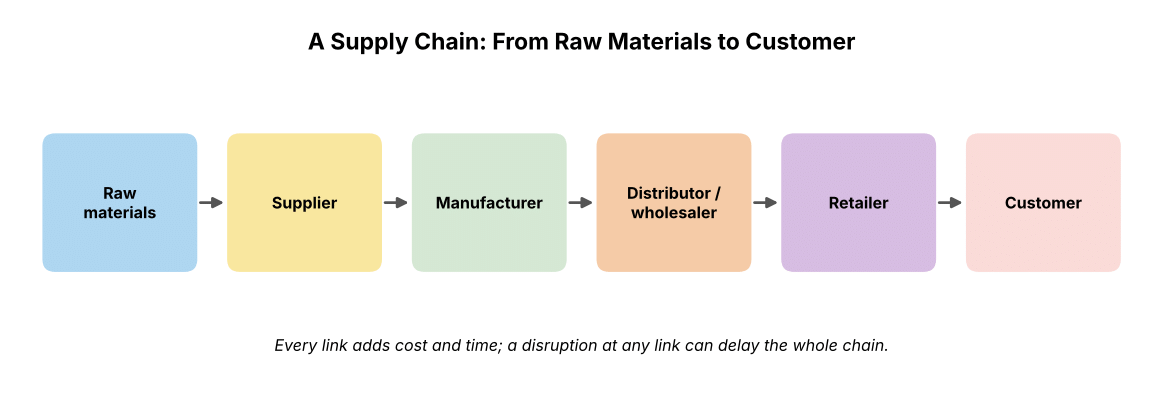
Place is determined by a business’s marketing channels, also called distribution channels. A marketing channel includes all the individuals and businesses needed to deliver a finished product to the final customer. It is the final stage of the supply chain you studied in Topic 1.8.
Types of Channels
| Category | Type | Description | Example |
|---|---|---|---|
| By customer | B2C (business-to-consumer) | Sells consumer products | A clothing brand’s website |
| B2B (business-to-business) | Sells business products | An industrial distributor selling machine parts to factories | |
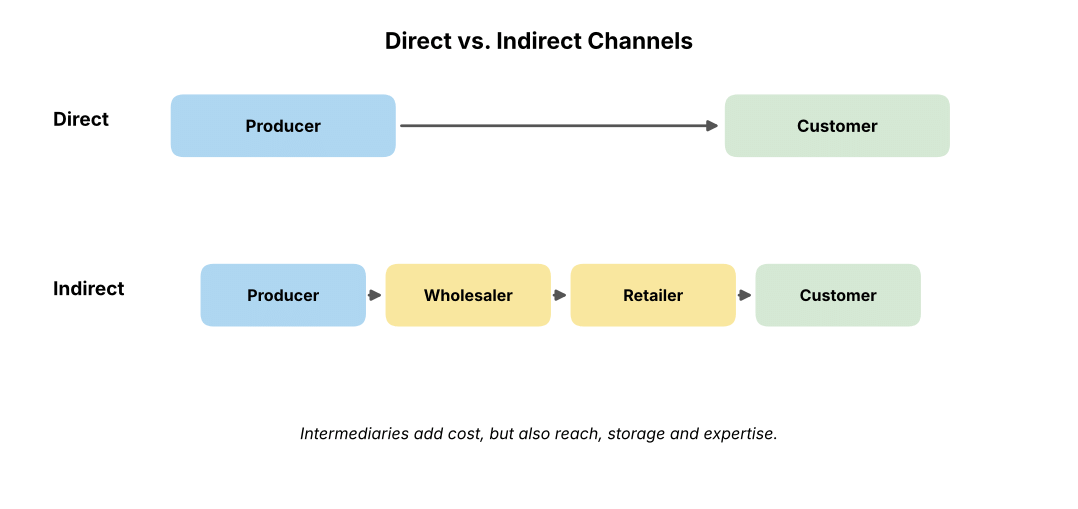
| By path | Direct | Connects the business to customers with no intermediaries | A farm stand; a company-owned store |
| Indirect | Uses intermediaries such as wholesalers and retailers | A cereal maker selling through grocery chains |
Why would a business share revenue with intermediaries at all? Wholesalers buy in bulk and store goods, retailers provide shelf space and foot traffic, and distributors already have relationships with thousands of buyers. A small company would need years and a lot of money to build those networks itself. Each intermediary adds cost, but each also adds reach and expertise.
Some products must use legally required channels. Prescription medications, for example, must go through licensed pharmacies, and products that pose health or safety risks often face similar rules.
Choosing a Channel
Businesses compare channels on three criteria:
- Cost and potential profitability of each channel.
- Customer experience in each channel.
- Ability to reach the target customers.
| Direct channels | Indirect channels | |
|---|---|---|
| Advantages | More control over pricing and the customer experience | Partners’ expertise and networks can reduce costs and reach more customers |
| Disadvantages | Can be costly to set up, limited in reach, and may require new sales and distribution expertise | Hard to access when rivals already dominate distributors and retail space |
Worked Example: A Hot Sauce Startup
A two-person company makes small-batch hot sauce. It is weighing three options.
- Own website (direct, B2C): The company keeps the full price and controls branding, but it must pay for website ads and shipping and reaches only people who find the site.
- Regional grocery chain (indirect, B2C): Shelf space in 80 stores would put the sauce in front of thousands of shoppers, but the grocer takes a large share of each sale, and big brands already dominate the hot sauce aisle.
- Restaurant supplier (indirect, B2B): Selling bulk bottles to restaurants builds steady orders but gives less brand recognition with consumers.
Evaluation: Starting direct online protects margins and lets the founders learn from customer data. Once demand is proven, a specialty food retailer might offer more reach than a crowded grocery aisle. Many businesses end up combining channels.
Why does this matter? Task 7 of the Business Canvas Project asks you to select a marketing channel. The strongest choices are justified with all three criteria, not just “it reaches lots of people.”
Test-Taking Strategies
Mnemonic Devices and Memory Shortcuts
For direct vs. indirect, remember “Direct = control, Indirect = reach.” For choosing channels, use “Cost, Customer, Coverage.”
Cross-Topic Connections
- Topic 1.8: Supply Chains covers the earlier stages that marketing channels complete.
- Topic 2.5: Price explains pricing control, a major advantage of direct channels.
- Topic 2.1: Marketing to Customers defines the target customers a channel must reach.
- Topic 1.2: Markets and Competitive Advantage explains how rivals can block access to distribution as a barrier to entry.
Common Question Formats
- A distribution description asking whether it is direct or indirect.
- A product asking whether it is sold through B2B or B2C channels.
- A business goal asking which channel best supports it.
Frequent Student Mistakes
- Calling an online marketplace a direct channel. A third-party marketplace is an intermediary.
- Assuming direct channels are always cheaper. They often cost more to establish.
- Forgetting that some products have legally required channels.
Test-Day Shortcuts
Count the businesses between maker and buyer. Zero means direct. One or more means indirect.
Time Management Tips
The AP Business with Personal Finance Exam on May 4, 2027, is fully digital in Bluebook. Free-response Question 4 asks you to choose between two courses of action, and channel decisions are a natural fit. Set two or three criteria first, then compare both options against each one.
Check for Understanding
Think you’ve got it? Complete the quiz below to make sure. Download your results at the end.