
Maximize your score with these resources:
- Albert.io AP® Business with Personal Finance question banks
- Free AP® Business with Personal Finance score calculator
A popular food truck is thinking about opening a sit-down restaurant downtown. Before signing a lease, the owners need to answer two very different questions. First, how tough is the downtown restaurant market: how many rivals, how picky the customers, how pricey the suppliers? Second, how well is their own business built to compete there? Two classic tools answer those questions. Porter’s Five Forces sizes up the competition, and SWOT analysis sizes up the business. Topic 4.4 teaches both.
This article covers Topic 4.4: Strategic Frameworks: Porter’s Five Forces and SWOT Analysis in Unit 4, Management and Strategy. The topic asks you to describe and apply Porter’s Five Forces to judge a market’s competitiveness, and to describe and apply SWOT analysis to assess a business’s internal capabilities and external conditions.
By the end, you should be able to:
- Name and define Porter’s five forces and explain when each is strong.
- Use the five forces to judge whether a market is attractive.
- Classify factors as strengths, weaknesses, opportunities, or threats.
- Use SWOT results to recommend strategic moves.
Porter’s Five Forces
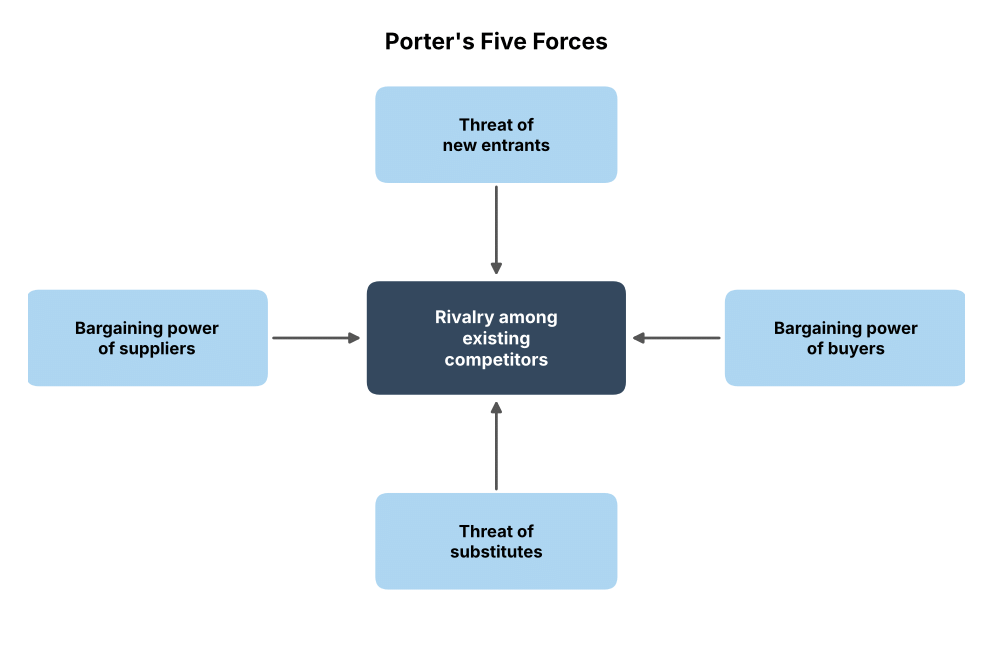
Michael Porter’s Five Forces framework evaluates the competitive intensity, attractiveness, and potential profitability of a market. A business might use it to decide which market to enter or which pricing strategy to adopt. Each force describes how power held by some group can threaten a business’s ability to compete.
| Force | What it measures | The threat is strong when… |
|---|---|---|
| Competitive rivalry | Intensity among existing businesses; usually the strongest force | Many direct competitors sell equivalent products and businesses have little pricing power |
| Threat of new entrants | Ease of entering the market | Barriers to entry are low |
| Threat of substitutes | Availability of different products that meet the same need | Many alternatives exist, especially cheaper, easier to get, or higher quality ones |
| Customer power | Buyers’ ability to push prices down | Few customers, each a large share of sales; high acquisition costs; low switching costs |
| Supplier power | Resource providers’ ability to raise input costs | Few suppliers to choose from and high costs to switch |
Switching costs are the monetary and psychological costs a customer faces when changing products or brands. When switching is cheap and easy, customers have more power.
Rival vs. substitute: A rival sells the same kind of product (another burger restaurant). A substitute meets the same need differently (a grocery store’s frozen meals).
Bottom line: Strong forces make a market less attractive by reducing potential profit. Weak forces make it more attractive.
SWOT Analysis
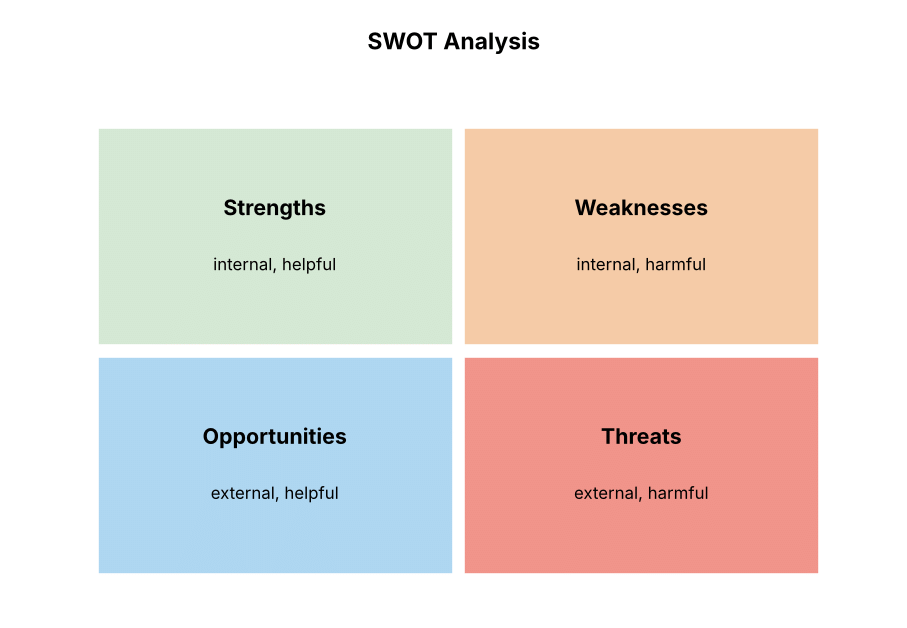
SWOT analysis evaluates internal and external factors that affect whether a business can reach its goals and stay competitive.
| Helpful | Harmful | |
|---|---|---|
| Internal (within the business’s control) | Strengths: core competencies, brand recognition, intellectual property, product quality, ample funds, skilled employees, efficient supply chain | Weaknesses: missing competencies, low brand recognition, product flaws, limited funds, trouble staffing, poor service, outdated technology, supply chain risks |
| External (beyond the business’s control) | Opportunities: market growth, reduced competition, new technology, favorable regulation changes | Threats: rising input costs, natural disasters, unfavorable regulation, disruptive innovation |
Internal capabilities are judged against rivals, industry benchmarks, and past performance to decide if they are strengths or weaknesses. External factors draw on market size, customer preferences, PESTEL factors, and Porter’s Five Forces. The results guide four moves: build on strengths, address weaknesses, capitalize on opportunities, and respond to threats.
Worked Example: The Food Truck Goes Downtown
Five Forces for the downtown lunch market:
- Rivalry: Strong. Twelve lunch spots within three blocks.
- New entrants: Moderate. Leases are expensive, but new spots open every year.
- Substitutes: Strong. Delivery apps and office cafeterias meet the same need.
- Customer power: Strong. Office workers can switch at no cost.
- Supplier power: Weak. Many food distributors compete for business.
Verdict: A tough market with limited profit potential.
SWOT for the food truck business:
- Strengths: a loyal following and a signature dish no rival makes.
- Weaknesses: no experience managing a large staff; limited funds.
- Opportunities: a new office tower opening nearby with 2,000 workers.
- Threats: rising downtown rents.
Recommendation: Build on the signature dish and loyal following, which reduce customer power by raising psychological switching costs. Address the staffing weakness by starting with a small counter-service space instead of a full restaurant, keeping costs low while capturing the office tower opportunity.
Why does this matter? Task 4 of Unit 4 in the Business Canvas Project asks you to use both frameworks on your own business. On the exam, Five Forces answers “Is this market attractive?” and SWOT answers “Are we ready for it?”
Test-Taking Strategies
Mnemonic Devices and Memory Shortcuts
Five Forces as “Really Eager Students Crave Snacks”: Rivals, Entrants, Substitutes, Customers, Suppliers. For SWOT: “S and W live inside; O and T come from outside.”
Cross-Topic Connections
- Topic 1.2: Markets and Competitive Advantage introduces barriers to entry and differentiation.
- Topic 1.3: PESTEL Factors feeds the opportunities and threats in a SWOT.
- Topic 2.5: Price explains the pricing power that rivalry and customer power affect.
- Topic 4.3: Strategy and Decision Making shows how frameworks support the PACED model.
Common Question Formats
- A market description asking which force is strongest.
- A factor asking whether it is a strength, weakness, opportunity, or threat.
- A SWOT result asking which strategic move it supports.
Frequent Student Mistakes
- Listing an external trend, such as market growth, as a strength. It is an opportunity.
- Confusing substitutes with direct rivals.
- Saying strong forces make a market attractive. Strong forces reduce profit potential.
Test-Day Shortcuts
Ask “Can the business control this?” If yes, it is a strength or weakness. If no, it is an opportunity or threat.
Time Management Tips
The AP Business with Personal Finance Exam on May 4, 2027, is fully digital in Bluebook. When a question gives a long market description, jot one word per force (strong, moderate, weak) as you read. The overall verdict then takes seconds.
Check for Understanding
Think you’ve got it? Complete the quiz below to make sure. Download your results at the end.