
Maximize your score with these resources:
- Albert.io AP® US Government question banks
- Free AP® US Government cheat sheets
- Free AP® US Government score calculator
Article III, which creates the federal courts, is the shortest of the three articles that set up the branches of government. It establishes one Supreme Court, lets Congress create lower courts, and gives judges their jobs “during good Behaviour.” It never mentions the power the courts are best known for today, striking down laws that violate the Constitution. The Court claimed that power itself in 1803. On the AP® U.S. Government and Politics exam, this topic brings together two required sources, Federalist No. 78 and Marbury v. Madison, along with the basic structure of the federal courts.
This article covers Topic 2.8: The Judicial Branch in Unit 2, Interactions Among Branches of Government. The topic asks you to explain how the federal courts are organized, how judicial review works, and how it lets the courts check the other branches and the states.
By the end, you should be able to:
- Describe the three levels of federal courts and the difference between original and appellate jurisdiction.
- Explain Hamilton’s argument in Federalist No. 78 about judicial independence and the “least dangerous” branch.
- Explain the facts, holding, and significance of Marbury v. Madison.
- Describe how a case reaches the Supreme Court and what happens once it does.
How the Federal Courts Are Organized
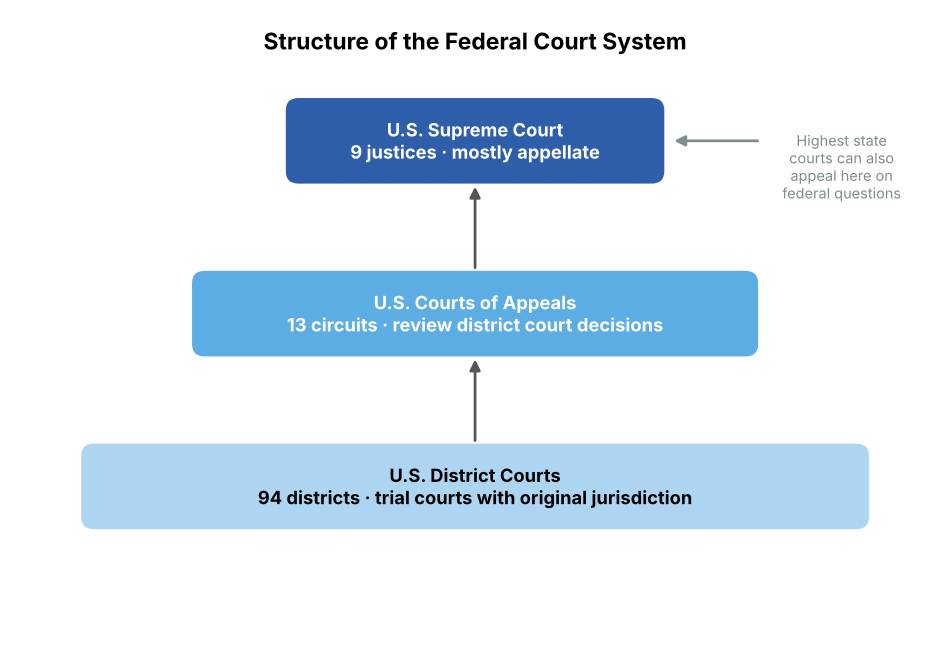


The Constitution creates only the Supreme Court. Congress built everything below it, starting with the Judiciary Act of 1789. Today the federal system has three levels.
| Level | What It Does | Key Facts |
|---|---|---|
| U.S. District Courts | Trial courts. They hear evidence, hold jury trials, and decide the facts of a case. | 94 districts. Nearly all federal cases start and end here. |
| U.S. Courts of Appeals | Review district court decisions for legal errors. No juries and no new evidence. | 13 circuits. Their rulings bind lower courts in their region. |
| U.S. Supreme Court | Final word on federal law and the Constitution. | Nine justices since 1869. Hears only a tiny share of the cases it’s asked to review. |
Federal courts also have two kinds of jurisdiction, meaning the authority to hear a case.
- Original jurisdiction means a court hears the case first. The Supreme Court has original jurisdiction in only a few situations listed in Article III, mostly disputes between states and cases involving ambassadors. A water-rights fight between two states, for example, goes straight to the Supreme Court.
- Appellate jurisdiction means a court reviews a decision made by a lower court. Almost all of the Supreme Court’s work is appellate. Cases come up from the federal courts of appeals or from state supreme courts when a federal question is involved.
Federal judges are nominated by the president, confirmed by the Senate, and serve for life unless they’re impeached and removed. That lifetime tenure is the most important feature of the branch, and Alexander Hamilton explained why.
Federalist No. 78: The Least Dangerous Branch
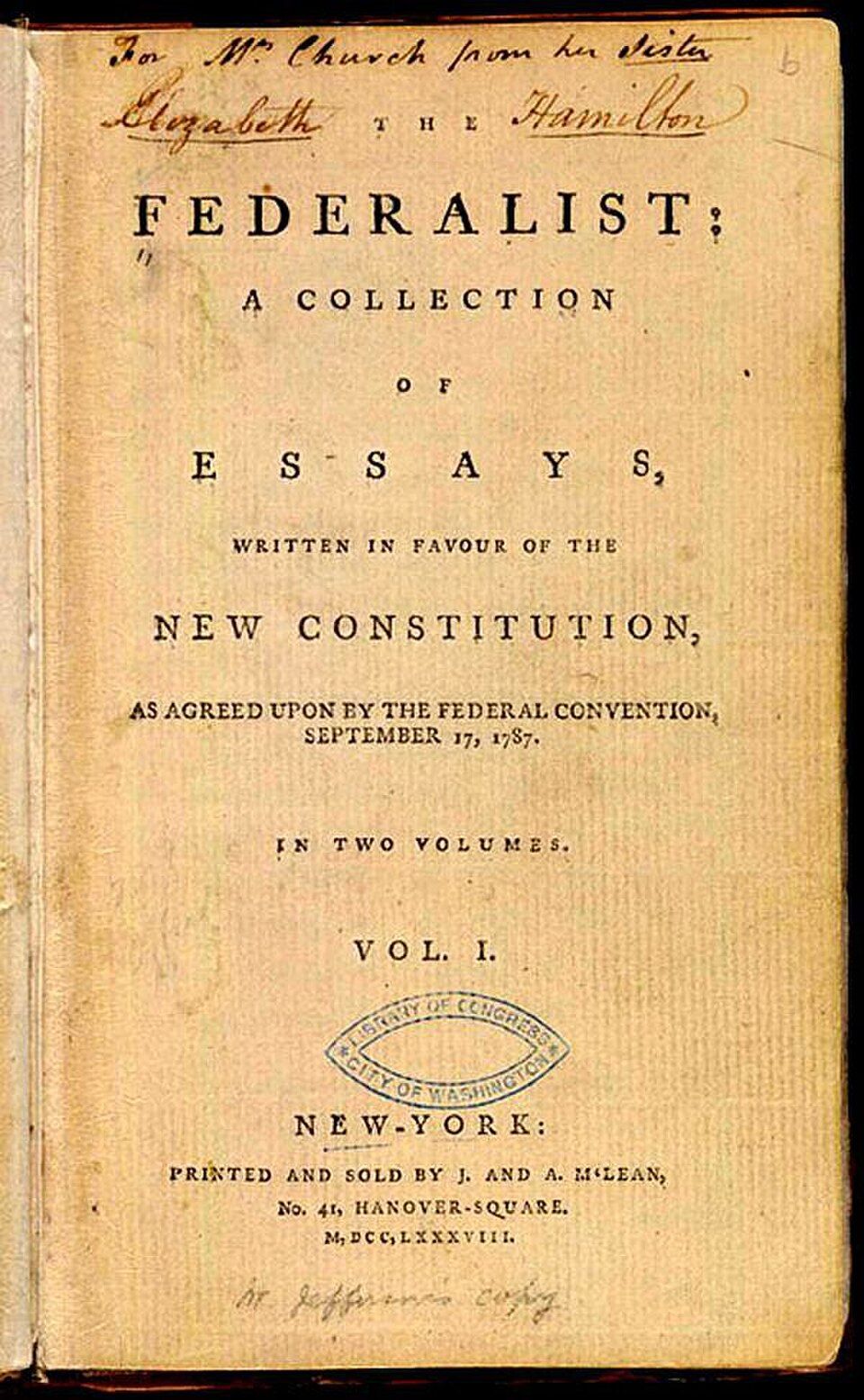
Federalist No. 78 is a required foundational document, and it’s Hamilton’s defense of an independent judiciary. Anti-Federalists worried that unelected judges with lifetime jobs would become too powerful. Hamilton argued the opposite. The courts, he wrote, would be the weakest branch because they control neither the military nor the budget:
The judiciary, on the contrary, has no influence over either the sword or the purse; no direction either of the strength or of the wealth of the society; and can take no active resolution whatever. It may truly be said to have neither FORCE nor WILL, but merely judgment.
Hamilton’s argument moves in three steps:
- The courts are the least dangerous branch. Congress controls money and the president controls the army. Judges can only issue rulings, and they depend on the other branches to enforce them.
- Judges need independence to protect the Constitution. Lifetime tenure frees them from pressure by voters, presidents, and Congress, so they can rule against popular majorities when the Constitution requires it.
- Courts should declare void any law that conflicts with the Constitution. The Constitution is the will of the people, and a law passed by Congress is only the will of their representatives. When the two conflict, the Constitution wins.
Why does this matter? Hamilton described judicial review 15 years before the Supreme Court used it. On the exam, Federalist No. 78 is the go-to evidence for arguments about judicial independence, lifetime appointments, and why the Court can stand up to majorities. If an argument essay asks whether the Court has too much power, Federalist No. 78 gives you the original case for its design.
Marbury v. Madison (1803): The Court Claims Judicial Review
Marbury v. Madison began as a political fight. In his final days in office, President John Adams appointed dozens of Federalist judges and justices of the peace, known as the “midnight judges.” Some commissions weren’t delivered before Thomas Jefferson took office. Jefferson’s Secretary of State, James Madison, refused to deliver them. William Marbury, one of the appointees, asked the Supreme Court to order Madison to hand over his commission.
Chief Justice John Marshall faced a trap. If he ordered Madison to deliver the commission, Jefferson would likely ignore the order and the Court would look powerless. If he refused, he’d appear to bow to Jefferson. His solution was clever:
- Marbury had a right to his commission. Madison was wrong to withhold it.
- But the Court couldn’t order its delivery. Marbury had filed his case directly with the Supreme Court under a section of the Judiciary Act of 1789 that expanded the Court’s original jurisdiction beyond what Article III allowed.
- That section of the law was unconstitutional. Congress can’t change the Court’s original jurisdiction by ordinary statute, so the Court struck the provision down.
Marbury lost his job, but the Court gained a far bigger power. Marshall wrote that “it is emphatically the province and duty of the judicial department to say what the law is.” By striking down part of an act of Congress, the Court established judicial review: the power to declare laws and government actions unconstitutional.
Why does this matter? Judicial review is the courts’ main check on Congress, the president, and the states. It’s why the Court can strike down a federal law, as in United States v. Lopez, or a state law, as in Brown v. Board of Education. Because the power came from a court decision and not from the text of the Constitution, debates about how boldly judges should use it have never gone away.
How a Case Reaches the Supreme Court
The Supreme Court controls almost all of its own docket. It receives several thousand requests each year and agrees to hear only around 60 cases. The path looks like this:
- A party asks for review. The losing side in a lower court files a petition for a writ of certiorari, a request for the Court to review the case.
- The justices decide whether to take it. Under the rule of four, the Court grants review if at least four of the nine justices agree. The Court usually takes cases where lower courts disagree with each other or where a major constitutional question is at stake.
- Both sides file briefs. Outside groups can file amicus curiae (“friend of the court”) briefs to support one side. Interest groups use these briefs to influence the outcome.
- Oral argument. Lawyers for each side get a limited time to argue and answer the justices’ questions.
- Conference and decision. The justices discuss the case privately and vote. One justice in the majority writes the opinion.
The Court’s decisions come with written opinions, and the exam expects you to know the types.
| Opinion | What It Is | Why It Matters |
|---|---|---|
| Majority opinion | The official ruling and reasoning of the Court. | Sets precedent that lower courts must follow. |
| Concurring opinion | Agrees with the outcome but gives different reasoning. | Can shape how future courts read the decision. |
| Dissenting opinion | Disagrees with the outcome. | Can lay the groundwork for a future reversal. Justice Harlan’s dissent in Plessy v. Ferguson (1896) was vindicated by Brown in 1954. |
Courts generally follow earlier decisions, a principle called stare decisis (“let the decision stand”). It makes the law stable and predictable. The Court can overturn its own precedents, but it does so rarely. How judges balance precedent against their own reading of the Constitution is a major theme of the next topic, the legitimacy of the judicial branch.
Test-Taking Strategies
Mnemonic Devices and Memory Shortcuts
- “No sword, no purse.” Hamilton’s two-word summary of why the judiciary is weakest. If you remember it, you can explain Federalist No. 78 in a sentence.
- “Marbury lost, the Court won.” Marbury never got his job, but the Court gained judicial review. That’s the twist the exam loves to test.
- “Four to hear, five to win.” Four justices must agree to take a case. Five votes form a majority to decide it.
- “O is for Opening.” Original jurisdiction means the court hears the case at the opening, first. Appellate means it hears the appeal.
Cross-Topic Connections
- Topic 1.6: Judicial review is one of the key checks in the separation of powers. See our review of the principles of American government.
- Topic 2.9: Lifetime tenure plus judicial review is exactly why the Court’s legitimacy is debated.
- Topic 2.11: Congress and the president have tools to limit the Court’s power. Review them in our article on checks on the judicial branch.
- Topic 5.6 and 5.7: Interest groups file amicus briefs and bring test cases to shape the Court’s agenda.
Common Question Formats
- Federalist No. 78 quote MCQ. A passage about the courts having “neither force nor will” is paired with a question about lifetime tenure or judicial independence.
- Jurisdiction MCQ. A scenario describes how a case reached the Court, and you identify whether it’s original or appellate jurisdiction.
- SCOTUS comparison FRQ. Marbury is often the required case paired with a newer case about judicial review. You explain the shared principle and how the rulings relate.
- Argument essay. Prompts about whether the Supreme Court has too much power, or whether judges should have lifetime appointments, call for Federalist No. 78 as evidence.
Frequent Student Mistakes
- Saying the Constitution grants judicial review. It doesn’t mention it. The power comes from Marbury, with Hamilton’s argument in Federalist No. 78 as background.
- Thinking Marbury won. The Court said Marbury deserved his commission but ruled it had no power to order its delivery. He never became a justice of the peace.
- Believing the Supreme Court must hear appeals. Review by certiorari is discretionary. When the Court denies a petition, the lower court’s ruling stands, and the denial sets no precedent.
- Confusing concurring and dissenting opinions. A concurring justice votes with the majority. A dissenting justice votes against it.
Test-Day Shortcuts
- Look for “void” or “unconstitutional.” Any stimulus about courts striking down a law is testing judicial review, which points you back to Marbury.
- Tie independence to tenure. If a question asks how the Framers insulated judges from politics, the answer is lifetime appointments during good behavior.
- Separate the Court’s choice from the ruling. Questions about the rule of four or certiorari are about which cases get heard, not how they’re decided.
Time Management Tips
- Multiple choice: Structure and jurisdiction questions are quick recall. Answer them in under 45 seconds and bank the time for quote-based Federalist No. 78 questions, which need a careful read.
- SCOTUS comparison FRQ: Budget about 20 minutes. When Marbury is the required case, state its holding in one sentence (the Court can strike down unconstitutional laws) and spend the rest explaining the connection to the other case.
- Argument essay: Spend five minutes outlining. Federalist No. 78 works as evidence on either side of a debate about judicial power, so decide your claim first and then decide how Hamilton’s argument supports it.
Check for Understanding
Think you’ve got it? Complete the quiz below to make sure. Download your results at the end.