
Maximize your score with these resources:
- Albert.io AP® Business with Personal Finance question banks
- Free AP® Business with Personal Finance score calculator
Open a streaming app and the home screen looks different for you than for your parents. Shop online for running shoes and you may see ads for socks and fitness trackers for days. Neither is an accident. Businesses collect huge amounts of customer data to decide who to sell to, what to make, and how to reach them. That data is powerful, and it carries real risks for both customers and the business. Topic 2.1 opens the marketing unit by explaining how businesses figure out who their customers are.
This article covers Topic 2.1: Marketing to Customers in Unit 2, Marketing. The topic asks you to explain why and how marketers collect customer data, use segmentation to build customer profiles, plan customer relationships, and weigh the privacy risks of data collection.
By the end, you should be able to:
- Define marketing and distinguish demographic from psychographic data.
- Use market segmentation to identify target customers and write a customer profile.
- Calculate customer acquisition cost and explain customer lifetime value.
- Explain how customer data can expose people and businesses to harm.
Marketing and Customer Data
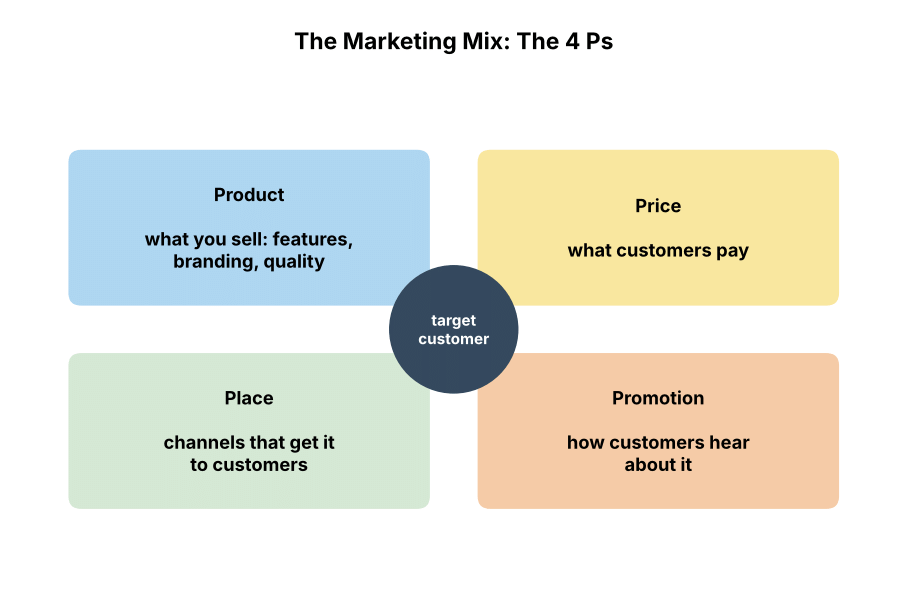
Marketing is everything a business does to identify customers’ problems, needs, and wants, and to promote, sell, and deliver products. Customer data helps marketers decide which customers to serve, which products to make, and how to market them profitably.
| Data type | Definition | Examples |
|---|---|---|
| Demographic | Measurable qualities that describe a population | Age, sex, race, ethnicity, income, location |
| Psychographic | Cognitive and behavioral factors | Interests, activities, values, lifestyles |
Businesses collect this data with digital tools (subscriber lists, online accounts, click-tracking software, tracking apps, and social media monitoring) and traditional tools (surveys and interviews). They also buy customer data from other businesses.
Segmentation, Target Customers, and Profiles
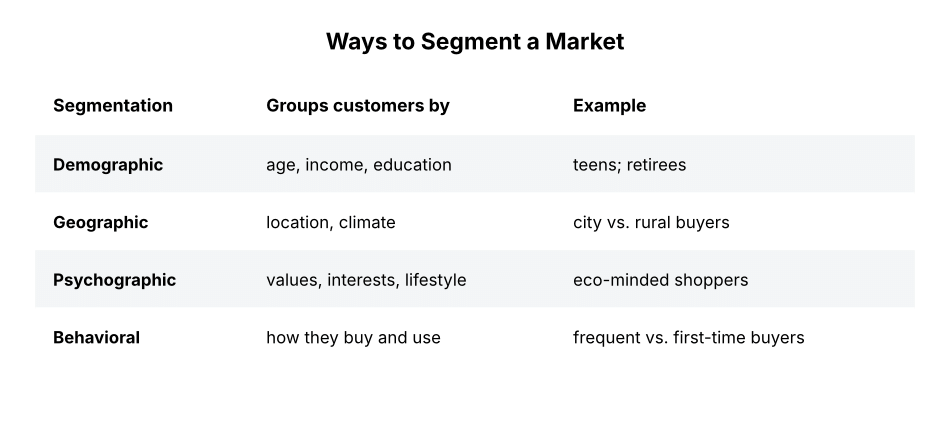
- Market segmentation groups potential customers into market segments based on shared demographic and psychographic traits.
- Target customers are the buyers most likely to purchase a specific product because of their needs, wants, and preferences.
- A customer profile is a fictional description of one sample customer, combining demographic and psychographic data with needs, wants, and preferences.
Targeting lets a business design products, branding, pricing, and advertising that appeal to a specific group. That is typically more effective and less costly than trying to appeal to everyone.
Sample customer profile for a meal-kit company: “Alex, 29, lives in a city apartment and earns $65,000 a year. Alex works long hours, values healthy eating, and enjoys trying new cuisines but has little time to shop. Alex wants dinners ready in 30 minutes without takeout prices.”
Building Customer Relationships
Tactics include personalized service, rewards programs for frequent buyers, and feedback opportunities such as satisfaction surveys. Social media and the internet make these easier. Strong relationships pay off in two measurable ways.
1. Lower customer acquisition cost (CAC). Satisfied customers refer new ones, so less spending is needed to win each customer.
\(\text{CAC}=\dfrac{\text{total marketing, advertising, and sales costs to acquire customers}}{\text{number of customers acquired}}\)
2. Higher customer lifetime value. The lifetime value of a customer is the estimated amount that customer will spend on the business’s products over time. Loyal customers make repeat purchases, which raises it.
Worked Example: A Climbing Gym
- Segment: A climbing gym finds two segments: college students who climb for fun and adults over 35 who want low-impact strength training.
- CAC: Last quarter, the gym spent $12,000 on ads and promotions and gained 300 new members. \(\text{CAC}=\dfrac{12{,}000}{300}=\$40\) per member.
- Lifetime value: The average member pays $60 a month and stays 15 months, so lifetime value is about \(60\times 15=\$900\).
- Relationship plan: A “bring a friend free” program rewards referrals, which should lower CAC, while monthly route-setting surveys keep members engaged and staying longer.
The Risks of Customer Data
- Privacy: Collecting searches, purchases, credit card numbers, social media posts, and location may violate privacy, especially when customers do not know data is being collected or how it will be used.
- Security: Poorly secured data can lead to data breaches, fraud, and identity theft for customers and businesses.
- Business risk: Businesses must balance data’s benefits against losing customers, violating core values, and damaging their reputation.
Why does this matter? This is one of the course’s personal finance links. Knowing how your data is collected helps you protect yourself from identity theft and fraud, a skill the exam treats as part of managing risk.
Test-Taking Strategies
Mnemonic Devices and Memory Shortcuts
“Demographics = Data you can count; Psychographics = Personality.” For CAC, remember “Cost over Count.”
Cross-Topic Connections
- Topic 1.1: What Is a Business? introduces the customer problems that marketing starts with.
- Topic 1.6: Business Ethics helps you weigh the ethics of collecting customer data.
- Topic 1.7: Organization, Roles, and Responsibilities describes the sales and marketing department.
- Topic 1.3: PESTEL Factors covers the social trends and consumer protection laws behind data use.
Common Question Formats
- A list of customer traits asking which are demographic and which are psychographic.
- Marketing costs and new customers, asking you to calculate CAC.
- A scenario asking how a rewards program affects lifetime value.
Frequent Student Mistakes
- Calling income a psychographic trait. It is demographic.
- Dividing by total customers instead of newly acquired customers for CAC.
- Writing a customer profile with only demographics. Profiles need psychographics, needs, and wants too.
Test-Day Shortcuts
If a trait can be measured with a number or checkbox, it is demographic. If it describes what someone cares about or does for fun, it is psychographic.
Time Management Tips
The AP Business with Personal Finance Exam on May 4, 2027, is fully digital in Bluebook, and calculators are permitted. Unit 2 makes up 20 to 30% of the multiple-choice section, so quick CAC and lifetime value calculations are worth practicing until they take under a minute.
Check for Understanding
Think you’ve got it? Complete the quiz below to make sure. Download your results at the end.