
Maximize your score with these resources:
- Albert.io AP® Business with Personal Finance question banks
- Free AP® Business with Personal Finance score calculator
A local bakery sells a croissant for $4. Raise it to $5 and regulars might shrug and pay, or they might walk across the street to the café selling croissants for $3.50. Cut it to $3 and the line might grow, or the bakery might simply earn less on every sale. Price is the one part of marketing that directly brings in revenue, and getting it wrong can sink a good product. Topic 2.5 covers the main pricing strategies, the market conditions that give a business pricing power, and the laws that limit it.
This article covers Topic 2.5: Price in Unit 2, Marketing. The topic asks you to develop and evaluate a pricing strategy, evaluate how market conditions affect pricing power, and describe legal constraints on pricing.
By the end, you should be able to:
- Explain why price must exceed per-unit cost for a product to be profitable.
- Compare value-based, competitive, cost-based, and penetration pricing.
- Explain pricing power and how customer responsiveness limits it.
- Describe three legal limits on pricing: collusion, price gouging, and illegal price discrimination.
Price and Per-Unit Cost
A pricing strategy is a way of deciding how much to charge. The right price is critical because it attracts and keeps customers and generates revenue and profit.
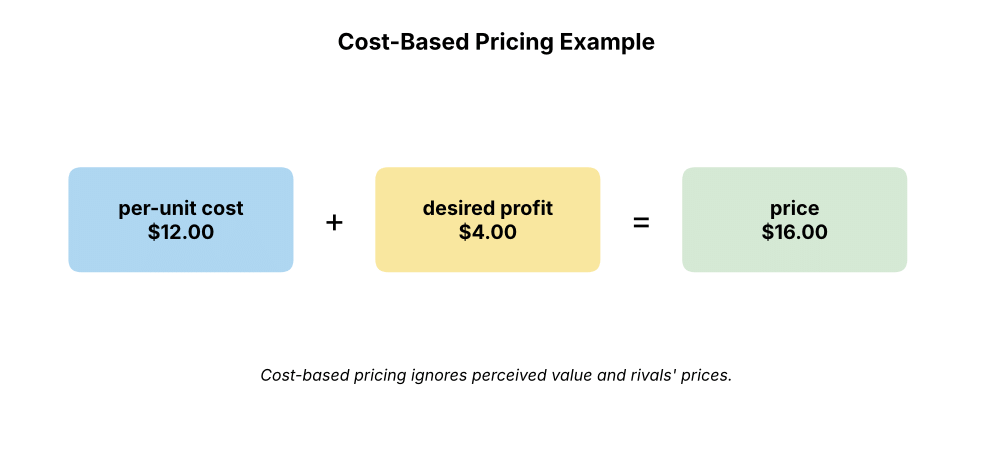
Every pricing decision starts with per-unit cost, the cost to produce and distribute one unit. Per-unit profit is:
\(\text{per-unit profit}=\text{price}-\text{per-unit cost}\)
A low price may win market share, but if price is equal to or below per-unit cost, the product is not profitable.
Four Pricing Strategies
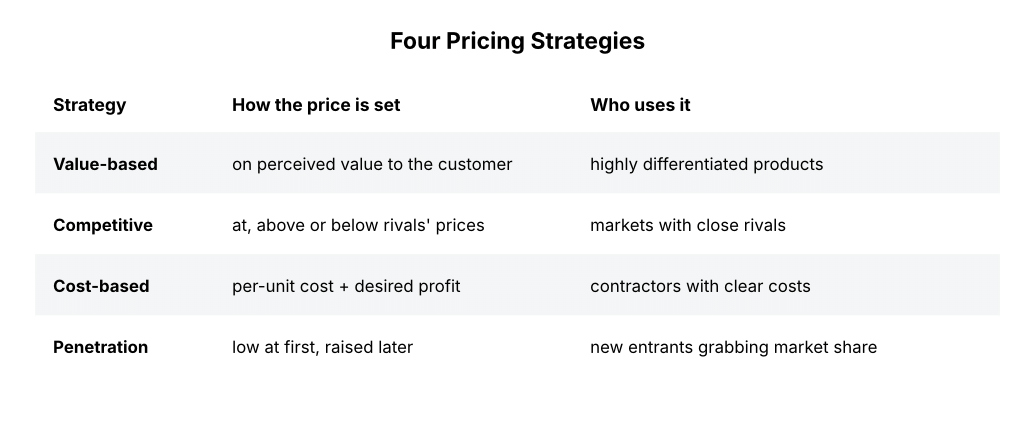
| Strategy | How the price is set | Who tends to use it |
|---|---|---|
| Value-based | On the product’s perceived value or worth to the customer | Businesses with highly differentiated or uniquely valuable products |
| Competitive (price matching) | On rivals’ prices: a premium if well differentiated, at or below rivals if not | Businesses in markets with close rivals |
| Cost-based | Per-unit cost plus a desired per-unit profit, ignoring perceived value and rival prices | Businesses with clearly defined costs they can explain, such as construction contractors |
| Penetration | Low at first, possibly below per-unit cost, then raised later | New entrants trying to pull price-sensitive customers from rivals and grow share fast |
Pricing Power
Pricing power is the ability to raise prices without risking market share.
| Less pricing power | More pricing power |
|---|---|
| Highly competitive market | Less competitive market |
| Little product differentiation | Highly differentiated product |
| Customers highly responsive to price (more elastic demand) | Customers less responsive to price (more inelastic demand) |
When customers are very responsive, a price increase may reduce revenue because they buy much less. A price cut may raise sales, but not enough to make up for the lower price. Businesses measure this responsiveness with price elasticity of demand.
Exam note: The CED excludes calculating price elasticity. You need to explain what elastic and inelastic demand mean for pricing, not compute them.
Legal Limits on Pricing
- Collusion: Agreeing with competitors to set a price, usually above the competitive level, is illegal in many countries, including the United States.
- Price gouging: Raising prices on products in high demand because of a crisis, such as bottled water after a hurricane, is illegal in many states and countries.
- Price discrimination on protected status: Charging different segments different prices for the same product is illegal when based on race, nationality, sex, or another protected status.
Worked Example: Pricing a New Phone Case
A startup’s phone case costs $6 per unit to make and ship. Rival cases sell for $15 to $20.
- Cost-based: Target $8 per-unit profit, so price is \(6+8=\$14\).
- Competitive: If the case is similar to rivals, price at about $15. If it has a unique drop-proof design, charge a premium, such as $22.
- Penetration: Launch at $10 to win share, then raise the price later. Per-unit profit starts at \(10-6=\$4\).
- Evaluation: With a strong unique feature, value-based or premium competitive pricing captures more value. Without one, penetration pricing risks a price war the startup cannot afford.
Why does this matter? Task 6 of the Business Canvas Project asks you to develop a pricing strategy. Strong answers connect the strategy to differentiation and pricing power, not just to cost.
Test-Taking Strategies
Mnemonic Devices and Memory Shortcuts
Remember the four strategies as “V-C-C-P”: Value, Competitors, Cost, Penetrate. Ask what each price is anchored to: the customer, the rivals, the cost, or a future price.
Cross-Topic Connections
- Topic 1.2: Markets and Competitive Advantage explains how competitiveness and differentiation shape pricing power.
- Topic 2.4: Product covers the value proposition behind value-based pricing.
- AP® Microeconomics Topic 2.3: Price Elasticity of Demand shows how to calculate the responsiveness this topic describes.
- AP® Microeconomics Topic 4.3: Price Discrimination explains when charging different prices can be legal and profitable.
Common Question Formats
- A scenario asking which pricing strategy a business is using.
- A market description asking whether a business has strong or weak pricing power.
- A pricing practice asking whether it is legal.
Frequent Student Mistakes
- Thinking a price below per-unit cost can be profitable. It cannot, though penetration pricing may accept it temporarily.
- Assuming a higher price always raises revenue.
- Calling all price discrimination illegal. It is illegal when based on a protected status.
Test-Day Shortcuts
If a scenario mentions “raise the price later,” it is penetration pricing. If it mentions “a markup on what it costs us,” it is cost-based.
Time Management Tips
The AP Business with Personal Finance Exam on May 4, 2027, is fully digital in Bluebook, and calculators are permitted. Per-unit profit questions are one subtraction away. Do them quickly and spend saved time on strategy-evaluation questions.
Check for Understanding
Think you’ve got it? Complete the quiz below to make sure. Download your results at the end.