
Maximize your score with these resources:
- Albert.io AP® Business with Personal Finance question banks
- Free AP® Business with Personal Finance score calculator
A car dealership, a pizza shop, and a new video game all want your attention, but they go about it very differently. The dealership has a salesperson walk you through features on a test drive. The pizza shop slides a coupon under your door. The game studio drops a trailer on social media and watches, in real time, how many people click “wishlist.” Each one is choosing tools from the same toolkit. Topic 2.7 explains that toolkit, the promotional mix, and how digital marketing has changed the way businesses talk to customers.
This article covers Topic 2.7: Promotion and Marketing Communications in Unit 2, Marketing. The topic asks you to develop or evaluate a marketing campaign and explain how digital marketing tools have changed business interactions with customers.
By the end, you should be able to:
- Define a marketing campaign and name the five tools in the promotional mix.
- Match each promotional tool to the goal it serves best.
- Explain how the type of buying decision affects which tools a business uses.
- Explain how digital marketing changed reach, cost, personalization, and data collection.
The Promotional Mix
A marketing campaign is a coordinated effort to promote a product using some or all of the promotional mix. These five tools communicate messages that differentiate products, build brand loyalty, and increase sales and revenue.
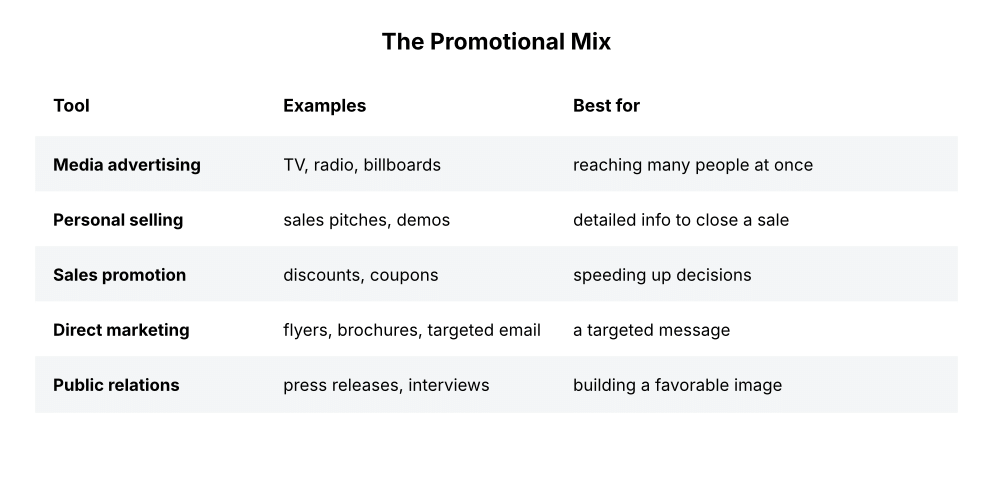
| Tool | Examples | Best used when a business wants to… |
|---|---|---|
| Media advertising | TV, radio, newspapers, billboards | Reach a large number of customers with the same message at the same time |
| Personal selling | Sales pitches, product demonstrations | Give detailed information or a demonstration to complete a sale |
| Sales promotion | Discounts, coupons | Speed up customer decisions or clear unsold inventory |
| Direct marketing | Flyers, brochures | Reach many potential customers with a targeted message |
| Public relations | Press releases, media interviews | Build a favorable public image rather than push a specific sale |
A sales pitch is a short presentation that conveys the product’s value proposition. It is a key part of personal selling and also part of free-response Question 1, where you pitch your Business Canvas Project product.
Matching Tools to Buying Decisions
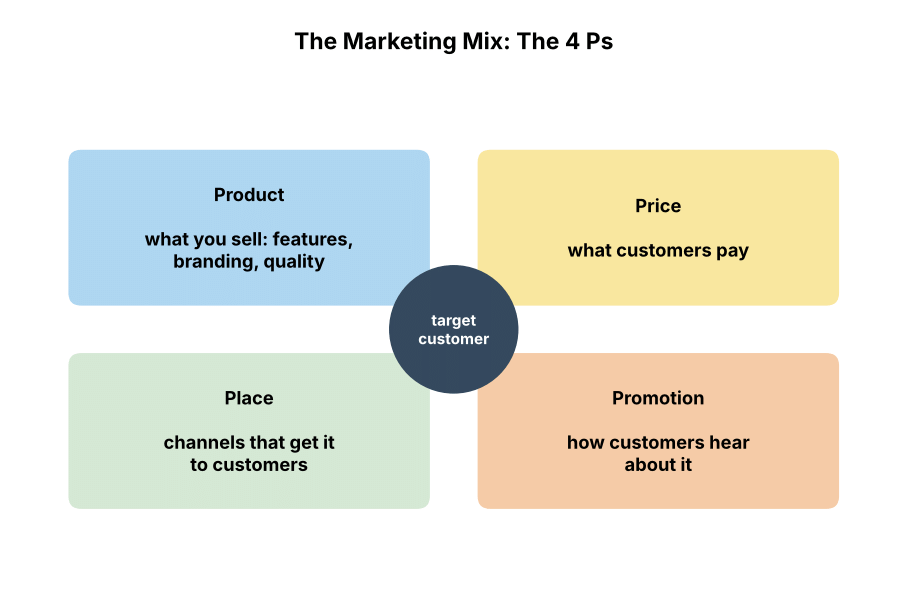
Recall from Topic 2.2 that some purchases are consequential and others are routine. That difference shapes the campaign.
- Consequential purchases (a car, a home, business software) often need detailed, personalized interaction, so personal selling plays a big role.
- Routine purchases (snacks, toothpaste) are usually well served by mass media or direct-marketing messages.
How Digital Marketing Changed the Game
Digital marketing uses the internet and digital tools, such as websites, email, social media, and mobile apps, to connect with and serve customers. In the early 21st century, businesses shifted resources away from newspaper, magazine, radio, and TV ads toward digital platforms.
| Feature | Traditional tools | Digital tools |
|---|---|---|
| Reach | Broad audiences, limited targeting | Global audiences or narrow customer segments |
| Personalization | Same message for everyone | Messages tailored to individuals |
| Cost | Often expensive per customer reached | Generally lower cost |
| Data | Personal selling gathered data on a small scale; TV ads and billboards gathered almost none | Large volumes of big data on how customers respond and what makes them buy |
Worked Example: Evaluating a Campaign
A new indoor trampoline park targets families with children ages 6 to 14. Its campaign plan:
- Social media ads targeted to parents within 15 miles (digital, targeted).
- Grand-opening coupon: half-price jump passes for the first month (sales promotion to speed decisions).
- Flyers sent home through local elementary schools (direct marketing).
- Press release about free sessions for a children’s hospital (public relations).
Evaluation: The mix fits routine family entertainment purchases, and digital ads let the park measure which messages drive bookings. A billboard would add awareness but would be costly and impossible to track, so it may not be worth it early on.
Why does this matter? Task 8 of the Business Canvas Project asks you to develop a marketing campaign that includes digital tools. Justify each tool by the goal it serves.
Test-Taking Strategies
Mnemonic Devices and Memory Shortcuts
Remember the promotional mix as “A PSDP” or “All People Seem Drawn to Promos”: Advertising, Personal selling, Sales promotion, Direct marketing, Public relations.
Cross-Topic Connections
- Topic 2.2: Consumer Behavior explains the rational and routine decisions that shape tool choice.
- Topic 2.1: Marketing to Customers covers the customer data digital tools collect.
- Topic 2.4: Product covers the value proposition a sales pitch delivers.
- Topic 2.6: Place and Channels explains where customers go to buy once a campaign reaches them.
Common Question Formats
- A promotional activity asking which tool in the mix it represents.
- A business goal asking which tool fits it best.
- A question asking how digital marketing changed a business’s interaction with customers.
Frequent Student Mistakes
- Calling a press release advertising. It is public relations.
- Confusing direct marketing (flyers, brochures) with direct channels (selling without intermediaries).
- Recommending a TV ad for a tightly targeted, low-budget product.
Test-Day Shortcuts
Spot the goal word: “image” means PR, “urgency” or “inventory” means sales promotion, “demonstration” means personal selling, and “same message to many” means media advertising.
Time Management Tips
The AP Business with Personal Finance Exam on May 4, 2027, is fully digital in Bluebook. Free-response Question 1 asks you to pitch your Business Canvas Project product within 25 minutes. Practice a pitch that names the product, target customer, problem, and value in under a minute of writing.
Check for Understanding
Think you’ve got it? Complete the quiz below to make sure. Download your results at the end.