
Maximize your score with these resources:
- Albert.io AP® Business with Personal Finance question banks
- Free AP® Business with Personal Finance score calculator
A family-owned ice cream shop has $40,000 to spend. Should it buy a second freezer truck to sell at summer events, or renovate the shop to add seating and stay open through winter? Both options sound reasonable, and the owners are split. Gut feeling will not settle it. What helps is a clear process: define the problem, list the options, decide what matters, compare the options on those criteria, and then choose. Topic 4.3 teaches that process, which is also the backbone of the exam’s biggest free-response question.
This article covers Topic 4.3: Strategy and Decision Making in Unit 4, Management and Strategy. The topic asks you to explain how and why businesses develop and use strategy, and to apply a deliberative process, the PACED model, to make a business decision.
By the end, you should be able to:
- Define strategy and tactics and explain how they relate.
- Explain how businesses use data to define, evaluate, and modify strategy.
- Apply each step of the PACED model.
- Build decision criteria, including return on investment, and recommend a course of action.
Strategy and Tactics
A strategy is a plan or approach to achieving a goal. Business strategy describes how a business will achieve goals such as competitive advantage, its mission, higher revenue, lower costs, or higher profit. Businesses choose different strategies based on their capabilities, competitive landscape, and industry.
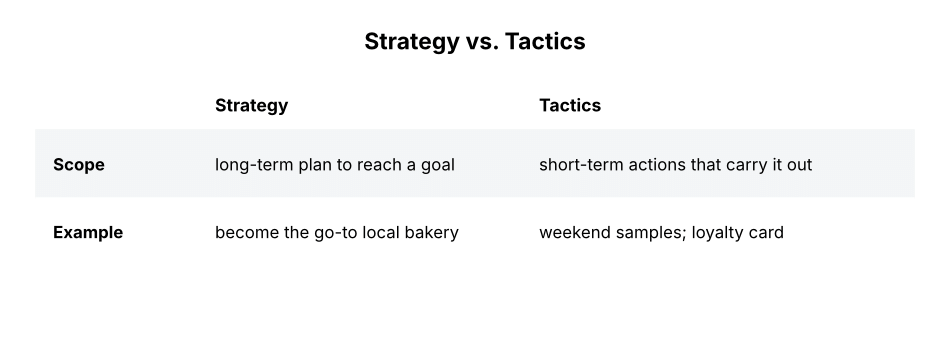
- A clear strategy helps mobilize and align resources toward a goal, which raises the odds of success.
- Tactics are the specific actions that advance a strategy. If the strategy is “become the neighborhood’s favorite study spot,” tactics might include free Wi-Fi, outlets at every table, and a student discount.
- Businesses gather and track data on financial performance, customers, competitors, and market trends to define a strategy, evaluate whether it works, and change it if needed.
The PACED Model
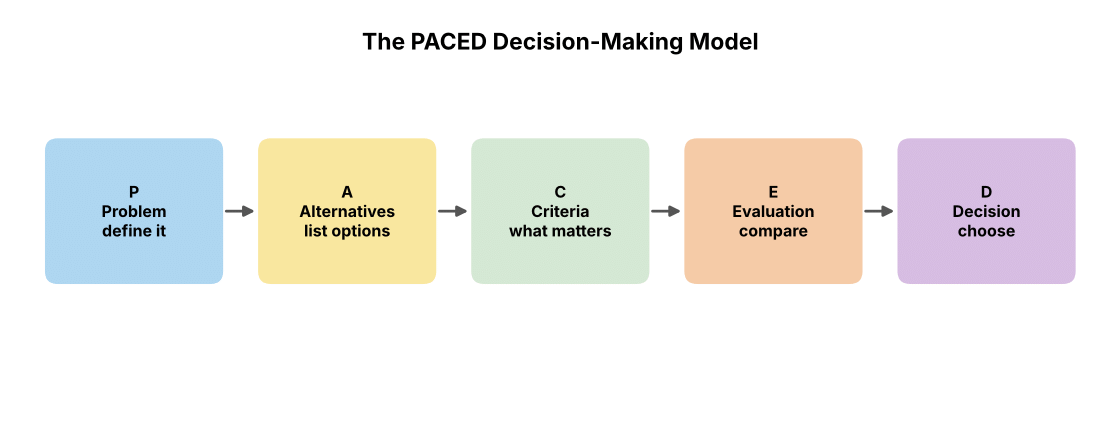
| Step | What you do |
|---|---|
| Problem | Define the problem to address or the decision to be made |
| Alternatives | Develop the options |
| Criteria | Establish what matters for judging the options |
| Evaluation | Compare each alternative against each criterion |
| Decision | Choose the best approach |
Building Strong Criteria
Criteria should cover both kinds of costs and benefits:
- Quantifiable: effects on production costs, total sales, and profit.
- Intangible: effects on reputation, mission, and core values.
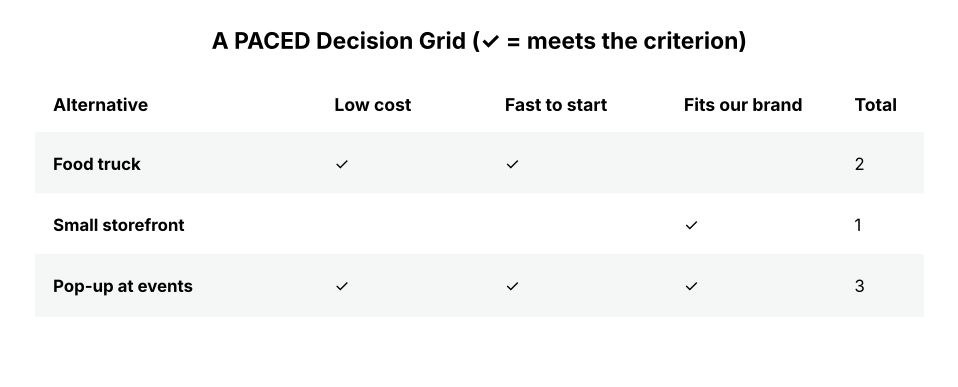
The CED names four common categories:
| Category | Example question |
|---|---|
| Financial | Which option has the greatest return on investment (ROI)? |
| Market | How does each option affect competitiveness? |
| Operational | How does each option affect supply chain risk? |
| Organizational | How does each option affect employees? |
\(\text{ROI}=\dfrac{\text{additional profit from the investment}}{\text{cost of the investment}}\)
Managers also use strategic frameworks (covered in Topic 4.4) to evaluate internal and external factors against long-term goals. And sometimes they must prioritize conflicting criteria with limited or imperfect data, so even good decisions can turn out imperfect.
Worked Example: The Ice Cream Shop
- Problem: Sales drop sharply from October to March. How should the shop use $40,000 to grow annual profit?
- Alternatives: (A) a freezer truck for summer events; (B) a renovation adding seating and hot drinks for winter.
- Criteria: ROI, fit with the mission of being “the neighborhood’s gathering place,” and effect on employees.
- Evaluation:
- Truck: expected extra profit $10,000 a year, so ROI \(=\dfrac{10{,}000}{40{,}000}=25\%\). Busier summers, but it pulls staff away from the shop.
- Renovation: expected extra profit $8,000 a year, so ROI \(=\dfrac{8{,}000}{40{,}000}=20\%\). Gives employees steady winter hours and fits the mission strongly.
- Decision: The truck wins on ROI, but the renovation wins on mission and employees. A reasonable recommendation is the renovation, because a 5-point ROI gap is small compared with keeping trained staff year-round and building the gathering-place identity. Another student could recommend the truck and earn full credit if the reasoning uses the criteria clearly.
Why does this matter? Free-response Question 4, worth 15% of the exam, gives you two courses of action with financial and nonfinancial details and asks you to set criteria, compare, and recommend. PACED is the structure for that answer.
Test-Taking Strategies
Mnemonic Devices and Memory Shortcuts
The model’s name is the mnemonic: PACED, Problem, Alternatives, Criteria, Evaluation, Decision. For criteria categories, think “FMOO”: Financial, Market, Operational, Organizational.
Cross-Topic Connections
- Topic 4.2: Evaluating Performance Using KPIs supplies the data used to evaluate strategy.
- Topic 1.6: Business Ethics shows how stakeholder and values-based criteria guide decisions.
- Topic 1.2: Markets and Competitive Advantage covers the competitive strategies businesses pursue.
- AP® Microeconomics Topic 1.5: Cost-Benefit Analysis models weighing costs against benefits.
Common Question Formats
- A scenario asking which PACED step a manager is on.
- Investment cost and added profit asking for ROI.
- Two options asking which criterion each one performs better on.
Frequent Student Mistakes
- Recommending an option without stating criteria first.
- Using only financial criteria and ignoring mission, reputation, or employees.
- Confusing strategy (the plan) with tactics (the actions).
Test-Day Shortcuts
For Question 4, write two or three criteria as a short list, compare both options on each, and end with “I recommend ___ because ___.” Clear structure is easy for scorers to follow.
Time Management Tips
The AP Business with Personal Finance Exam on May 4, 2027, is fully digital in Bluebook. The College Board recommends about 40 minutes for Question 4, including a 15-minute reading period. Use the reading time to calculate any ROI figures and draft your criteria.
Check for Understanding
Think you’ve got it? Complete the quiz below to make sure. Download your results at the end.