
Maximize your score with these resources:
- Albert.io AP® Business with Personal Finance question banks
- Free AP® Business with Personal Finance score calculator
Your first paycheck is often a surprise. You worked 40 hours at $16 an hour, so you expected $640, but the check says something closer to $520. Where did the rest go? Federal income tax, Social Security, Medicare, maybe state tax, and possibly money you chose to set aside for retirement or health insurance. Understanding where your money goes before it reaches you is the first step toward building a realistic budget. Topic 5.1 explains the taxes individuals pay, why people pay different amounts, and how to read a pay stub.
This article covers Topic 5.1: Taxes, Net Income, and Budgeting in Unit 5, Personal Goals, Budgeting, and Investing. The topic asks you to identify the types of taxes individuals pay, explain why households pay different amounts of federal income tax, and determine and describe the parts of a pay stub.
By the end, you should be able to:
- Identify income, capital gains, payroll, property, and sales taxes.
- Explain progressive income tax and the difference between deductions and credits.
- Read a pay stub, separating gross pay, mandatory and voluntary deductions, and net pay.
- Explain why pretax deductions encourage saving.
Types of Taxes Individuals Pay
Individuals pay taxes to federal, state, and local governments. The types and amounts vary by state.
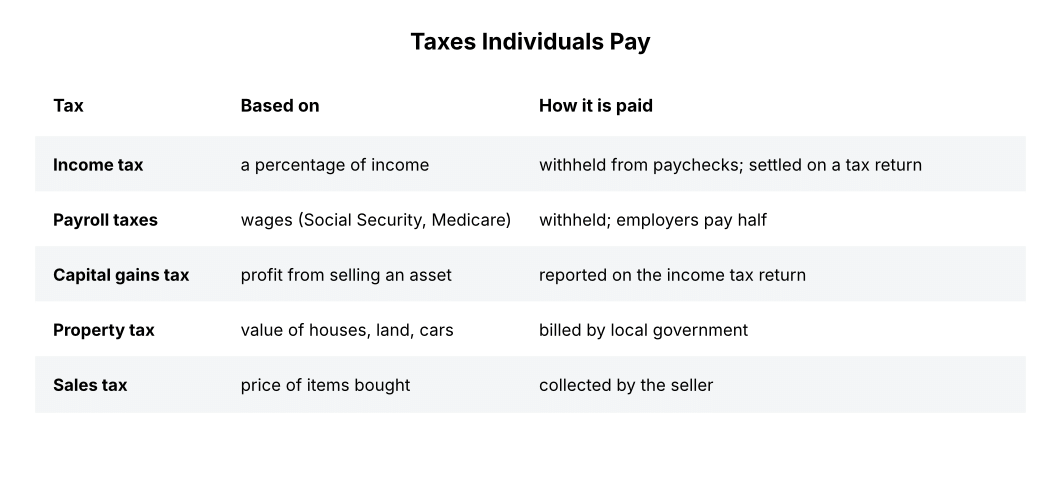
| Tax | Based on | How it is paid |
|---|---|---|
| Income tax | A percentage of income | Employers withhold part of each paycheck; an annual tax return settles the rest or produces a refund. Self-employed people submit their own. |
| Capital gains tax | Profit from selling an asset for more than you paid | Reported on the income tax return, usually at a lower rate than income tax |
| Payroll taxes | Wages, to fund government insurance programs such as Social Security and Medicare | Withheld from paychecks; employers pay half, while self-employed and contract workers pay the full amount |
| Property tax | The value of houses, land, and cars | Billed annually, semiannually, or monthly |
| Sales tax | The sales price of an item | Collected by the seller, which sends it to the government |
Why People Pay Different Amounts of Federal Income Tax
Three things change a household’s federal income tax bill:
- Income level. The U.S. federal income tax, and some state income taxes, is progressive: higher incomes pay higher tax rates.
- Tax deductions reduce taxable income. Examples include home mortgage interest, retirement contributions, charitable donations, state and local taxes paid, and some medical expenses.
- Tax credits directly reduce taxes owed. Examples include the child tax credit, child or dependent care credit, education credits, and credits for specific purchases.
Deduction vs. credit: If a family pays a 12% rate on its last dollars of income, a $1,000 deduction lowers taxable income by $1,000 and saves \(1{,}000\times 0.12=\$120\) in tax. A $1,000 credit saves the full $1,000. Dollar for dollar, a credit is worth more.
Reading a Pay Stub
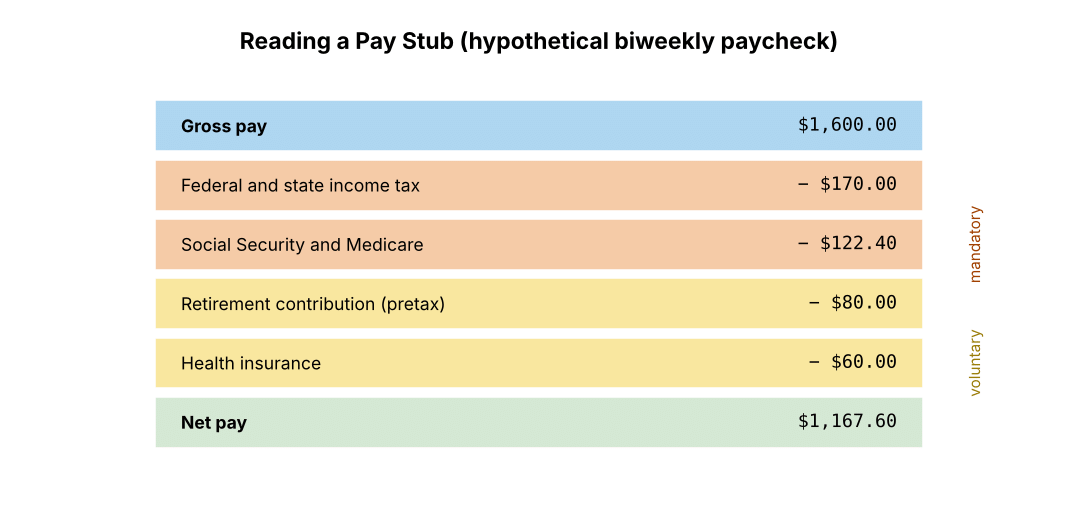
| Pay stub part | What it means |
|---|---|
| Gross income (pay) | Total earned in the pay period, from salary, hours worked, a contracted amount, or another pay scheme |
| Mandatory deductions | Required by law and withheld by the employer: income taxes and payroll taxes |
| Voluntary deductions | Money set aside for employer-sponsored benefits: health insurance, health or dependent care savings plans, life insurance, retirement savings, union dues |
| Net income (pay) | What you actually receive after all deductions; it can differ a lot from gross pay |
Some deductions are pretax, meaning that money is not counted as taxable income. Pretax deductions reduce your tax bill, which gives people an incentive to save, for example in an employer retirement plan.
Worked Example: Jordan’s Paycheck
Jordan earns $1,600 gross every two weeks. Here is a sample pay stub:
- Mandatory deductions: federal income tax $120, Social Security $99.20, Medicare $23.20, state income tax $48.
- Voluntary deductions: retirement plan $80 (pretax) and health insurance $60.
- Total deductions: \(120+99.20+23.20+48+80+60=\$430.40\).
- Net pay: \(1{,}600-430.40=\$1{,}169.60\), about 73% of gross pay.
Why does this matter? A budget must be built on net pay, not gross pay. Jordan’s budget starts with about $1,170 every two weeks, not $1,600. Planning around the bigger number is one of the most common budgeting mistakes.
Test-Taking Strategies
Mnemonic Devices and Memory Shortcuts
“Deductions shrink the income; credits shrink the bill.” For the five taxes, remember “I Can Pay Property Sales”: Income, Capital gains, Payroll, Property, Sales.
Cross-Topic Connections
- Topic 4.1: Management and Leadership covers the pay schemes and benefits that appear on a pay stub.
- Topic 3.6: The Income Statement introduces consumer budgets built on net pay.
- Topic 3.1: Saving for Future Purchases explains tax-advantaged retirement and health savings plans.
- Topic 3.5: Financial Capital explains the capital gains that capital gains taxes apply to.
Common Question Formats
- A pay stub asking you to calculate net pay or identify a deduction type.
- A scenario asking whether a tax benefit is a deduction or a credit.
- A question asking who pays the employer’s share of payroll taxes for a self-employed worker.
Frequent Student Mistakes
- Budgeting with gross pay instead of net pay.
- Treating deductions and credits as equal in value.
- Calling health insurance premiums a mandatory deduction. They are voluntary.
Test-Day Shortcuts
If a deduction is required by law, it is mandatory. If the worker chose it to pay for a benefit, it is voluntary.
Time Management Tips
Unit 5 is not assessed on the AP Business with Personal Finance Exam, which is on May 4, 2027, and fully digital in Bluebook. The skills here still matter: free-response Question 2 asks you to interpret a household’s financial data, and reading net income correctly is the starting point.
Check for Understanding
Think you’ve got it? Complete the quiz below to make sure. Download your results at the end.