
Maximize your score with these resources:
A parent gets a phone call. It is their teenager’s voice, panicked, saying they are in trouble and need money sent right away. The voice is perfect, but it is fake, built by an AI tool from a few seconds of video posted online. Artificial intelligence has made old attacks faster, cheaper, and far more convincing. Phishing emails no longer have to contain awkward grammar, and a voice on the phone is no longer proof of who is speaking. Topic 1.4 explains how adversaries use AI and how to defend against it.
This article covers Topic 1.4: AI-Based Cybersecurity Attacks in Unit 1, Introduction to Security. The topic asks you to explain how adversaries use AI-powered tools to strengthen cyberattacks and how to protect against some of these AI-augmented attacks.
By the end, you should be able to:
- Explain how AI enables voice and video impersonation.
- Explain why AI-written phishing is harder to spot.
- Describe attacks that target or misuse large language models (LLMs).
- Recommend four defenses against AI-augmented attacks.
Six Ways Adversaries Use AI
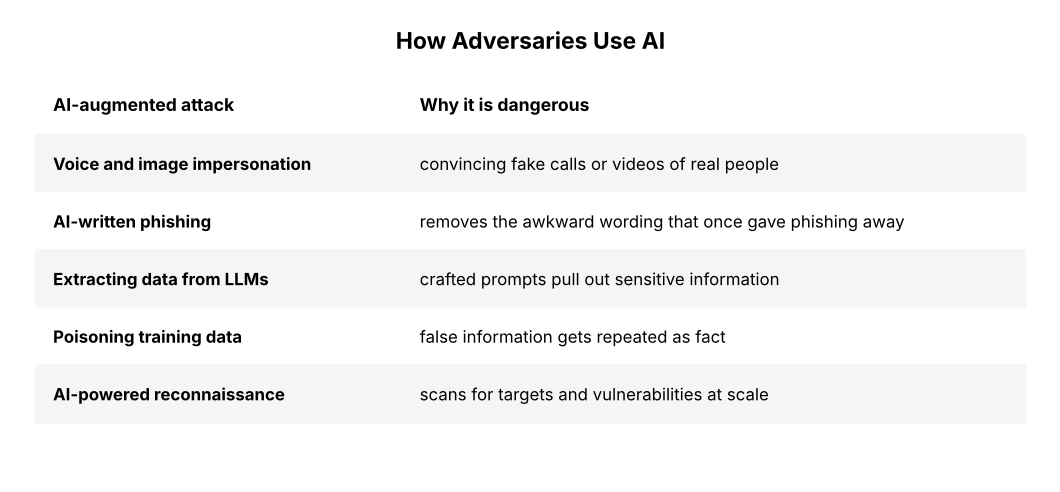
| AI-augmented attack | What it does | Why it is dangerous |
|---|---|---|
| Voice and image impersonation | Uses existing voice and image samples to build a digital avatar of a person | Enables convincing phone or video impersonation, leading to financial loss or leaked information; grows more serious as organizations adopt voice-based authentication |
| AI-written phishing | LLMs write convincing phishing messages in any language | Removes the unnatural language that once helped people spot phishing written by non-native speakers |
| Extracting data from LLMs | Crafted prompts pull secure or sensitive information out of an LLM | That information can come from other users’ input or from the model’s training data |
| Poisoning training data | Publishing or altering websites with false information so it ends up in LLM training sets | The LLM may repeat the false information as if it were true |
| AI-powered reconnaissance | Tools scan the internet to gather a target’s social media and public information | Builds detailed profiles for social engineering and password guessing much faster |
| AI-enhanced coding | Helps write new malware, modify code to act maliciously, or find vulnerabilities in large code bases | Lowers the skill needed to create or adapt malicious tools |
Notice the pattern: AI rarely creates a brand-new type of attack. It augments familiar ones, such as social engineering from Topic 1.1 and password guessing from Topic 1.2, making them faster and more convincing.
Four Defenses
| Defense | Which attack it counters |
|---|---|
| Shared secrets: a word or phrase known only to two people, used to verify identity in high-stakes situations | Voice and video impersonation |
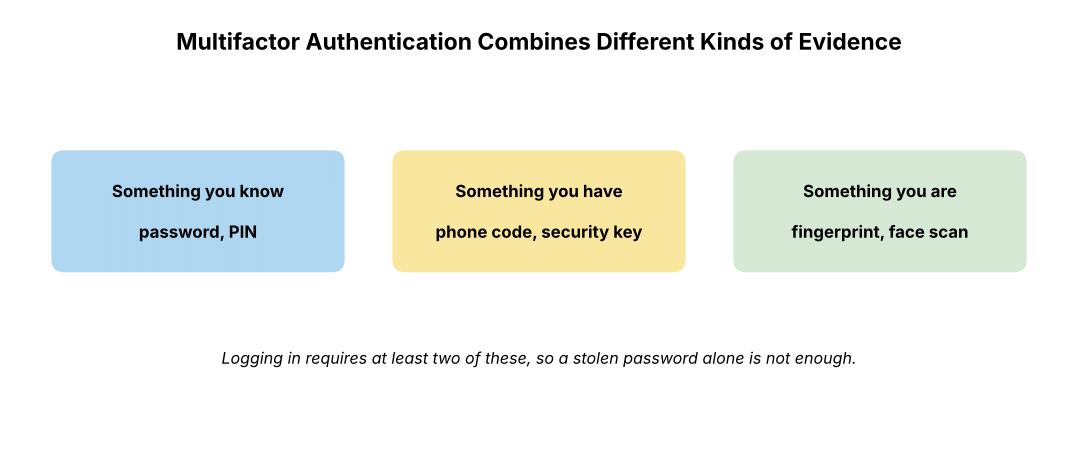
| Multifactor authentication (MFA): a second factor beyond a voice or password | Cloned voices used against voice authentication |
| Keep personal or sensitive data out of AI tools such as chatbots and virtual assistants, since some feed input back into training | Data extraction from LLMs |
| Verify AI output with reputable, stable, non-AI sources | Poisoned training data and false information |
Worked Example: Stopping a Voice-Clone Scam
The Garcia family agreed months ago on a shared secret phrase: “purple pancakes.” One evening, Mr. Garcia receives a call from what sounds exactly like his daughter, crying and asking him to wire $1,500 for an emergency.
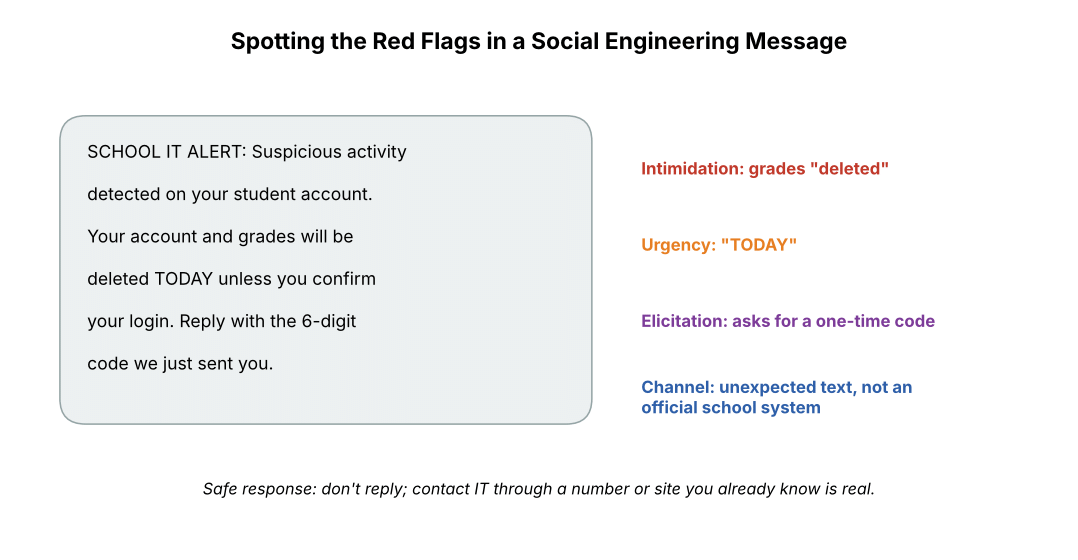
- Recognize the tactics: urgency and fear (Topic 1.1), delivered with an AI-cloned voice.
- Apply the defense: He asks, “What’s our phrase?” The caller hesitates and hangs up.
- Verify independently: He calls his daughter’s real number. She is safe at a friend’s house.
- Takeaway: A shared secret works because an AI can copy a voice but cannot know a secret that was never posted online.
Why does this matter? As AI makes fakes more realistic, defenses that rely on noticing something odd become weaker. Defenses that rely on verification, such as shared secrets, MFA, and independent sources, still work.
Test-Taking Strategies
Mnemonic Devices and Memory Shortcuts
The four defenses: “Secret, Second factor, Silence, Source-check.” Use a shared secret, add MFA, keep sensitive data silent in AI tools, and check AI output against reliable sources.
Cross-Topic Connections
- Topic 1.1: Understanding Social Engineering covers the tactics AI makes more convincing.
- Topic 1.2: Suspicious Website Logins explains MFA and password dictionaries built from personal data.
- Topic 1.3: Best Practices for Public Networks covers adversaries’ skill levels, which AI tools can raise.
- AP® Computer Science Principles Topic 5.3: Computing Bias explains how training data shapes what models produce.
Common Question Formats
- A scenario asking which AI-augmented attack is described.
- An attack asking which defense would best prevent it.
- A question asking why traditional phishing clues are less reliable now.
Frequent Student Mistakes
- Assuming good grammar means a message is legitimate.
- Treating a familiar voice as proof of identity.
- Pasting sensitive information into a chatbot to “check” it.
Test-Day Shortcuts
Match the target: a person’s identity points to shared secrets or MFA; an AI model’s data points to keeping sensitive input out; an AI’s answers point to verifying with non-AI sources.
Time Management Tips
The AP Cybersecurity Exam on May 5, 2027, is fully digital in Bluebook. With 80 minutes for 60 multiple-choice questions, flag any long scenario you are unsure of and return to it, rather than spending three minutes on a single item.
Check for Understanding
Think you’ve got it? Complete the quiz below to make sure. Download your results at the end.