
A machine part must be 50 millimeters long, give or take 0.2 millimeters. A thermostat keeps a room within 3 degrees of 70. Both situations describe distance from a target, and distance is exactly what absolute value measures. This topic shows you how to turn “within” and “at least this far away” into equations and inequalities you can solve.
This article covers Topic 3.3: Absolute Value Equations and Inequalities in Unit 3, Linear Inequalities. The topic asks you to solve absolute value equations and inequalities by rewriting them as two linear statements and to interpret the results on a number line.
By the end, you should be able to:
- Explain absolute value as distance from zero.
- Solve absolute value equations and identify when they have no solution.
- Rewrite absolute value inequalities as “and” or “or” compound inequalities.
- Model tolerance problems with absolute value.
Absolute Value as Distance
The absolute value of a number is its distance from zero on the number line. Distance is never negative, so \(|5|=5\) and \(|-5|=5\). Both numbers sit 5 units from zero, just on opposite sides.
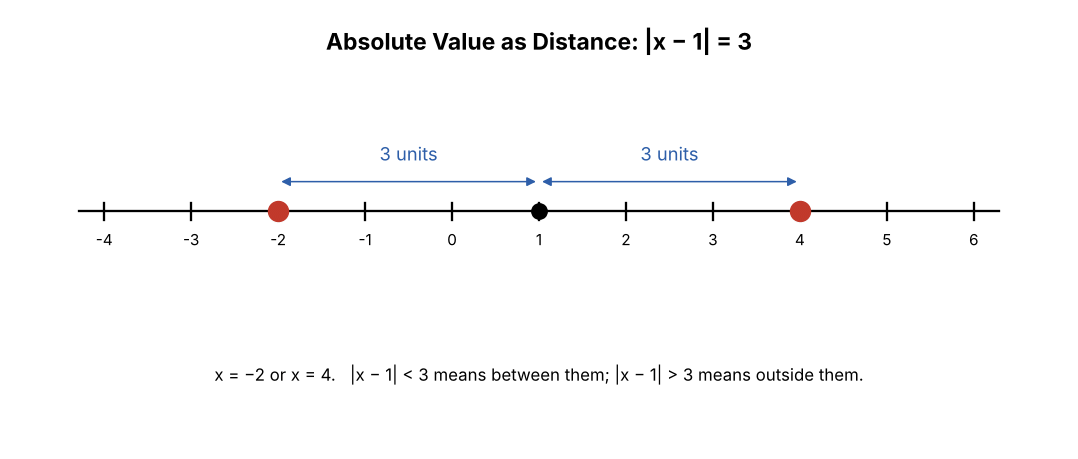
That idea gives you the meaning of \(|x-a|\): it is the distance between \(x\) and \(a\). So \(|x-70|\le 3\) says “the temperature \(x\) is within 3 degrees of 70.” Reading absolute value as distance turns every problem in this topic into a picture.
Here is how the three statement types look through that lens:
- \(|x-70|=3\) means \(x\) is exactly 3 away from 70, so \(x\) is 67 or 73. Equations give two points.
- \(|x-70|\le 3\) means \(x\) is no more than 3 away, so every value from 67 to 73 works. Less-than statements give a segment.
- \(|x-70|\gt 3\) means \(x\) is more than 3 away, so \(x\) is below 67 or above 73. Greater-than statements give two rays.
Solving Absolute Value Equations
Follow three steps for every absolute value equation.
- Isolate the absolute value. Get \(|\text{expression}|\) alone on one side.
- Check the other side. If it is negative, stop: there is no solution, because a distance cannot be negative.
- Split into two equations. Set the expression equal to the positive value and to the negative value, then solve both.
Worked example 1: Solve \(|2x-3|=7\).
- Split: \(2x-3=7\) or \(2x-3=-7\).
- Solve the first: \(2x=10\), so \(x=5\).
- Solve the second: \(2x=-4\), so \(x=-2\).
- Check: \(|2(5)-3|=7\) and \(|2(-2)-3|=|-7|=7\). Both work.
Worked example 2: Solve \(3|x+1|+4=1\).
- Subtract 4: \(3|x+1|=-3\).
- Divide by 3: \(|x+1|=-1\).
- An absolute value cannot equal a negative number, so there is no solution.
Why does this matter? Example 2 shows why isolating first is essential. If you split \(3|x+1|+4=1\) before isolating, you get two answers that both fail when checked. The “check the other side” step catches impossible equations in seconds.
Solving Absolute Value Inequalities
After isolating the absolute value, the inequality symbol tells you which compound form to use.
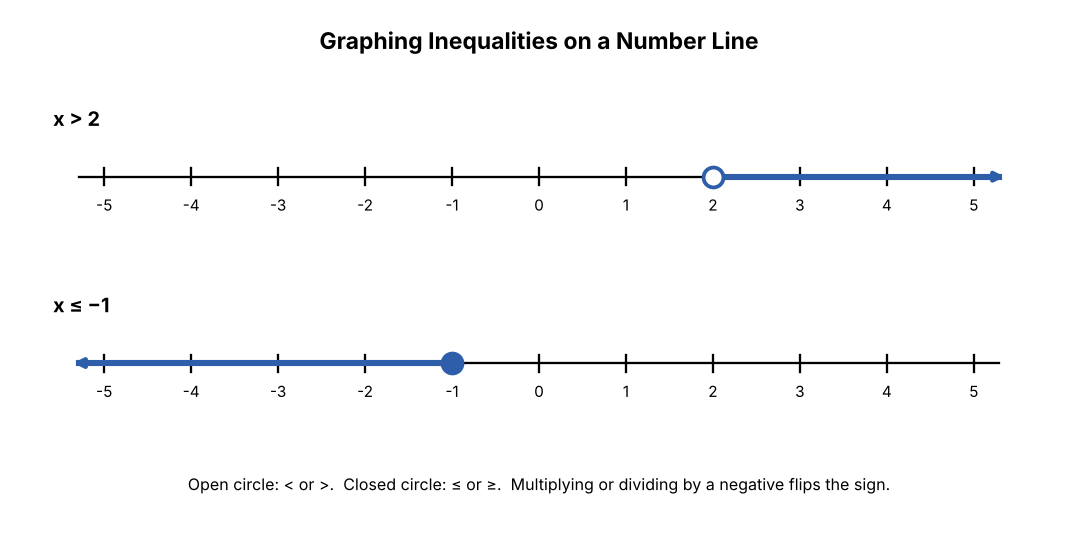
| Form | Meaning as Distance | Rewrite As | Graph |
|---|---|---|---|
| \(|x|\lt a\) | Within \(a\) of zero | \(-a\lt x\lt a\) (an “and”) | One segment |
| \(|x|\le a\) | Within or exactly \(a\) of zero | \(-a\le x\le a\) | One segment, closed ends |
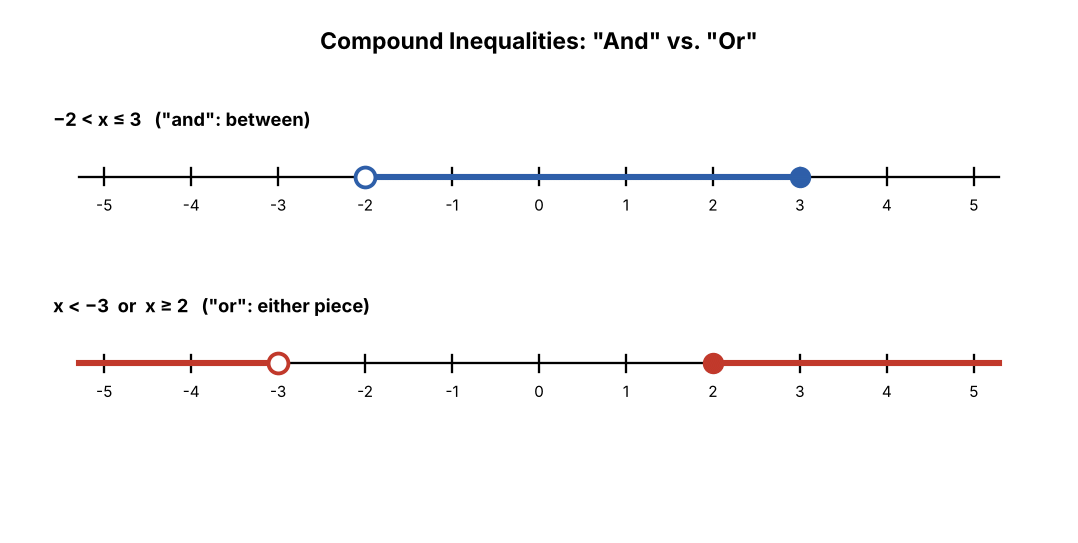
| \(|x|\gt a\) | More than \(a\) from zero | \(x\lt-a\) or \(x\gt a\) | Two rays |
| \(|x|\ge a\) | At least \(a\) from zero | \(x\le-a\) or \(x\ge a\) | Two rays, closed ends |
Worked example 3: Solve \(|x-4|\lt 6\).
- Rewrite as an “and”: \(-6\lt x-4\lt 6\).
- Add 4 to all three parts: \(-2\lt x\lt 10\).
Worked example 4: Solve \(|3x+1|\ge 8\).
- Rewrite as an “or”: \(3x+1\le-8\) or \(3x+1\ge 8\).
- Solve the first: \(3x\le-9\), so \(x\le-3\).
- Solve the second: \(3x\ge 7\), so \(x\ge\frac{7}{3}\).
Why does this matter? Tolerance problems are the most common real-world application. A part that must be 50 millimeters within 0.2 millimeters is modeled by \(|L-50|\le 0.2\), which gives \(49.8\le L\le 50.2\). The center of the range is the target, and the number on the right is the allowed error.
Test-Taking Strategies
Mnemonic Devices and Memory Shortcuts
Use “Less thAND, GreatOR.” A less-than absolute value inequality becomes an “and” sandwich, while a greater-than one becomes an “or” pair of rays. For equations, remember “isolate, then split.”
Cross-Topic Connections
- The “and” and “or” forms come straight from Topic 3.2: Compound Inequalities.
- Graphing with open and closed circles follows Topic 3.1: Solving and Graphing Inequalities.
- Isolating the absolute value uses the steps from Topic 2.2: Solving Two-Step Equations.
- Absolute value bars act as grouping symbols, as explained in Topic 1.2: Order of Operations.
Common Question Formats
- Solve an absolute value equation and choose both solutions.
- Identify which absolute value equation has no solution.
- Write an absolute value inequality for a tolerance or “within” statement.
- Match an absolute value inequality to its number line graph.
Frequent Student Mistakes
- Splitting before isolating the absolute value, which produces false solutions.
- Writing only the positive case and missing the second solution.
- Using “and” for a greater-than inequality, which produces an empty sandwich like \(8\lt x\lt-8\).
Test-Day Shortcuts
For tolerance questions, find the midpoint and half-width of the allowed range. A range from 66 to 74 has midpoint 70 and half-width 4, so the inequality is \(|x-70|\le 4\). This skips several algebra steps.
Time Management Tips
Absolute value problems on Algebra 1 unit tests and end-of-course exams usually take two to three minutes because there are two cases. Solve both cases on separate lines so nothing gets mixed together. If time is short, check answer choices by substitution instead of solving.