
A movie theater sells between 0 and 200 tickets per showing. It can’t sell 3.5 tickets or negative 10 tickets. Those limits on the inputs, and the matching limits on the money collected, are the domain and range of the theater’s revenue function. Every function you study has a domain and range, and reading them correctly is a core Algebra 1 skill.
This article covers Topic 4.3: Domain and Range in Unit 4, Functions. The topic asks you to identify the domain and range of a function from sets of ordered pairs, graphs, equations, and real-world situations.
By the end, you should be able to:
- Define domain and range and connect them to inputs and outputs.
- State the domain and range of a relation given as ordered pairs or a table.
- Read the domain and range from a graph using inequality and interval notation.
- Determine a reasonable domain and range for a real-world function.
Domain and Range Defined
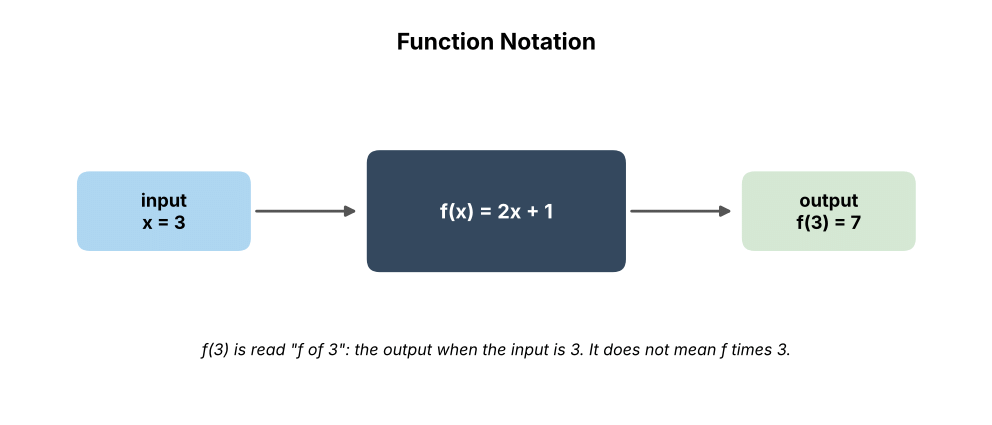
The domain is the set of all possible inputs, the \(x\) values. The range is the set of all possible outputs, the \(y\) values. For the ordered pairs \(\{(-2, 5), (0, 1), (3, 5), (4, 8)\}\):
- The domain is \(\{-2, 0, 3, 4\}\), the list of first coordinates.
- The range is \(\{1, 5, 8\}\), the list of second coordinates. The 5 appears twice but is listed only once.
Why does this matter? Students often list repeated values or mix up which coordinate goes where. Remember that domain and input both come first in the alphabet compared with range and output, just as \(x\) comes before \(y\).
Reading Domain and Range From Graphs
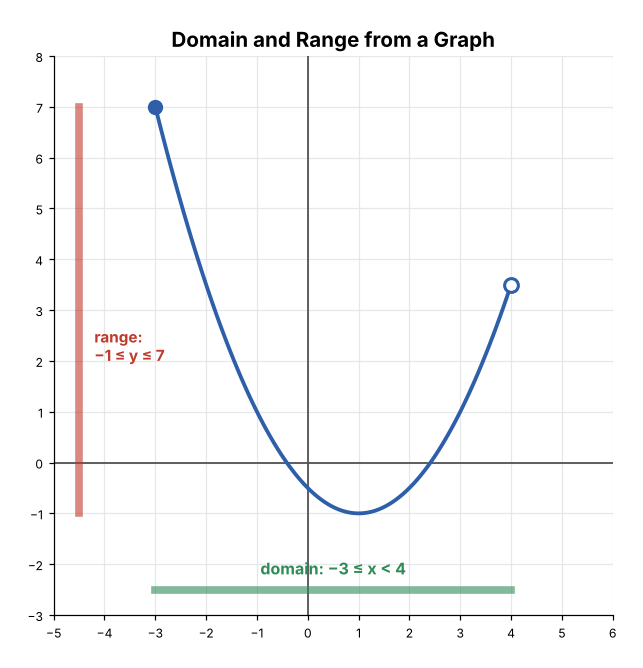
For a graph, the domain is how far the graph stretches left to right, and the range is how far it stretches bottom to top. Look at the endpoints and arrows carefully.
| Feature on the Graph | What It Means |
|---|---|
| Closed dot at an endpoint | That value is included, so use \(\le\) or \(\ge\), or a bracket in interval notation. |
| Open dot at an endpoint | That value is excluded, so use \(\lt\) or \(\gt\), or a parenthesis. |
| Arrow on the graph | The graph continues forever in that direction, toward infinity. |
| Lowest or highest point of a curve | Sets the minimum or maximum of the range. |
Here are common graphs and their domains and ranges:
| Function | Domain | Range |
|---|---|---|
| \(y=2x+1\), a non-horizontal line | All real numbers | All real numbers |
| \(y=4\), a horizontal line | All real numbers | \(\{4\}\) |
| \(y=x^{2}\), a parabola opening up | All real numbers | \(y\ge 0\) |
| \(y=-(x-1)^{2}+3\), opening down | All real numbers | \(y\le 3\) |
| A segment from \((-1, 2)\) to \((5, 6)\) with closed dots | \(-1\le x\le 5\) | \(2\le y\le 6\) |
Interval notation is a compact way to write these sets. The domain \(-1\le x\le 5\) becomes \([-1, 5]\). The range \(y\ge 0\) becomes \([0, \infty)\). Infinity always gets a parenthesis because it is not a number you can include.
Why does this matter? A parabola’s range is limited by its vertex, even though its domain is unlimited. Missing that detail is the most common error on graph-based domain and range questions. Always ask: does the graph ever go below or above a certain height?
Reasonable Domain and Range in Context
In real-world problems, the situation limits the inputs even when the equation does not. Suppose a theater earns \(R(t)=12t\) dollars from selling \(t\) tickets, with 200 seats available.
- Domain: \(t\) must be a whole number from 0 to 200. You cannot sell part of a ticket or more tickets than seats.
- Range: The revenue is a multiple of 12 from 0 to 2,400 dollars, since \(R(200)=2400\).
- Discrete versus continuous: Ticket counts are discrete because only whole numbers make sense. Time or distance is usually continuous because any value in an interval is possible.
Why does this matter? Test questions often offer an answer like “all real numbers” for a context problem. That choice is mathematically true for the equation but wrong for the situation. Always check whether negative values, fractions, or very large values make sense.
Test-Taking Strategies
Mnemonic Devices and Memory Shortcuts
Use “D-I-X, R-O-Y”: Domain, Input, \(x\) and Range, Output, \(y\). For graphs, think “domain scans left to right, range scans bottom to top,” like reading a page and then climbing a ladder.
Cross-Topic Connections
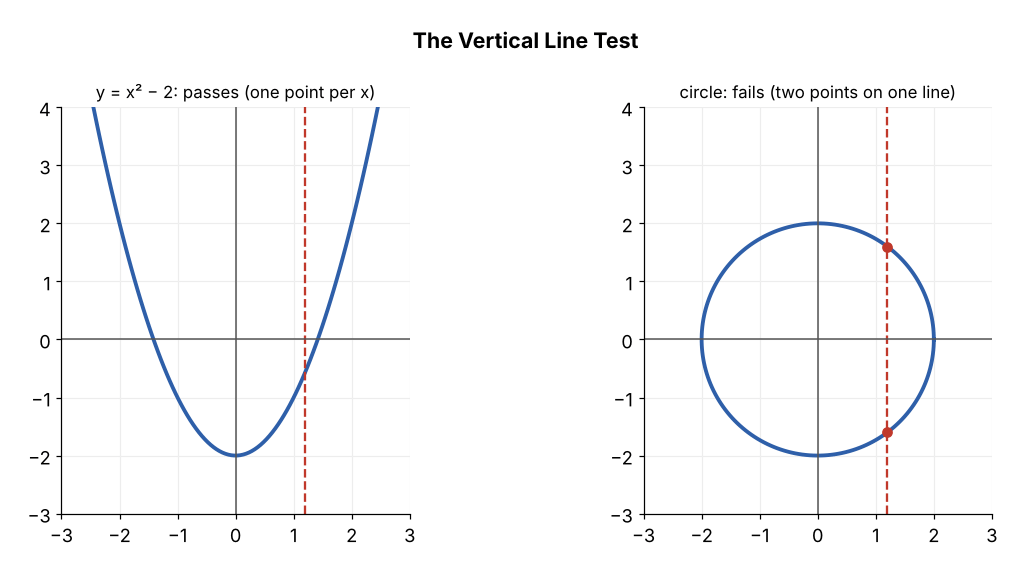
- Inputs and outputs come from Topic 4.1: Relations and Functions.
- Writing domains uses the symbols from Topic 3.1: Solving and Graphing Inequalities.
- Bounded domains look like the sandwich form in Topic 3.2: Compound Inequalities.
- The vertex sets a parabola’s range, explored in Topic 10.2: Forms of Quadratic Functions.
Common Question Formats
- State the domain and range of a set of ordered pairs or a mapping.
- Choose the domain and range of a graph written in inequality or interval notation.
- Select a reasonable domain for a word problem.
- Identify whether a situation is discrete or continuous.
Frequent Student Mistakes
- Swapping domain and range. Domain is always the \(x\) values.
- Including an endpoint marked with an open dot.
- Giving “all real numbers” as the range of a parabola, which always has a minimum or maximum.
Test-Day Shortcuts
Run two pencils along the graph: one sliding left and right to find the domain edges, and one sliding up and down to find the range edges. For context problems, cross out any answer that allows negative counts or fractional people right away.
Time Management Tips
Domain and range items on Algebra 1 unit tests and end-of-course exams usually take about a minute each. Graph items go faster if you check the endpoints first, since most wrong choices differ only in brackets or a single boundary value.