
Two triangles are congruent when all six pairs of corresponding parts match: three sides and three angles. Checking all six every time would be slow. Fortunately, you don’t have to. Certain combinations of just three parts guarantee congruence, and the first two shortcuts, SSS and SAS, are the workhorses of triangle proofs.
This article covers Topic 5.2: Triangle Congruence: SSS and SAS in Unit 5, Triangles. The topic asks you to write congruence statements with matching vertices, apply the Side-Side-Side and Side-Angle-Side postulates, and use them in proofs.
By the end, you should be able to:
- Write a congruence statement with corresponding vertices in the correct order.
- Apply the SSS Congruence Postulate.
- Apply the SAS Congruence Postulate and identify an included angle.
- Write proofs that use SSS or SAS, including shared sides and vertical angles.
Congruence Statements
The statement \(\triangle ABC\cong\triangle DEF\) does more than say the triangles match. The order of the letters tells you which parts correspond:
- \(A\) matches \(D\), \(B\) matches \(E\), and \(C\) matches \(F\).
- \(\overline{AB}\cong\overline{DE}\), \(\overline{BC}\cong\overline{EF}\), and \(\overline{AC}\cong\overline{DF}\).
- \(\angle A\cong\angle D\), \(\angle B\cong\angle E\), and \(\angle C\cong\angle F\).
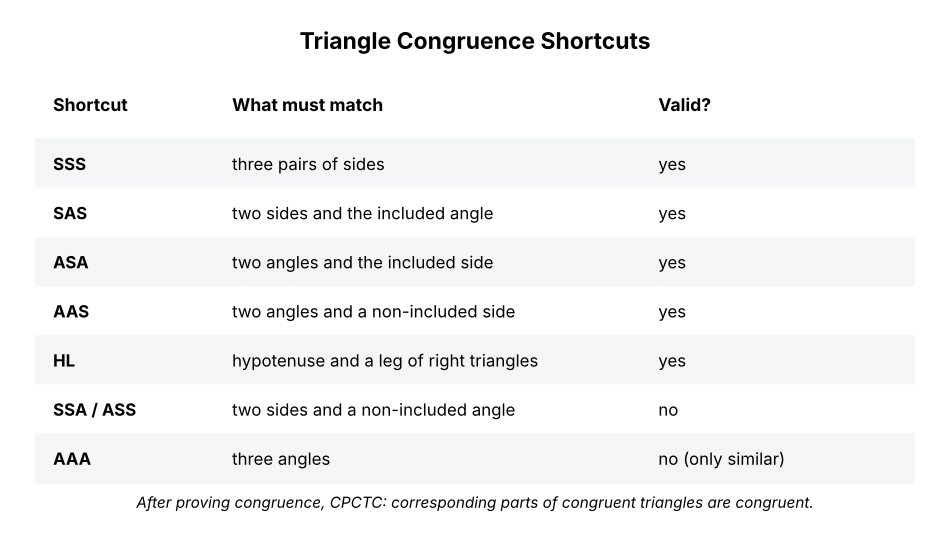
Why does this matter? A statement like \(\triangle ABC\cong\triangle EDF\) is a different claim. It says \(A\) matches \(E\), which may be false. Many test questions give a correct shortcut but a congruence statement with the vertices in the wrong order, so always match vertex to vertex.
Side-Side-Side (SSS)
The SSS Congruence Postulate states that if three sides of one triangle are congruent to three sides of another triangle, then the triangles are congruent.
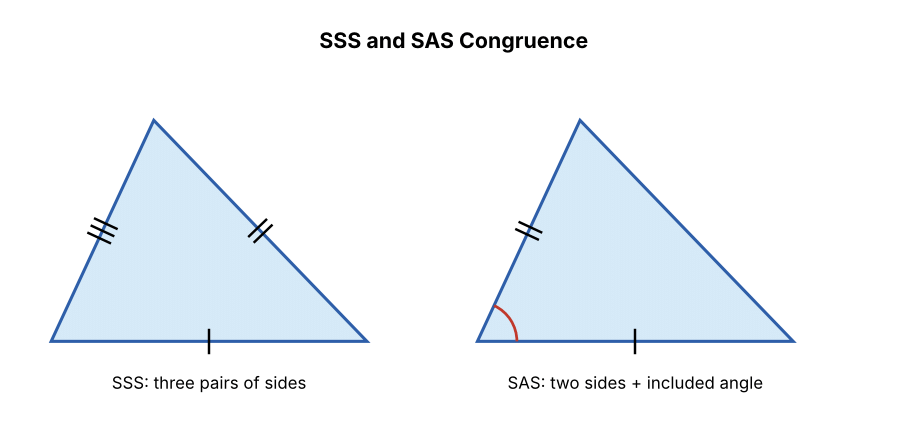
SSS works because three side lengths lock a triangle into one shape. Build a triangle from three straws and it cannot flex; that rigidity is why triangles are used in bridges and roof trusses.
Worked example 1: \(\triangle PQR\) has \(P(0,0)\), \(Q(4,0)\), \(R(0,3)\), and \(\triangle STU\) has \(S(5,1)\), \(T(9,1)\), \(U(5,4)\). Are they congruent?
- \(PQ=4\) and \(ST=4\).
- \(PR=3\) and \(SU=3\).
- \(QR=\sqrt{16+9}=5\) and \(TU=\sqrt{16+9}=5\).
- All three pairs of sides match, so \(\triangle PQR\cong\triangle STU\) by SSS.
Side-Angle-Side (SAS)
The SAS Congruence Postulate states that if two sides and the included angle of one triangle are congruent to two sides and the included angle of another, then the triangles are congruent. The included angle is the angle formed between the two sides, at the vertex they share.
| Sides Given | Included Angle | Not Included |
|---|---|---|
| \(\overline{AB}\) and \(\overline{BC}\) | \(\angle B\) | \(\angle A\) or \(\angle C\) |
| \(\overline{AB}\) and \(\overline{AC}\) | \(\angle A\) | \(\angle B\) or \(\angle C\) |
| \(\overline{AC}\) and \(\overline{BC}\) | \(\angle C\) | \(\angle A\) or \(\angle B\) |
Why does this matter? Two sides and a non-included angle, often called SSA, does not guarantee congruence. Two different triangles can share those parts. The angle must sit between the two sides for SAS to apply, so check the shared vertex every time.
Proofs With SSS and SAS
Proofs often hide a needed part in the diagram. Two common sources:
- Shared sides: If two triangles share a side, it is congruent to itself by the reflexive property.
- Vertical angles: If two triangles meet at a point where segments cross, the angles at that point are congruent by the Vertical Angles Theorem.
Worked example 2: Given: \(\overline{AB}\cong\overline{CB}\), and \(\overline{BD}\) bisects \(\angle ABC\). Prove: \(\triangle ABD\cong\triangle CBD\).
| Statements | Reasons |
|---|---|
| 1. \(\overline{AB}\cong\overline{CB}\) | 1. Given |
| 2. \(\overline{BD}\) bisects \(\angle ABC\) | 2. Given |
| 3. \(\angle ABD\cong\angle CBD\) | 3. Definition of angle bisector |
| 4. \(\overline{BD}\cong\overline{BD}\) | 4. Reflexive property of congruence |
| 5. \(\triangle ABD\cong\triangle CBD\) | 5. SAS |
The angle in step 3 is included between the sides in steps 1 and 4, which is exactly what SAS requires.
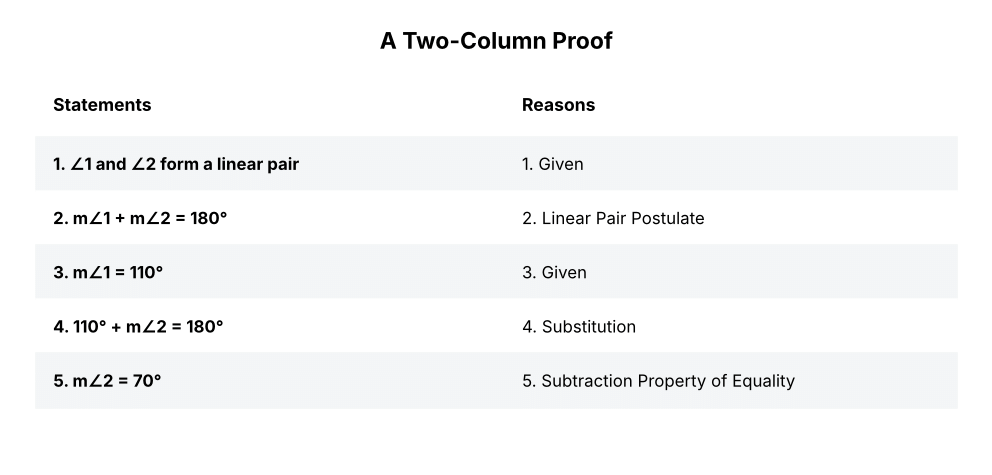
Why does this matter? Once triangles are proven congruent, every remaining pair of corresponding parts is congruent too. In this proof, you could add a final step concluding \(\overline{AD}\cong\overline{CD}\), with the reason “corresponding parts of congruent triangles are congruent,” often abbreviated CPCTC. That step is how congruence proofs lead to new facts about segments and angles.
Test-Taking Strategies
Mnemonic Devices and Memory Shortcuts
For SAS, picture the angle as a “sandwich filling” between two sides. If the angle is not between them, the sandwich falls apart. Never use SSA, which spelled backward reminds you not to.
Cross-Topic Connections
- Congruence as a sequence of rigid motions comes from Topic 4.5: Symmetry and Compositions of Transformations.
- Side lengths on a grid use Topic 1.2: Measuring Segments and the Distance Formula.
- Vertical angles provide hidden parts, from Topic 1.5: Angle Pair Relationships.
- Proof format follows Topic 2.3: Two-Column Proofs.
Common Question Formats
- Decide whether SSS, SAS, or neither proves two triangles congruent.
- Identify the additional information needed to use SAS.
- Complete a congruence statement with vertices in the correct order.
- Fill in missing steps of an SSS or SAS proof.
Frequent Student Mistakes
- Using a non-included angle with SAS.
- Writing the congruence statement with vertices out of order.
- Forgetting a shared side, which is often the third part needed.
Test-Day Shortcuts
Mark the diagram with tick marks and arcs for every given part, then add any shared sides or vertical angles. Count what you have before choosing a shortcut. Most items become obvious once the diagram is fully marked.
Time Management Tips
Choose-the-shortcut items on Geometry unit tests and end-of-course exams take about a minute. Full proofs take three to five minutes. Mark the diagram first, since that step finds the parts you need and saves time writing.