
Can you build a triangle from sticks that are 2, 3, and 7 inches long? Try it, and the two short sticks won’t reach each other. Not every set of three lengths makes a triangle, and within a triangle, the biggest angle always faces the longest side. These inequality relationships let you rule out impossible figures and order the parts of any triangle without measuring.
This article covers Topic 5.6: Triangle Inequalities in Unit 5, Triangles. The topic asks you to apply the Triangle Inequality Theorem, find the possible range for a third side, and order the sides and angles of a triangle by size.
By the end, you should be able to:
- Decide whether three lengths can form a triangle.
- Find the range of possible lengths for the third side.
- Order the angles of a triangle given its sides.
- Order the sides of a triangle given its angles.
The Triangle Inequality Theorem
The Triangle Inequality Theorem states that the sum of any two side lengths of a triangle is greater than the third side length. For sides \(a\), \(b\), and \(c\), all three statements must hold:
- \(a+b\gt c\)
- \(a+c\gt b\)
- \(b+c\gt a\)
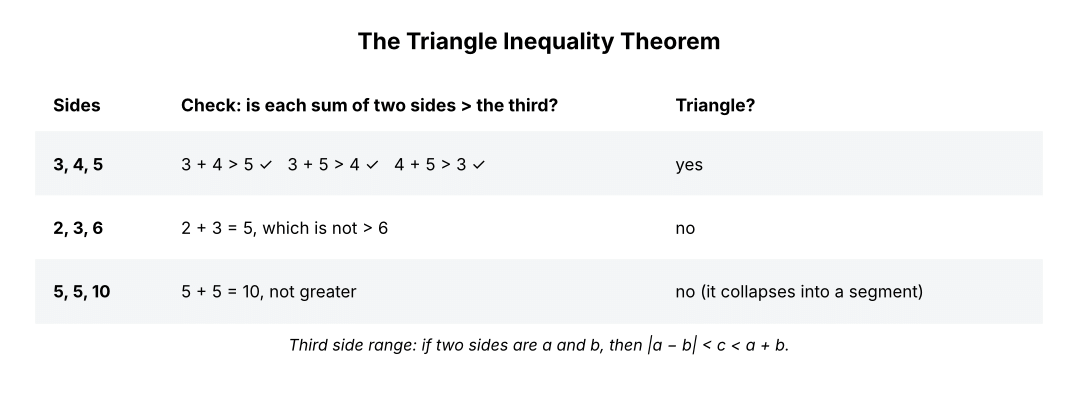
In practice, you only need one check: the two shorter sides must add to more than the longest side. If that works, the other two inequalities automatically hold.
| Lengths | Check | Triangle? |
|---|---|---|
| 2, 3, 7 | \(2+3=5\), which is less than 7 | No |
| 4, 5, 9 | \(4+5=9\), which equals 9 | No, the sides lie flat |
| 5, 6, 10 | \(5+6=11\), which is greater than 10 | Yes |
| 8, 8, 15 | \(8+8=16\), which is greater than 15 | Yes |
Why does this matter? The sum must be strictly greater. When the two short sides add exactly to the longest side, the three segments collapse into a straight line, which is not a triangle. Test writers include this equal case on purpose.
Finding the Range for a Third Side
If you know two sides, the third side must be greater than their difference and less than their sum.
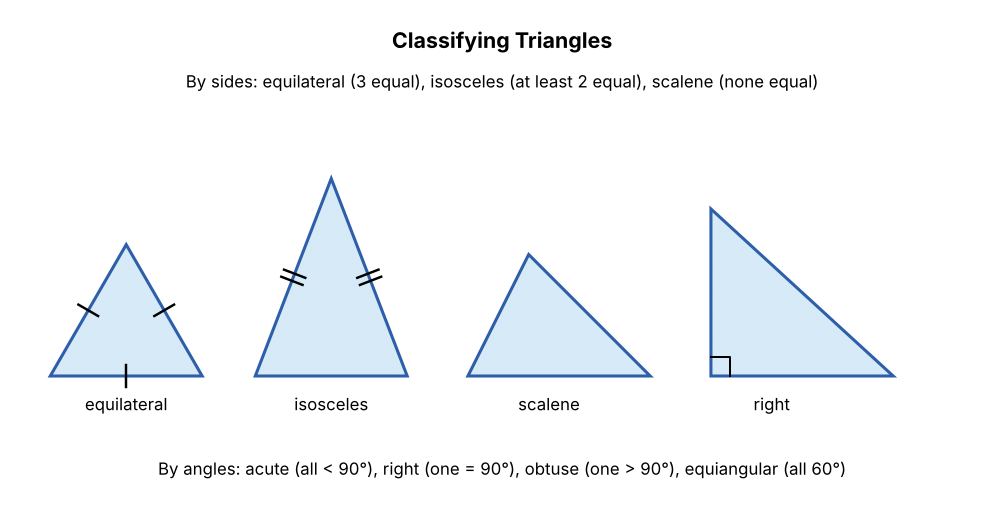
Worked example 1: Two sides of a triangle measure 6 and 11. Find the possible lengths of the third side \(x\).
- Difference: \(11-6=5\).
- Sum: \(11+6=17\).
- The range is \(5\lt x\lt 17\). If the side must be a whole number, it can be any value from 6 to 16.
The short version: difference less than \(x\) less than sum. This one compound inequality replaces all three separate checks.
Ordering Sides and Angles
Within a single triangle, size relationships between sides and angles match up.
- The longest side is opposite the largest angle.
- The shortest side is opposite the smallest angle.
- Congruent sides are opposite congruent angles, as in isosceles triangles.
Worked example 2: In \(\triangle ABC\), \(AB=9\), \(BC=5\), and \(AC=7\). Order the angles from smallest to largest.
- Order the sides: \(BC=5\), \(AC=7\), \(AB=9\).
- Find the opposite angles: \(BC\) is opposite \(\angle A\), \(AC\) is opposite \(\angle B\), and \(AB\) is opposite \(\angle C\).
- Smallest to largest: \(\angle A\), \(\angle B\), \(\angle C\).
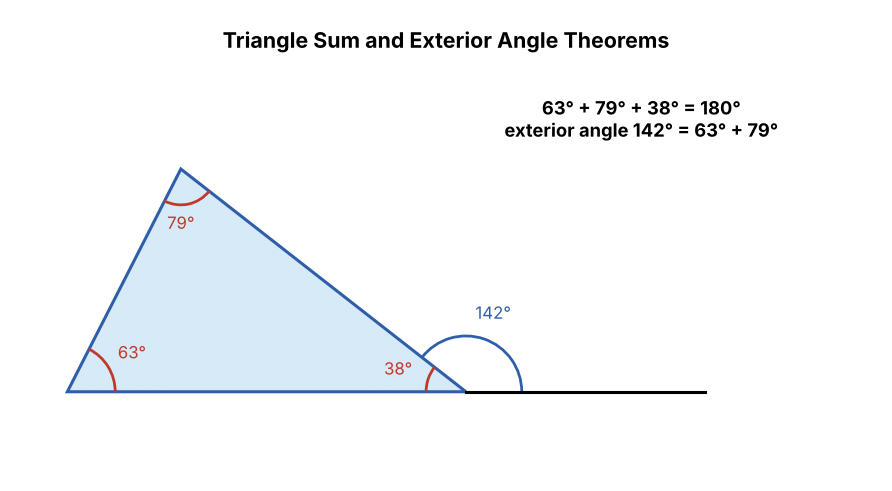
Worked example 3: In \(\triangle PQR\), \(m\angle P=50^{\circ}\) and \(m\angle Q=72^{\circ}\). Order the sides from shortest to longest.
- Find \(m\angle R=180-50-72=58^{\circ}\).
- Order the angles: \(\angle P\), \(\angle R\), \(\angle Q\).
- Opposite sides in the same order: \(\overline{QR}\), \(\overline{PQ}\), \(\overline{PR}\).
Why does this matter? The most common error is pairing an angle with an adjacent side. The side opposite \(\angle A\) is the one that does not touch \(A\), which is \(\overline{BC}\). Naming the opposite side by its two letters that are not the vertex letter makes this foolproof.
A Practical View
The Triangle Inequality explains why the shortest path between two points is a straight line. Going from \(A\) to \(C\) through a detour point \(B\) is always longer than going directly, unless \(B\) lies on the segment. Map apps, delivery routes, and even light traveling through space follow this principle.
Test-Taking Strategies
Mnemonic Devices and Memory Shortcuts
“Two short sides must beat the long side.” For the third-side range, remember “difference to sum, not including either.” For ordering, “big angle, big side; small angle, small side.”
Cross-Topic Connections
- Finding the third angle uses Topic 5.1: Classifying Triangles and the Triangle Sum Theorem.
- Equal sides opposite equal angles come from Topic 5.4: Isosceles and Equilateral Triangles.
- The third-side range is a compound inequality, as in Algebra 1 Topic 3.2: Compound Inequalities.
- Side lengths on a grid use Topic 1.2: Measuring Segments and the Distance Formula.
Common Question Formats
- Decide which set of three lengths can form a triangle.
- Find the range of possible lengths for a third side.
- Order the angles of a triangle from its side lengths.
- Order the sides from its angle measures.
Frequent Student Mistakes
- Accepting lengths where the two short sides add exactly to the third.
- Including the difference or sum itself in the third-side range.
- Pairing angles with adjacent sides instead of opposite sides.
Test-Day Shortcuts
Sort the three lengths before checking. Then add only the two smallest. For ordering questions, rewrite each side as the angle letter it does not contain, and you will have the order instantly.
Time Management Tips
Triangle inequality items on Geometry unit tests and end-of-course exams usually take under a minute. Ordering questions take about a minute, slightly more if you need to find a third angle first.