
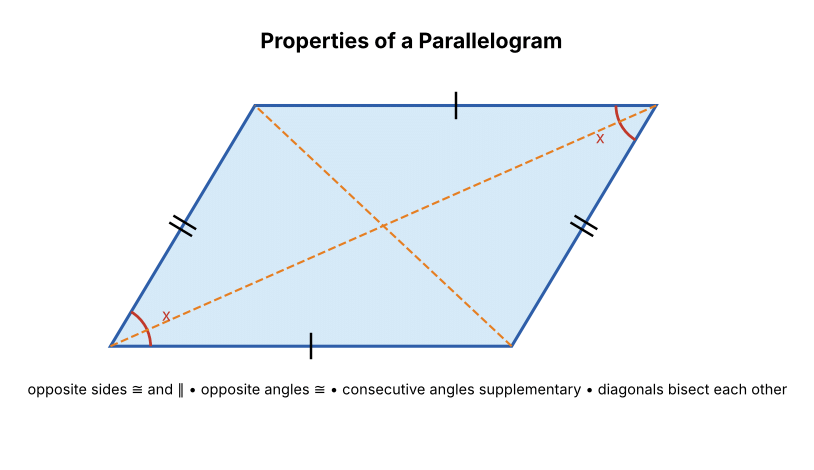
Rectangles, rhombuses, and squares are special parallelograms. Each one inherits every parallelogram property and adds its own. The key to this topic is knowing exactly which extra properties belong to which shape, especially the properties of the diagonals, because that is how you tell these figures apart and prove which one you have.
This article covers Topic 6.3: Rectangles, Rhombuses, and Squares in Unit 6, Quadrilaterals and Polygons. The topic asks you to apply the properties of these special parallelograms, use diagonal properties to solve problems, and classify quadrilaterals on the coordinate plane.
By the end, you should be able to:
- Define a rectangle, a rhombus, and a square.
- State the special diagonal properties of each.
- Solve for unknown lengths and angles using these properties.
- Classify a quadrilateral on the coordinate plane using slopes and lengths.
Definitions and Relationships
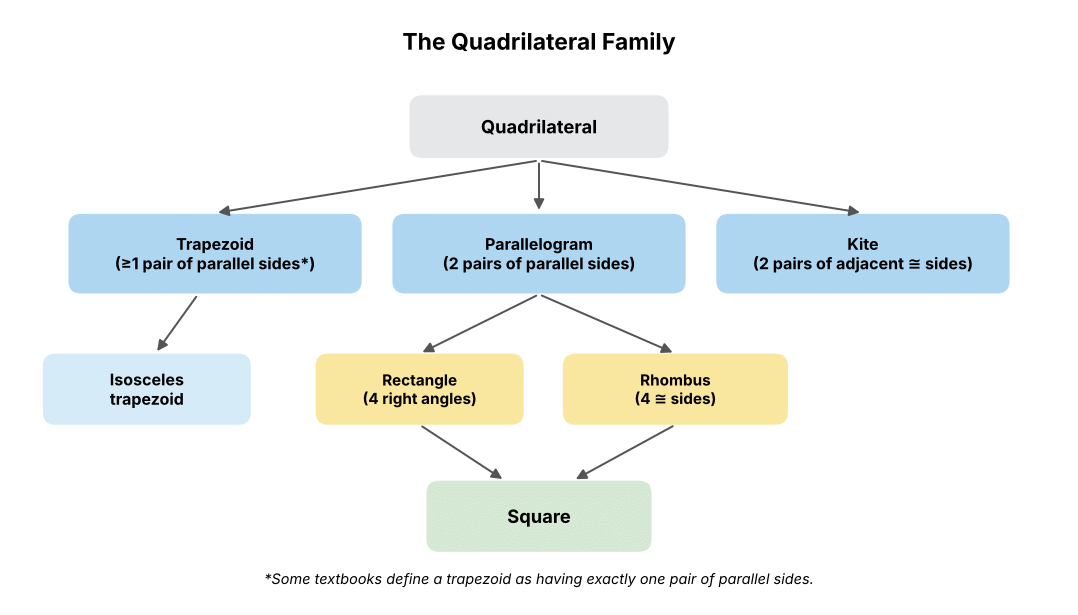
- A rectangle is a parallelogram with four right angles.
- A rhombus is a parallelogram with four congruent sides.
- A square is a parallelogram with four right angles and four congruent sides. It is both a rectangle and a rhombus.
Think of the relationships as nested groups. Every square is a rectangle and a rhombus. Every rectangle and every rhombus is a parallelogram. The reverse statements are not true: a rectangle is a square only if its sides are all equal.
The converses give you ways to prove a parallelogram is special. If a parallelogram has one right angle, all four angles are right, so it is a rectangle. If it has two consecutive congruent sides, all four sides are congruent, so it is a rhombus.
Diagonal Properties
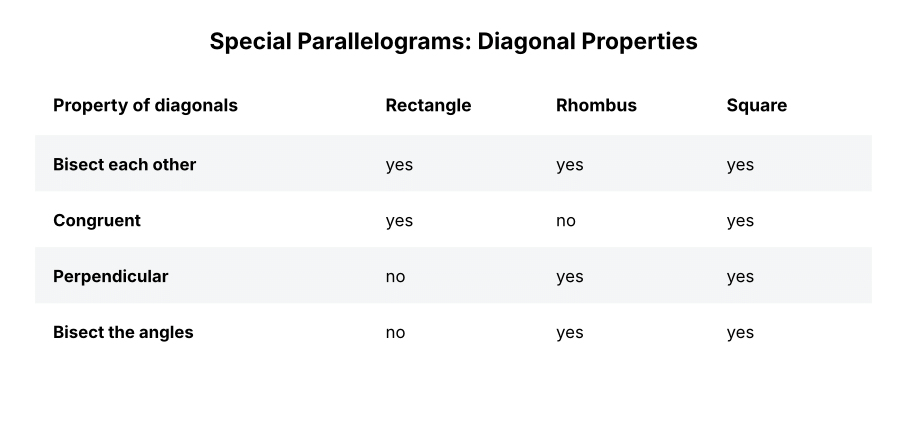
| Property | Parallelogram | Rectangle | Rhombus | Square |
|---|---|---|---|---|
| Diagonals bisect each other | Yes | Yes | Yes | Yes |
| Diagonals are congruent | No | Yes | No | Yes |
| Diagonals are perpendicular | No | No | Yes | Yes |
| Diagonals bisect the angles | No | No | Yes | Yes |
Why does this matter? Diagonals are the fastest way to identify a special parallelogram. Congruent diagonals point to a rectangle, perpendicular diagonals point to a rhombus, and both together mean a square. Memorizing this table answers most classification questions.
Solving Rectangle Problems
Worked example 1: In rectangle \(ABCD\), diagonal \(AC=4x-6\) and diagonal \(BD=2x+10\). Find \(AC\).
- Rectangle diagonals are congruent: \(4x-6=2x+10\).
- Solve: \(x=8\).
- Substitute: \(AC=4(8)-6=26\).
Because the diagonals are congruent and bisect each other, the four segments from the center to the vertices are all congruent. In rectangle \(ABCD\) with diagonals meeting at \(E\), \(AE=BE=CE=DE=13\). That creates isosceles triangles inside the rectangle, which is often the key to angle problems.
Solving Rhombus Problems
Worked example 2: In rhombus \(PQRS\), the diagonals meet at \(T\). If \(m\angle PQT=(3y+3)^{\circ}\) and \(m\angle QPT=(2y-3)^{\circ}\), find \(y\).
- Rhombus diagonals are perpendicular, so \(m\angle PTQ=90^{\circ}\).
- The other two angles of \(\triangle PTQ\) are complementary: \((3y+3)+(2y-3)=90\).
- Solve: \(5y=90\), so \(y=18\).
Worked example 3: A rhombus has diagonals of length 10 and 24. Find its side length.
- The diagonals bisect each other at right angles, forming four right triangles with legs 5 and 12.
- Use the Pythagorean Theorem: side \(=\sqrt{5^{2}+12^{2}}=\sqrt{169}=13\).
Why does this matter? The perpendicular diagonals of a rhombus split it into four congruent right triangles. Recognizing those triangles turns many rhombus problems into Pythagorean Theorem or complementary angle problems.
Classifying on the Coordinate Plane
To classify a quadrilateral that is already known to be a parallelogram, check the diagonals:
- Compute both diagonal lengths. If they are equal, the figure is a rectangle.
- Compute both diagonal slopes. If their product is \(-1\), the figure is a rhombus.
- If both conditions hold, the figure is a square.
For example, \(A(0,0)\), \(B(3,4)\), \(C(8,4)\), and \(D(5,0)\) form a parallelogram with all sides of length 5. Diagonal \(\overline{AC}\) has slope \(\frac{1}{2}\) and \(\overline{BD}\) has slope \(-2\). Their product is \(-1\), so the diagonals are perpendicular and \(ABCD\) is a rhombus. The diagonal lengths are \(\sqrt{80}\) and \(\sqrt{20}\), which are not equal, so it is not a square.
Test-Taking Strategies
Mnemonic Devices and Memory Shortcuts
“Rectangle diagonals are equal in length; Rhombus diagonals cross at Right angles.” A square gets “both perks.” Picture a kite-shaped diamond for a rhombus to recall the perpendicular diagonals.
Cross-Topic Connections
- All parallelogram properties carry over from Topic 6.2: Properties of Parallelograms.
- Perpendicular slopes are checked with Topic 3.3: Slopes of Parallel and Perpendicular Lines.
- Rectangle diagonal halves form isosceles triangles, as in Topic 5.4: Isosceles and Equilateral Triangles.
- Diagonal lengths use Topic 1.2: Measuring Segments and the Distance Formula.
Common Question Formats
- Choose the most specific name for a quadrilateral from its properties.
- Solve for \(x\) using congruent or perpendicular diagonals.
- Find a rhombus side from its diagonals.
- Classify a quadrilateral on the coordinate plane.
Frequent Student Mistakes
- Assuming rhombus diagonals are congruent.
- Calling a rectangle a square without checking side lengths.
- Using half a rhombus diagonal as a full leg, or the full diagonal as a leg.
Test-Day Shortcuts
On “most specific name” questions, test the strongest name first. If it is a square, it is also a rectangle and a rhombus, but the square is the best answer. Work down the hierarchy only if the stronger name fails.
Time Management Tips
Special parallelogram items on Geometry unit tests and end-of-course exams take one to two minutes. Coordinate classification takes three to four minutes, so compute diagonal lengths and slopes in a small table.