
Circles have a vocabulary all their own: radius, diameter, chord, secant, tangent, arc. Every circle theorem you will learn in this unit is stated in these terms, so a clear picture of each part is the foundation for the rest of the topic. Getting the names right also makes diagrams much faster to read on test day.
This article covers Topic 9.1: Parts of a Circle in Unit 9, Circles. The topic asks you to identify and name the segments, lines, and points associated with a circle, relate the radius and diameter, and describe how circles can intersect or be tangent to each other.
By the end, you should be able to:
- Define a circle and name it by its center.
- Identify radii, diameters, chords, secants, and tangents.
- Use the relationship between radius and diameter to find lengths.
- Describe congruent, concentric, and tangent circles.
What a Circle Is
A circle is the set of all points in a plane that are a fixed distance from a given point, called the center. A circle is named by its center, so a circle with center \(P\) is written \(\odot P\).
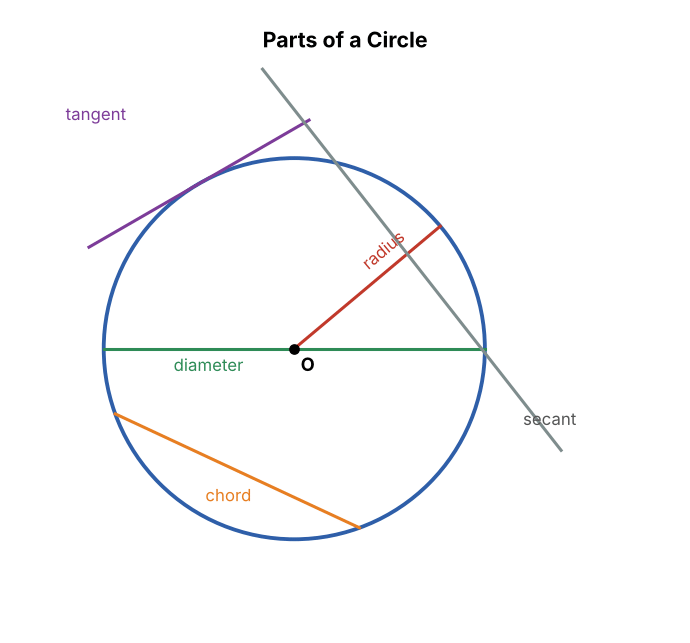
Points can lie inside the circle (closer to the center than the radius), on the circle (exactly the radius away), or outside (farther than the radius). The center itself is inside the circle, not on it.
Segments and Lines
| Part | Definition | Key Fact |
|---|---|---|
| Radius | A segment from the center to a point on the circle. | All radii of a circle are congruent. |
| Chord | A segment with both endpoints on the circle. | The longest chord is a diameter. |
| Diameter | A chord that passes through the center. | A diameter is twice the radius. |
| Secant | A line that intersects the circle at two points. | It contains a chord. |
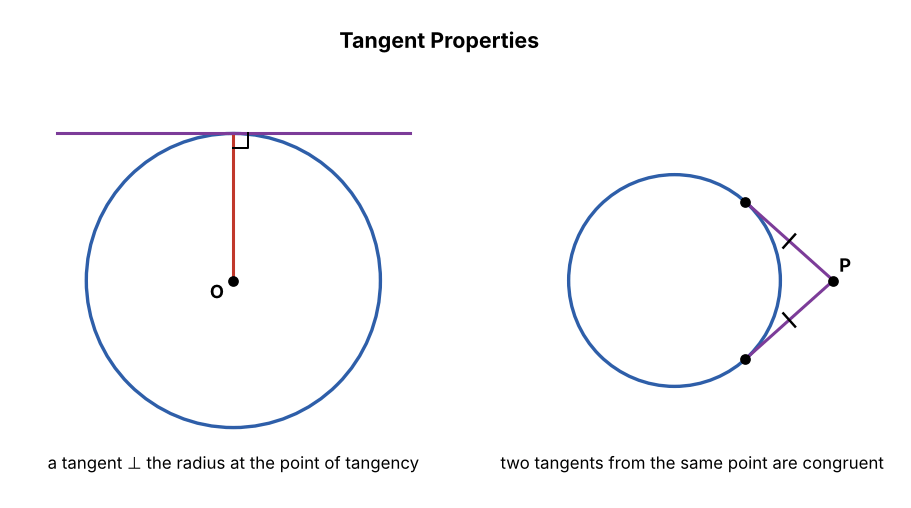
| Tangent | A line in the plane of the circle that touches it at exactly one point. | That point is the point of tangency. |
The relationship between radius \(r\) and diameter \(d\) is simple: \(d=2r\) and \(r=\frac{d}{2}\). If a circle has a diameter of 18, its radius is 9.
Why does this matter? A chord and a secant are closely related but not the same. A chord is a segment that stops at the circle. A secant is a line that keeps going past it. Questions that ask you to “name a secant” want a line, often shown with arrows, not a segment.
Using All Radii Are Congruent
The fact that every radius has the same length is one of the most useful tools in circle problems.
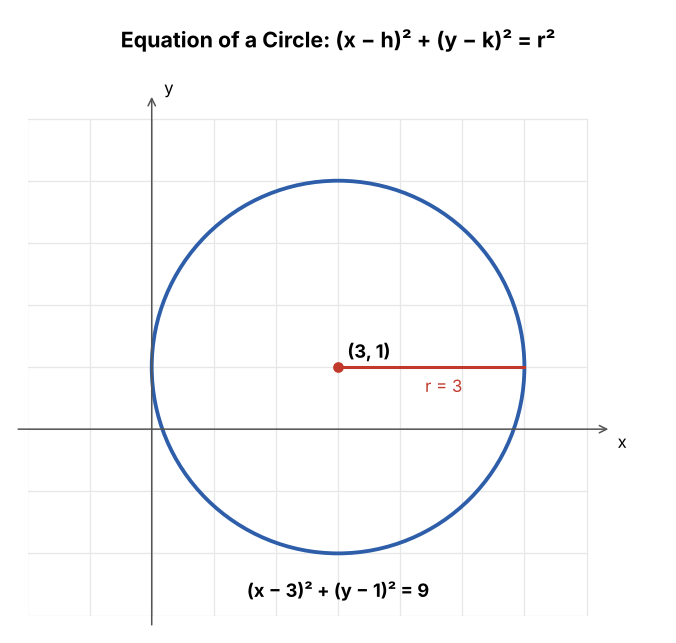
Worked example 1: In \(\odot O\), \(\overline{OA}\) and \(\overline{OB}\) are radii with \(OA=3x-4\) and \(OB=2x+5\). Find the diameter.
- All radii are congruent: \(3x-4=2x+5\).
- Solve: \(x=9\).
- Radius: \(3(9)-4=23\).
- Diameter: \(2(23)=46\).
Any triangle formed by two radii and a chord is isosceles, because two of its sides are radii. That fact lets you use the Base Angles Theorem inside circles, which comes up often in angle problems.
Relationships Between Circles
- Congruent circles have congruent radii.
- Concentric circles share the same center but have different radii, like the rings of a target.
- Tangent circles touch at exactly one point. They are internally tangent if one is inside the other, and externally tangent if they sit side by side.
A common tangent is a line tangent to two circles. Two separate circles that do not overlap have four common tangents: two that cross between the circles and two that do not.
Worked example 2: Two circles are externally tangent. One has radius 5 and the other has radius 8. Find the distance between their centers. The centers and the point of tangency lie on one line, so the distance is \(5+8=13\). If the circles were internally tangent, the distance would be \(8-5=3\).
Why does this matter? Tangent circle problems become simple once you notice that the point of tangency lies on the segment connecting the centers. Add the radii for external tangency and subtract them for internal tangency.
Circles on the Coordinate Plane
Many circle problems place the center at a point like \((2,-3)\) and give a point on the circle. The radius is then the distance between the center and that point, found with the distance formula. You will turn that idea into the equation of a circle at the end of this unit.
Test-Taking Strategies
Mnemonic Devices and Memory Shortcuts
“Diameter doubles, radius halves.” For lines, “tangent touches once, secant cuts twice.” A chord is a “string” across the circle, with both ends tied down.
Cross-Topic Connections
- Segments, lines, and points come from Topic 1.1: Points, Lines, and Planes.
- Two radii and a chord form an isosceles triangle, as in Topic 5.4: Isosceles and Equilateral Triangles.
- The radius on the coordinate plane uses Topic 1.2: Measuring Segments and the Distance Formula.
- The center is the midpoint of a diameter, from Topic 1.3: The Midpoint Formula.
Common Question Formats
- Name a radius, chord, diameter, secant, or tangent in a diagram.
- Find a radius or diameter from an expression.
- Find the distance between centers of tangent circles.
- Count common tangents for two circles.
Frequent Student Mistakes
- Calling any chord a diameter, even if it misses the center.
- Confusing a secant line with a chord segment.
- Reporting the radius when the question asks for the diameter.
Test-Day Shortcuts
Whenever a segment runs from the center to the circle, mark it as a radius immediately. Most circle problems become easy once you see every radius in the diagram.
Time Management Tips
Vocabulary items on Geometry unit tests and end-of-course exams take under a minute. Radius equations and tangent circle problems take one to two minutes.