
Strong readers do not simply start at the first word and hope for the best. Before they read, they preview and predict. While they read, they question, visualize, and check their understanding. After they read, they summarize and reflect. These habits are called active reading strategies, and they turn reading from a passive activity into a process of thinking. The good news is that every one of them can be learned and practiced.
This article covers Topic 4.2: Active Reading Strategies in Unit 4, Reading Strategies. The topic asks you to apply strategies before, during, and after reading to improve comprehension and retention of complex texts.
By the end, you should be able to:
- Use previewing and prediction before reading.
- Apply questioning, visualizing, and monitoring during reading.
- Use summarizing and reflection after reading.
- Use fix-up strategies when comprehension breaks down.
Before Reading
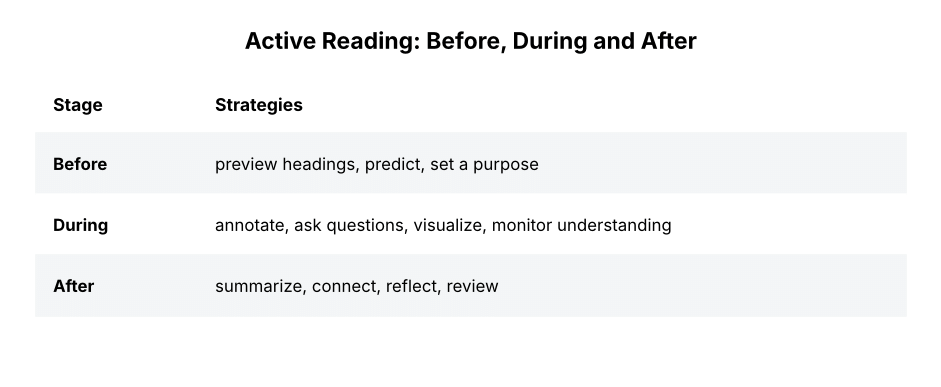
- Preview: look at the title, headings, images, captions, bold words, and the first and last paragraphs. This creates a mental map of the text.
- Activate background knowledge: ask what you already know about the topic. Connecting new information to what you know makes it easier to understand and remember.
- Set a purpose: decide why you are reading. Are you looking for the main argument, a specific fact, or details about a character?
- Predict: guess what the text will be about or what will happen. Predictions give you something to confirm or revise as you read.
During Reading
| Strategy | What It Looks Like |
|---|---|
| Questioning | Asking “Why did the author include this?” or “What does this mean?” |
| Visualizing | Creating mental pictures of scenes, processes, or ideas |
| Making connections | Linking the text to yourself, to other texts, and to the world |
| Monitoring | Noticing when you understand and when you are confused |
| Inferring | Drawing conclusions from clues the author provides |
| Annotating | Marking key ideas and writing short notes in the margins |
Why does this matter? Monitoring is the most important of these. Good readers notice the moment they lose track of meaning. Struggling readers often keep going without realizing they have stopped understanding.
Fix-Up Strategies
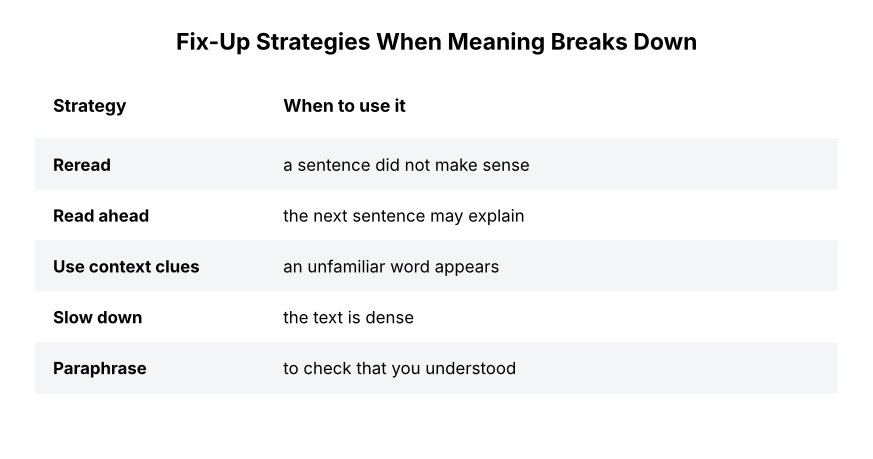
When comprehension breaks down, try one of these:
- Reread the confusing sentence or paragraph slowly.
- Read ahead a few sentences; later text often clarifies earlier text.
- Use context clues to figure out unfamiliar words.
- Paraphrase the difficult part in your own words.
- Slow down or read aloud.
- Look at text features such as headings, diagrams, or glossaries.
After Reading
- Summarize: state the main idea and key points in a few sentences.
- Check predictions: what was confirmed, and what surprised you?
- Answer your questions: return to the questions you asked during reading.
- Reflect and evaluate: what is the author’s purpose, and how well did the text achieve it? What do you think about the ideas?
- Review: revisit your notes within a day or two to strengthen memory.
The SQ3R Method
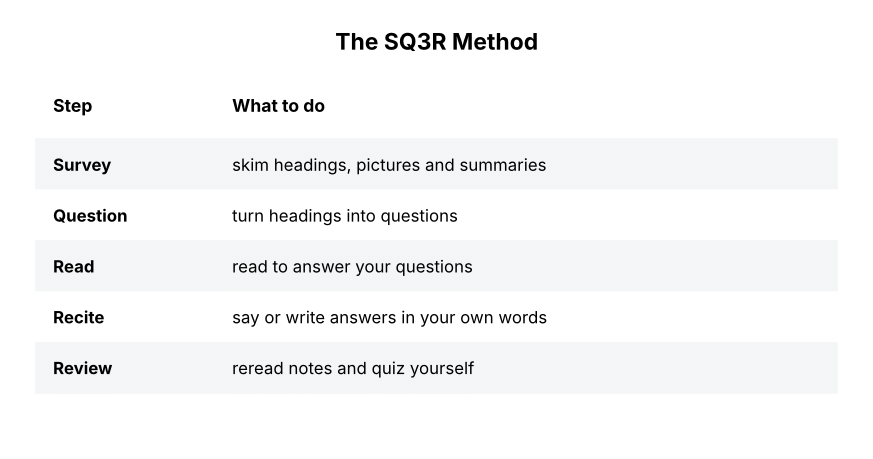
A classic study method developed by psychologist Francis P. Robinson in 1946 combines these steps for textbooks:
- Survey: skim headings and features.
- Question: turn each heading into a question.
- Read: read to answer the question.
- Recite: answer the question aloud or in writing without looking.
- Review: go over all the questions and answers at the end.
Worked Example
A student previews a science article titled “Why Do Leaves Change Color?”
- Preview: headings include “Chlorophyll,” “Hidden Pigments,” and “Weather and Color.”
- Background knowledge: leaves are green in summer and change color in fall.
- Question: “Where do red and yellow come from if leaves are green?”
- During reading: learns that yellow and orange pigments are present all summer but hidden by green chlorophyll, which breaks down in fall.
- Monitoring: confused by the term “anthocyanins,” rereads and uses context to learn that they are red pigments many trees produce in autumn.
- Summary: as chlorophyll breaks down in fall, hidden yellow and orange pigments appear, and some trees also produce new red pigments.
Why does this matter? Active reading strategies work across subjects. The same habits that help with a novel in English class help with a science textbook, a history document, or a test passage.
Test-Taking Strategies
Mnemonic Devices and Memory Shortcuts
“Before: preview. During: question. After: summarize.” For textbooks, remember SQ3R: Survey, Question, Read, Recite, Review.
Cross-Topic Connections
- Marking the text is explained in Topic 4.1: Annotating a Text.
- After-reading summaries follow Topic 1.4: Summarizing a Text.
- Drawing conclusions uses Topic 1.5: Making Inferences.
- Figuring out words uses Topic 2.1: Using Context Clues.
Common Question Formats
- Identify which strategy a reader is using in a scenario.
- Choose the best fix-up strategy for a comprehension problem.
- Write a prediction based on a preview.
- Summarize a passage after reading.
Frequent Student Mistakes
- Skipping the preview and diving straight in.
- Continuing to read after losing track of meaning.
- Never checking predictions or questions after reading.
Test-Day Shortcuts
Spend 15 seconds previewing a passage’s title and introduction, plus any italicized blurb, before reading. That context makes the passage easier to follow.
Time Management Tips
On English unit tests and standardized reading tests such as the SAT and ACT, a short preview and quick margin notes add a minute but usually save more time on the questions.