
Maximize your score with these resources:
- Albert.io AP® Physics C: Mechanics question banks
- Free AP® Physics C: Mechanics study guides
- Free AP® Physics C: Mechanics score calculator
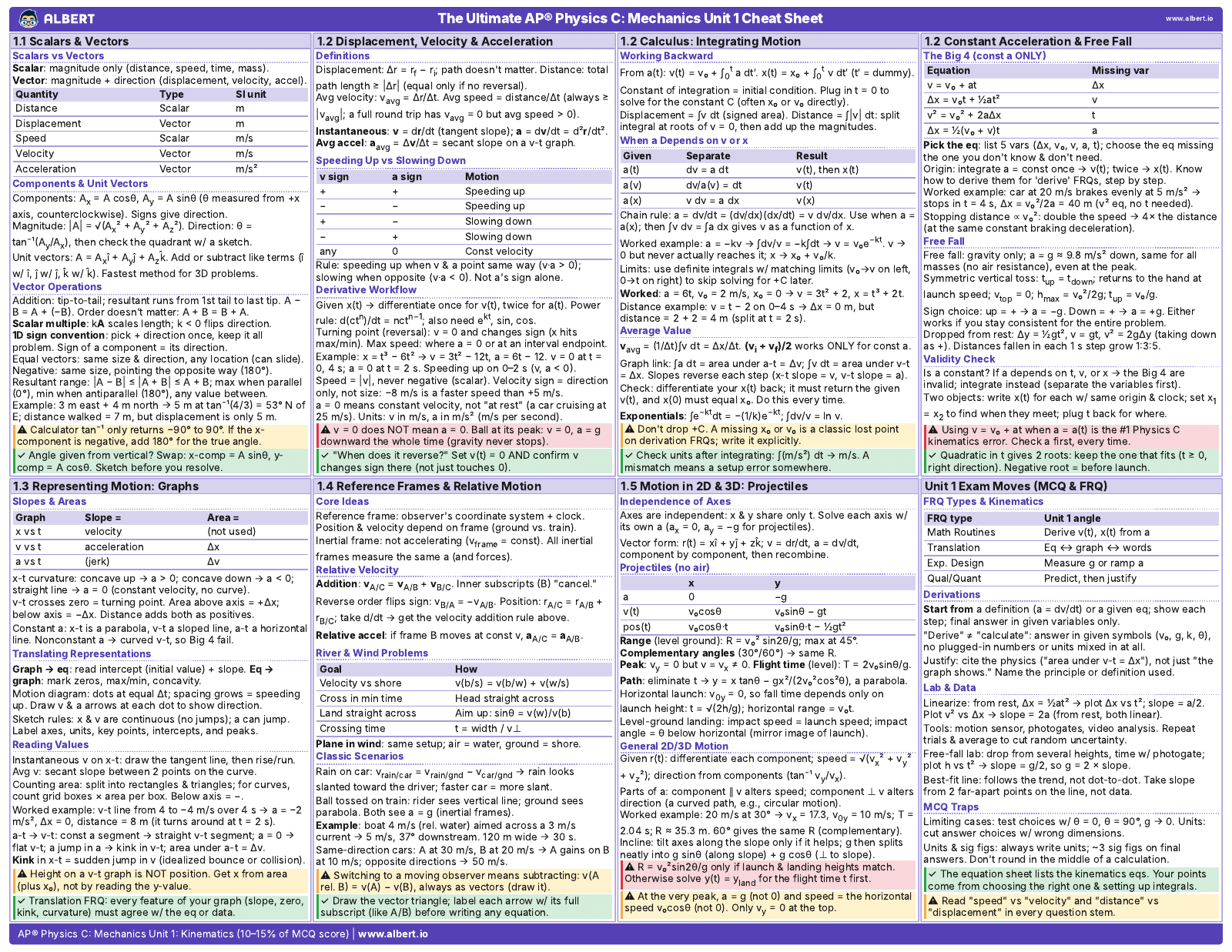
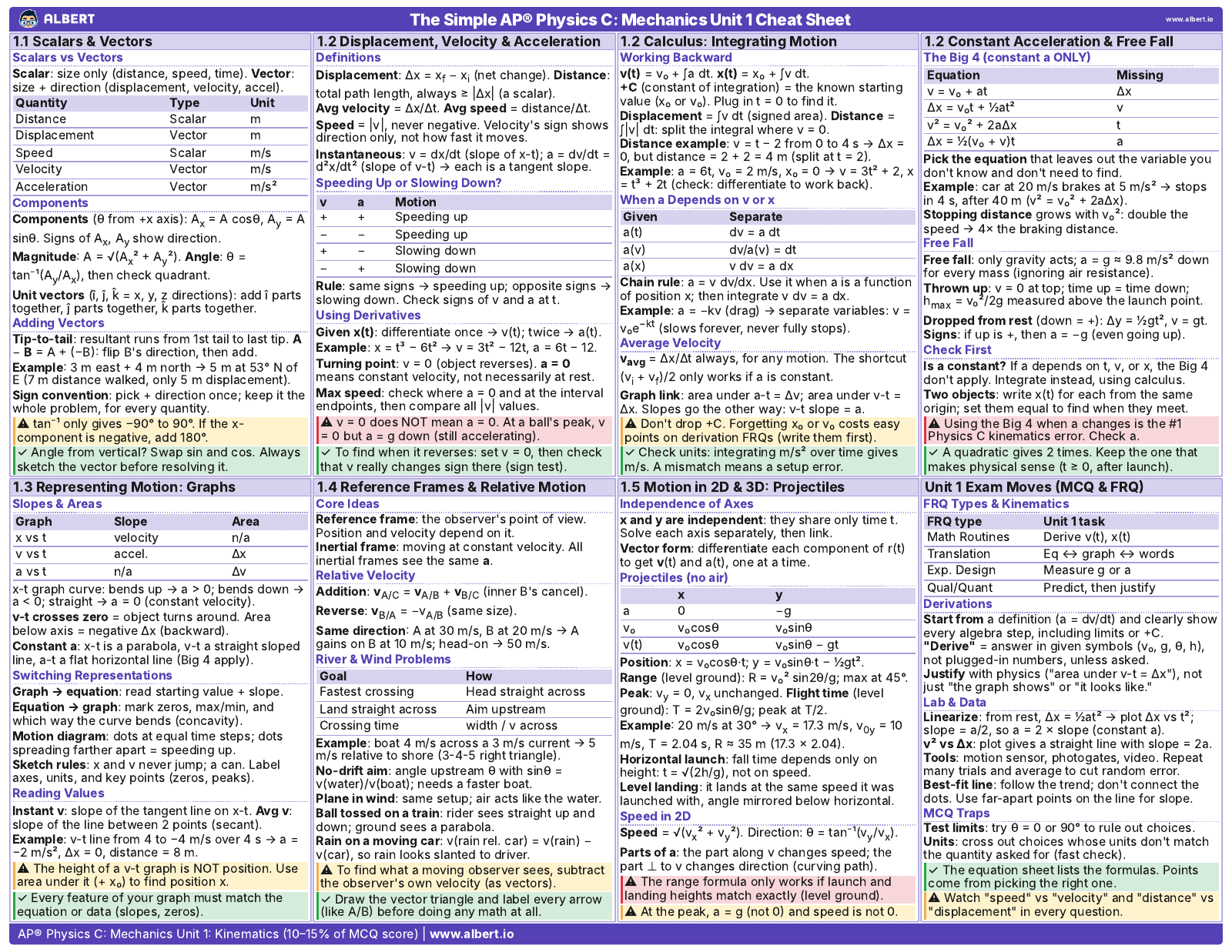
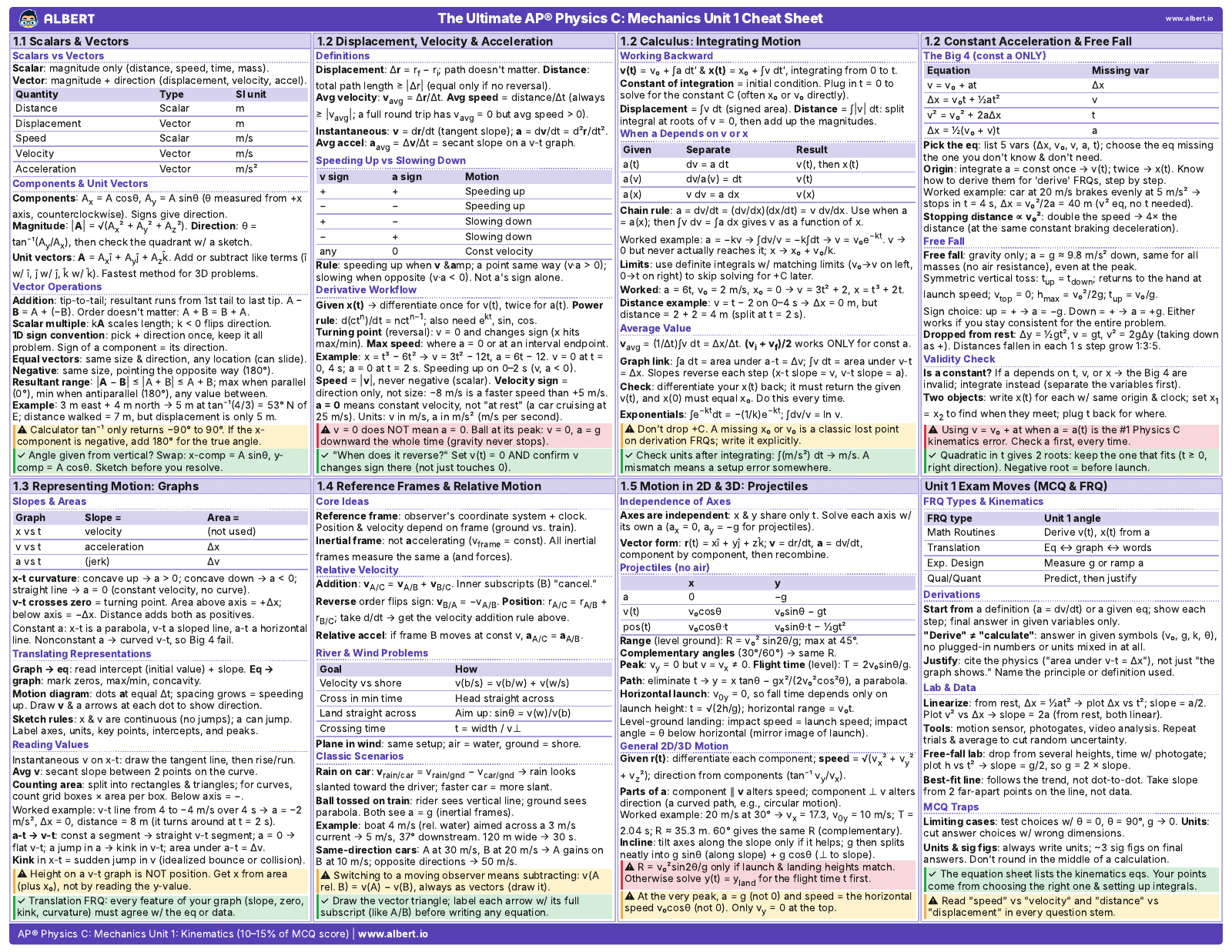
Our AP® Physics C Mechanics Unit 1 cheat sheet packs kinematics onto one landscape page: vectors, calculus-based motion, constant acceleration, graphs, relative motion, and projectiles. Unit 1 carries 10–15% of the multiple-choice score and sets up every unit after it. Pick the Simple version for a first pass or the Ultimate version for the full set of setups, traps, and worked examples.
Practice AP® Physics C: Mechanics Unit 1 questions on Albert
What’s on the AP® Physics C Mechanics Unit 1 Cheat Sheet?
Both versions follow the same eight cards, mapped to the five topics in the College Board’s AP® Physics C: Mechanics course framework: scalars and vectors, displacement and velocity and acceleration (split across three cards because it is the heart of the unit), representing motion, reference frames, and motion in two or three dimensions. The last card is about the exam itself.
The Simple version is for students meeting calculus-based kinematics for the first time, or anyone who wants the essentials in larger type. Each idea gets a few words of context, one worked example per topic, and the single most common trap.
The Ultimate version is for students who already know the basics and want everything that earns points: separating variables when acceleration depends on velocity or position, the chain-rule trick a = v dv/dx, distance versus displacement integrals, river-crossing setups, the general projectile path, and linearization moves for lab questions. Neither version repeats the official equation sheet. Both focus on choosing and setting up the right relationship, which is where students actually lose points.
AP® Physics C: Mechanics Unit 1 at a Glance
Unit 1 is weighted at 10–15% of the multiple-choice section, which works out to roughly four to six of the 42 questions on the May 2027 exam. Its real weight is higher, because kinematics shows up inside almost every free-response question about forces, energy, and rotation.
| Topic | Name | Focus |
|---|---|---|
| 1.1 | Scalars and Vectors | Components, unit vectors, vector addition and subtraction |
| 1.2 | Displacement, Velocity, and Acceleration | Derivatives and integrals linking x, v, and a; constant acceleration |
| 1.3 | Representing Motion | Slopes and areas of x-t, v-t, and a-t graphs; motion diagrams |
| 1.4 | Reference Frames and Relative Motion | Velocity addition, inertial frames, river and wind problems |
| 1.5 | Motion in Two or Three Dimensions | Independent axes, projectiles, vector position functions |
Check the College Board’s AP® Physics C: Mechanics student page for the current exam format before test day, since the multiple-choice count and section timing change starting with the May 2027 exam.
Key Concepts in Unit 1: Kinematics
Vectors and Components
Every two-dimensional problem in this course starts by breaking vectors into perpendicular components. With the angle measured from the positive x-axis, Ax = A cos θ and Ay = A sin θ. To go back, the magnitude is the square root of the sum of the squared components, and the direction is the inverse tangent of Ay/Ax.
Worked example: a hiker walks 3 m east, then 4 m north. In unit-vector form the displacement is 3î + 4ĵ m. Its magnitude is √(9 + 16) = 5 m, and its direction is tan⁻¹(4/3) ≈ 53° north of east. Notice that the hiker walked 7 m of distance but has only 5 m of displacement.
Exam tip: a calculator’s inverse tangent only returns angles between −90° and 90°. If the x-component is negative, add 180° to land in the correct quadrant. A quick sketch catches this every time.
Velocity and Acceleration as Derivatives
Physics C expects you to treat velocity and acceleration as derivatives: v = dx/dt and a = dv/dt. When position is given as a function of time, differentiate once for velocity and twice for acceleration. The object reverses direction where v = 0 and v changes sign, and it speeds up whenever velocity and acceleration point the same way.
Worked example: a particle moves along x with x(t) = t³ − 6t² (meters, seconds). Then v(t) = 3t² − 12t and a(t) = 6t − 12. Velocity is zero at t = 0 and t = 4 s. Between those times v is negative, so the particle moves backward, then turns around at t = 4 s. At t = 1 s, v = −9 m/s and a = −6 m/s². Both are negative, so the particle is speeding up even though it is moving in the negative direction.
Exam tip: “at rest” and “zero acceleration” are different conditions. At the top of a vertical toss, v = 0 but a is still g downward. Multiple-choice questions test this constantly.
Integrating to Find Velocity and Position
Going backward is where Physics C separates from algebra-based physics. Velocity is v₀ plus the integral of acceleration, and position is x₀ plus the integral of velocity. The constant of integration is never optional: it is the initial condition. When acceleration depends on velocity, separate variables as dv/a(v) = dt. When it depends on position, use the chain rule, a = v dv/dx, and integrate v dv = a dx.
Worked example: an object has a = −kv and starts with speed v₀. Separate: dv/v = −k dt. Integrate from v₀ to v on the left and 0 to t on the right: ln(v/v₀) = −kt, so v = v₀e−kt. The speed drops toward zero but never reaches it in finite time. Integrating once more gives the position, which approaches a finite limit of x₀ + v₀/k.
Exam tip: use definite integrals with matching limits on both sides. You skip the separate step of solving for C, and the reader can see exactly which initial condition you used.
Constant Acceleration and Free Fall
The four constant-acceleration equations are on the equation sheet, so the skill being tested is choosing the right one. List the five variables (Δx, v₀, v, a, t), cross out the one you neither know nor need, and use the equation that leaves it out. Free fall is the most common case: a = g ≈ 9.8 m/s² downward for every object when air resistance is ignored.
Worked example: a car moving at 20 m/s brakes with a constant 5 m/s² deceleration. Time is not asked for, so use v² = v₀² + 2aΔx: 0 = 400 − 10Δx gives Δx = 40 m. The same equation shows why stopping distance grows with the square of speed: double the speed and the car needs four times the distance.
Exam tip: before you reach for any of these four equations, confirm that acceleration is constant. If a depends on time, velocity, or position, the equations are invalid and you must integrate.
Graphs and Relative Motion
Two facts carry most graph questions: slope moves you down the chain (x-t slope is velocity, v-t slope is acceleration) and area moves you back up (area under v-t is displacement, area under a-t is change in velocity). For relative motion, the rule is vA/C = vA/B + vB/C, where the inner subscripts match.
Worked example: a boat that moves at 4 m/s relative to the water points straight across a river flowing at 3 m/s. Relative to the shore, its velocity is the vector sum: 5 m/s at about 37° downstream. If the river is 120 m wide, the crossing takes 120/4 = 30 s, because only the across-component of velocity covers the width. The current does not slow the crossing; it only moves the landing point downstream by 3 × 30 = 90 m.
Exam tip: label every vector in a relative-motion triangle with both subscripts before you write any equation. Most sign errors come from adding when you should subtract.
Projectile Motion
The horizontal and vertical motions of a projectile are independent and share only time. Horizontally, acceleration is zero and velocity stays v₀ cos θ. Vertically, acceleration is −g. At the peak, the vertical velocity is zero but the horizontal velocity is not.
Worked example: a ball is launched at 20 m/s and 30° above level ground. The components are vx = 17.3 m/s and v0y = 10 m/s. Time of flight is 2v0y/g = 2.04 s, and the range is 17.3 × 2.04 ≈ 35.3 m. Launching at 60° gives the same range because sin 2θ is the same for complementary angles.
Exam tip: the range formula R = v₀² sin 2θ / g only works when the launch and landing heights match. For a ball thrown off a cliff, solve the vertical equation for time first, then use that time horizontally.
How Unit 1 Shows Up on the Exam
The exam has a multiple-choice section and four free-response questions, one of each type: Mathematical Routines, Translation Between Representations, Experimental Design and Analysis, and Qualitative/Quantitative Translation. Kinematics can anchor any of them.
In Mathematical Routines, expect to derive v(t) or x(t) from a given acceleration function, often one that depends on velocity. Scorers reward a correct starting relationship, a correct integral setup with limits, and a final answer in the given symbols. In Translation Between Representations, you might sketch a v-t graph that matches an equation or a description, and every slope, intercept, and zero has to agree. Experimental Design questions often ask how to measure acceleration or g with motion sensors or photogates, and then how to linearize the data, such as plotting Δx against t² so that the slope equals a/2. Qualitative/Quantitative Translation asks you to predict a result in words, then show that your math agrees.
Multiple-choice questions lean on graph reading, sign conventions, and limiting cases. Testing an answer choice with θ = 0 or θ = 90° eliminates wrong options quickly.
Common Mistakes in Unit 1
- Using constant-acceleration equations when a changes. Fix: check whether a depends on t, v, or x before choosing a method. If it does, integrate.
- Dropping the constant of integration. Fix: write v₀ and x₀ explicitly, or use definite integrals with matching limits.
- Confusing distance and displacement. Fix: displacement is the integral of v; distance is the integral of |v|, split wherever v = 0.
- Reading position off a v-t graph. Fix: the height of a v-t graph is velocity. Find displacement from the area under it.
- Setting velocity to zero at a projectile’s peak. Fix: only the vertical component is zero. The horizontal component is unchanged for the whole flight.
Frequently Asked Questions
Can I use this AP® Physics C Mechanics Unit 1 cheat sheet on the exam?
No. It is a study tool for review and practice. On exam day you get the official equation sheet, which is why our sheet focuses on how to set up and apply relationships rather than listing formulas you will already have.
Should I start with the Simple or the Ultimate version?
Start with Simple if kinematics with calculus is new to you or you are reviewing early in the year. Switch to Ultimate once the core ideas feel solid and you want the edge cases, integral setups, and lab moves that separate a 4 from a 5.
How much calculus do I need for Unit 1?
You need derivatives and integrals of polynomials and simple exponentials, plus separation of variables. The chain-rule form a = v dv/dx also appears regularly. If you can integrate dv/v, you are ready.
What is the best way to practice after reviewing the cheat sheet?
Keep the AP® Physics C Mechanics Unit 1 cheat sheet open while you work timed problems that mix representations: an equation to graph, a graph to a number, and a short derivation. Then check every answer for units and limiting cases, the same habits that earn points on the free-response section.