
Maximize your score with these resources:
- Albert.io AP® Biology question banks
- Free AP® Biology study guides
- Free AP® Biology score calculator
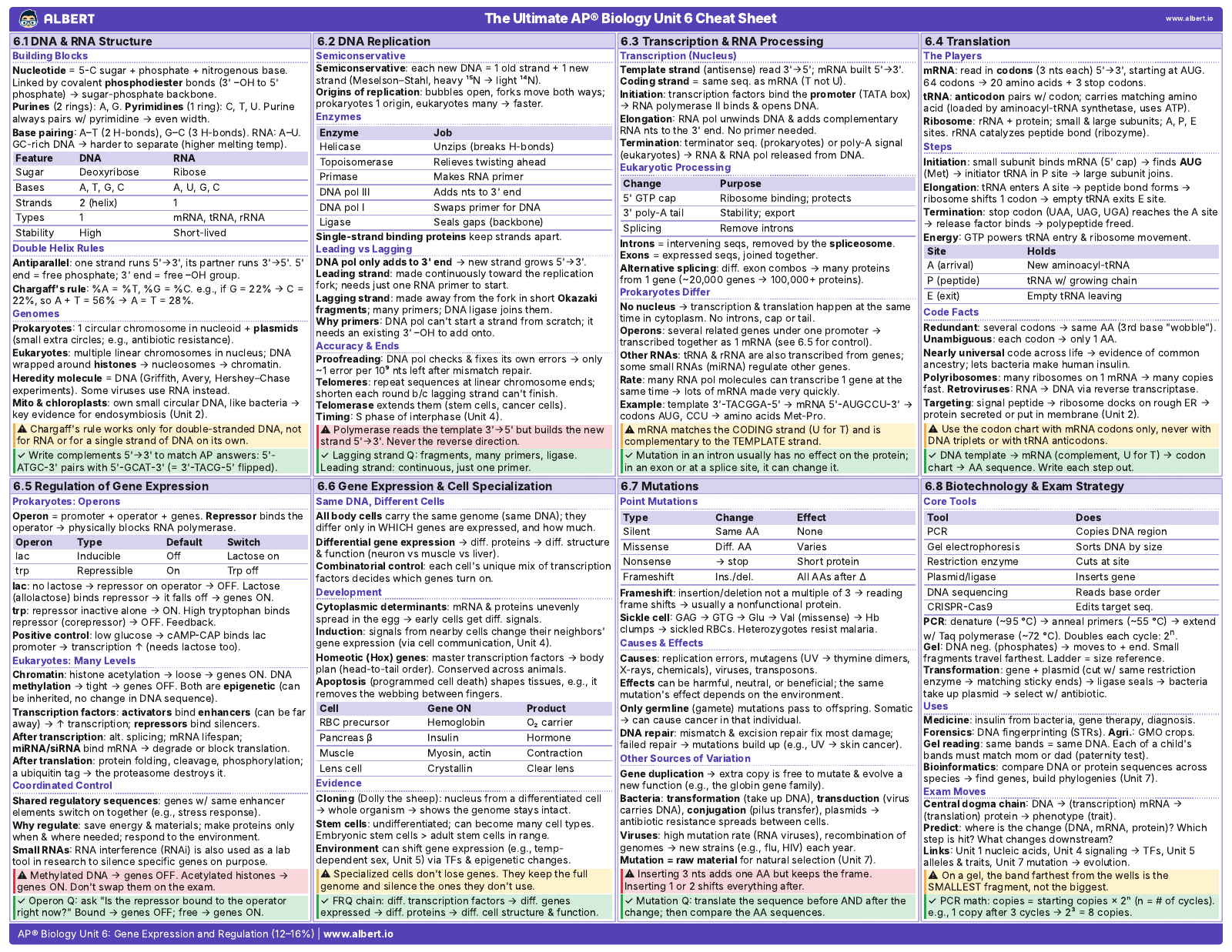
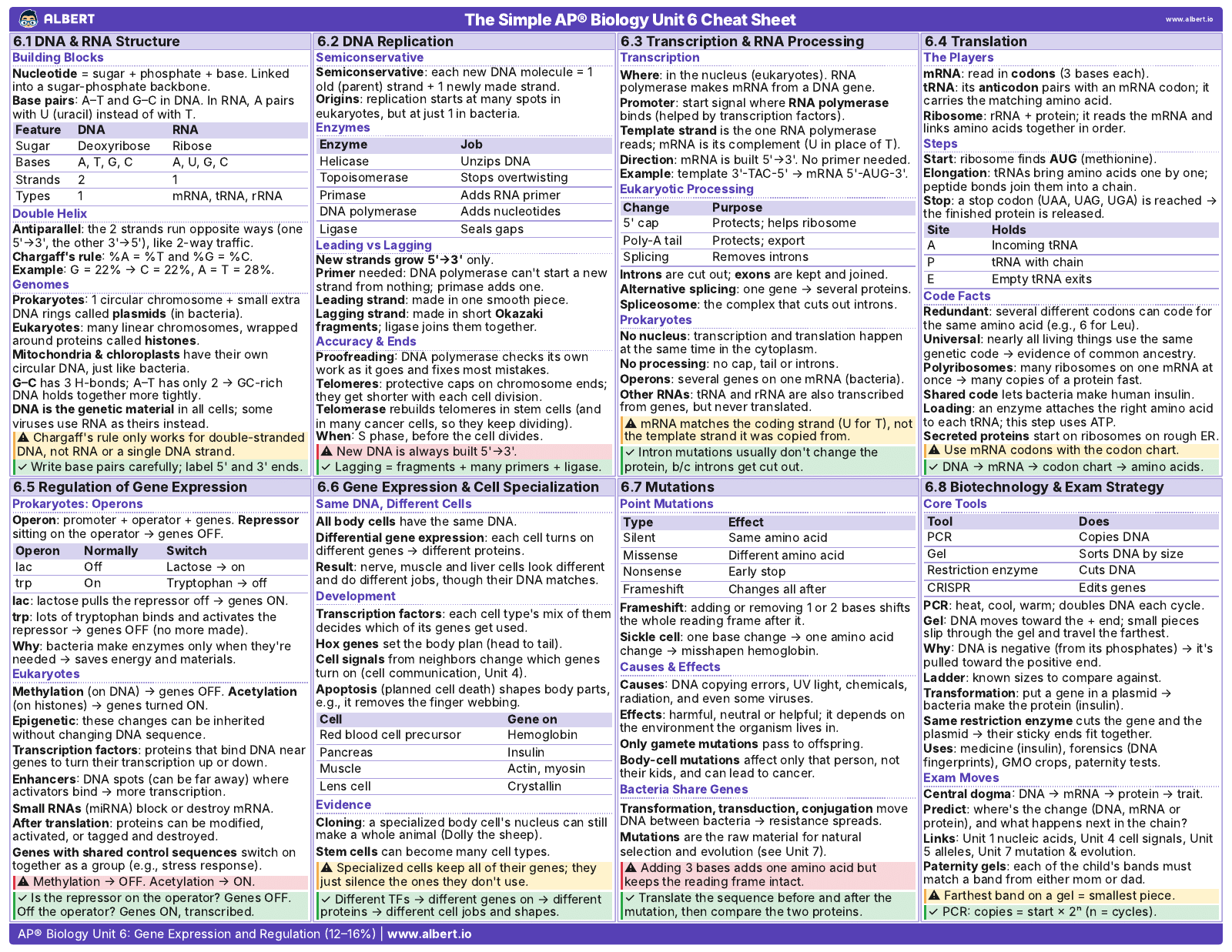
This AP Bio Unit 6 cheat sheet covers gene expression and regulation: DNA and RNA structure, replication, transcription, translation, how genes get switched on and off, mutations, and biotechnology. Unit 6 is worth 12–16% of the AP® Biology exam. Download it below in Simple for a first pass or Ultimate for full detail.
Practice AP® Biology Unit 6 questions on Albert
What’s on the AP Bio Unit 6 Cheat Sheet?
Both versions have eight cards, one for each College Board topic in the unit, from 6.1 DNA and RNA structure through 6.8 biotechnology. The last card also includes exam strategy.
- Simple is for students learning the unit or reviewing for a class test. It covers base pairing, the replication enzymes, the steps of transcription and translation, the lac and trp operons, mutation types, and what PCR and gel electrophoresis do.
- Ultimate is for students aiming for a 4 or 5. It adds leading and lagging strand detail, RNA processing, ribosome A, P and E sites, eukaryotic regulation by methylation, acetylation, enhancers and small RNAs, development and Hox genes, horizontal gene transfer in bacteria, and PCR math.
Start with Simple until you can trace DNA to protein without notes, then move to Ultimate.
AP® Biology Unit 6 at a Glance
Unit 6 is one of the heaviest units on the exam. It builds on nucleic acids from Unit 1 and connects to inheritance in Unit 5 and evolution in Unit 7. The AP® Biology Course and Exam Description splits it into eight topics.
| Topic | Name | Focus |
|---|---|---|
| 6.1 | DNA and RNA Structure | Nucleotides, base pairing, genome organization |
| 6.2 | Replication | Semiconservative copying and its enzymes |
| 6.3 | Transcription and RNA Processing | Making mRNA; caps, tails and splicing |
| 6.4 | Translation | Ribosomes, tRNA and the genetic code |
| 6.5 | Regulation of Gene Expression | Operons and eukaryotic control |
| 6.6 | Gene Expression and Cell Specialization | Why cells with the same DNA differ |
| 6.7 | Mutations | Types, causes and effects of DNA changes |
| 6.8 | Biotechnology | PCR, gels, cloning, sequencing, CRISPR |
At 12–16% of the score, expect roughly 7 to 10 multiple-choice questions, and gene expression is a frequent free-response topic.
Key Concepts in Unit 6: Gene Expression and Regulation
DNA Structure and Replication (6.1–6.2)
DNA is two antiparallel strands of nucleotides held together by hydrogen bonds between bases: A with T, G with C. Replication is semiconservative: each new double helix keeps one old strand. Helicase unzips the DNA, primase lays down a short RNA primer, DNA polymerase adds nucleotides to the 3′ end, and ligase seals the gaps. Because polymerase only builds 5′ to 3′, one strand is made continuously (leading) and the other in short Okazaki fragments (lagging).
Worked example: A DNA sample is 22% guanine. By Chargaff’s rule, cytosine is also 22%. That leaves 100 − 44 = 56% for A and T together, so each is 28%.
Exam tip: For lagging strand questions, look for three clues: fragments, many primers, and ligase.
Transcription and RNA Processing (6.3)
RNA polymerase binds a promoter, with help from transcription factors in eukaryotes, and builds mRNA complementary to the template strand. In eukaryotes the new RNA gets a 5′ cap and a poly-A tail, and introns are spliced out while exons are joined. Alternative splicing lets one gene make several proteins. Prokaryotes skip all of this processing, and because they have no nucleus, they can translate mRNA while it’s still being made.
Worked example: The template strand reads 3′-TACGGA-5′. The mRNA is its complement, 5′-AUGCCU-3′. The coding strand reads the same as the mRNA with T instead of U: 5′-ATGCCT-3′.
Exam tip: A mutation in an intron usually doesn’t change the protein, because introns are removed. A mutation at a splice site can.
Translation (6.4)
Ribosomes read mRNA three bases at a time. Each codon is matched by a tRNA anticodon, and the tRNA brings the right amino acid. Translation starts at AUG, adds amino acids one at a time as the ribosome moves along the mRNA, and ends at a stop codon. The genetic code is nearly universal, which is evidence of common ancestry and is why bacteria can make human insulin.
Worked example: The mRNA 5′-AUG-GCU-UGG-UAA-3′ codes for methionine, alanine, tryptophan, then stop. A tRNA carrying alanine would have the anticodon 3′-CGA-5′.
Exam tip: Always use mRNA codons with the codon chart, not DNA or tRNA sequences.
Regulating Gene Expression (6.5)
Bacteria group genes into operons controlled by one promoter and an operator. The lac operon is normally off: a repressor sits on the operator until lactose shows up and pulls it off. The trp operon is normally on: when tryptophan builds up, it activates the repressor and shuts the genes down. Eukaryotes control genes at many levels. DNA methylation tends to silence genes, histone acetylation tends to open them up, transcription factors and enhancers set how much a gene is transcribed, and small RNAs can block or destroy mRNA.
Worked example: A mutation stops the lac repressor from binding the operator. The lac genes are now transcribed all the time, with or without lactose, because nothing blocks RNA polymerase.
Exam tip: Ask one question for any operon problem: is the repressor bound to the operator? Bound means off; free means on.
Gene Expression and Cell Specialization (6.6)
Every cell in your body has the same genome. A nerve cell and a muscle cell differ because they express different genes, controlled by different combinations of transcription factors. During development, signals from neighboring cells and uneven materials in the egg push cells down different paths. Hox genes set the body plan from head to tail and are shared across animals.
Exam tip: The full chain for any specialization question: different transcription factors, different genes expressed, different proteins, different structure and function.
Mutations (6.7)
A point mutation changes a single base. A silent mutation still codes the same amino acid, a missense mutation changes one amino acid, and a nonsense mutation creates an early stop codon. Inserting or deleting bases in numbers other than three causes a frameshift that changes every amino acid after it. Mutations can be harmful, neutral or helpful depending on the environment, and only those in gametes are inherited. Bacteria also share genes directly through transformation, transduction and conjugation, which spreads antibiotic resistance.
Worked example: In sickle cell disease, the DNA codon GAG becomes GTG. The mRNA changes from GAG to GUG, and the amino acid changes from glutamic acid to valine. That single change makes hemoglobin clump at low oxygen, which bends red blood cells into a sickle shape.
Exam tip: Translate the sequence before and after the mutation, then compare the amino acids.
Biotechnology (6.8)
PCR copies a stretch of DNA by cycling through heating to separate strands, cooling so primers attach, and warming so a heat-stable polymerase copies the strand. Gel electrophoresis sorts DNA fragments by size: DNA is negatively charged, so it moves toward the positive end, and smaller pieces travel farther. Restriction enzymes cut DNA at specific sites, letting scientists paste a gene into a plasmid that bacteria take up and express.
Worked example: Starting with 10 copies of a DNA sequence, how many are there after 5 cycles of PCR? Each cycle doubles the amount: 10 × 2⁵ = 320 copies.
Exam tip: On a gel, the band farthest from the wells is the smallest fragment.
How Unit 6 Shows Up on the Exam
Multiple-choice questions often give you a DNA or mRNA sequence and a codon chart and ask what protein results, or what a mutation does. Others show an operon diagram, a gel, or a graph of gene expression in different cells or conditions.
On the free-response section, expect a question that asks you to predict the effect of a mutation or a regulatory change and justify it step by step, from DNA through protein. Scorers reward naming the specific step and molecule involved. See the AP® Biology exam page for the current format.
Common Mistakes in Unit 6
- Mistake: Reading the codon chart with DNA bases. Fix: Convert to mRNA first, using U instead of T.
- Mistake: Saying DNA polymerase builds 3′ to 5′. Fix: New strands always grow 5′ to 3′.
- Mistake: Swapping methylation and acetylation. Fix: Methylated DNA is usually off; acetylated histones are usually on.
- Mistake: Thinking specialized cells have lost genes. Fix: They keep the full genome and silence what they don’t need.
- Mistake: Calling the farthest gel band the largest. Fix: Small fragments move farthest.
Frequently Asked Questions
Can I use this cheat sheet on the exam?
No. Notes aren’t allowed on the AP® Biology exam. The AP Bio Unit 6 cheat sheet is a study tool for reviewing and testing yourself before exam day.
Should I start with the Simple or Ultimate version?
Start with Simple if Unit 6 is new or you have a class test coming. Switch to Ultimate once Simple feels easy, or if you’re aiming for a 5.
Do I need to memorize the codon chart?
No. The exam gives you a codon chart when you need one. You do need to know start (AUG) and that there are three stop codons, and how to convert DNA to mRNA before using the chart.
How are prokaryotic and eukaryotic gene expression different?
Prokaryotes have no nucleus, so transcription and translation happen together, there are no introns to remove, and related genes are often grouped in operons. Eukaryotes process their mRNA and regulate genes at many more points.
How does Unit 6 connect to other units?
Nucleotides come from Unit 1, signaling that switches genes on comes from Unit 4, and alleles from Unit 5 are versions of the genes here. Mutations are the raw material for evolution in Unit 7.