
Maximize your score with these resources:
- Albert.io AP® Precalculus question banks
- Free AP® Precalculus study guides
- Free AP® Precalculus score calculator
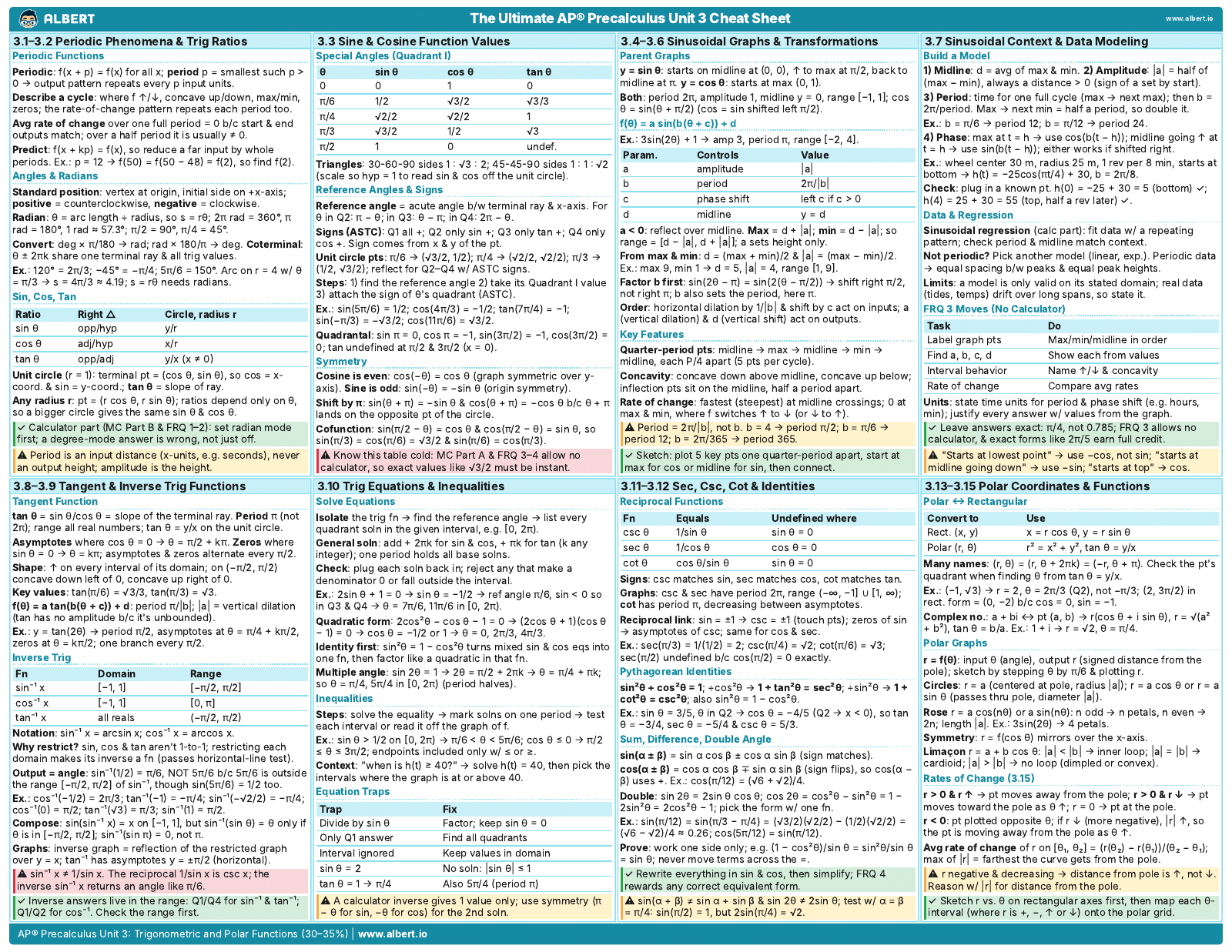
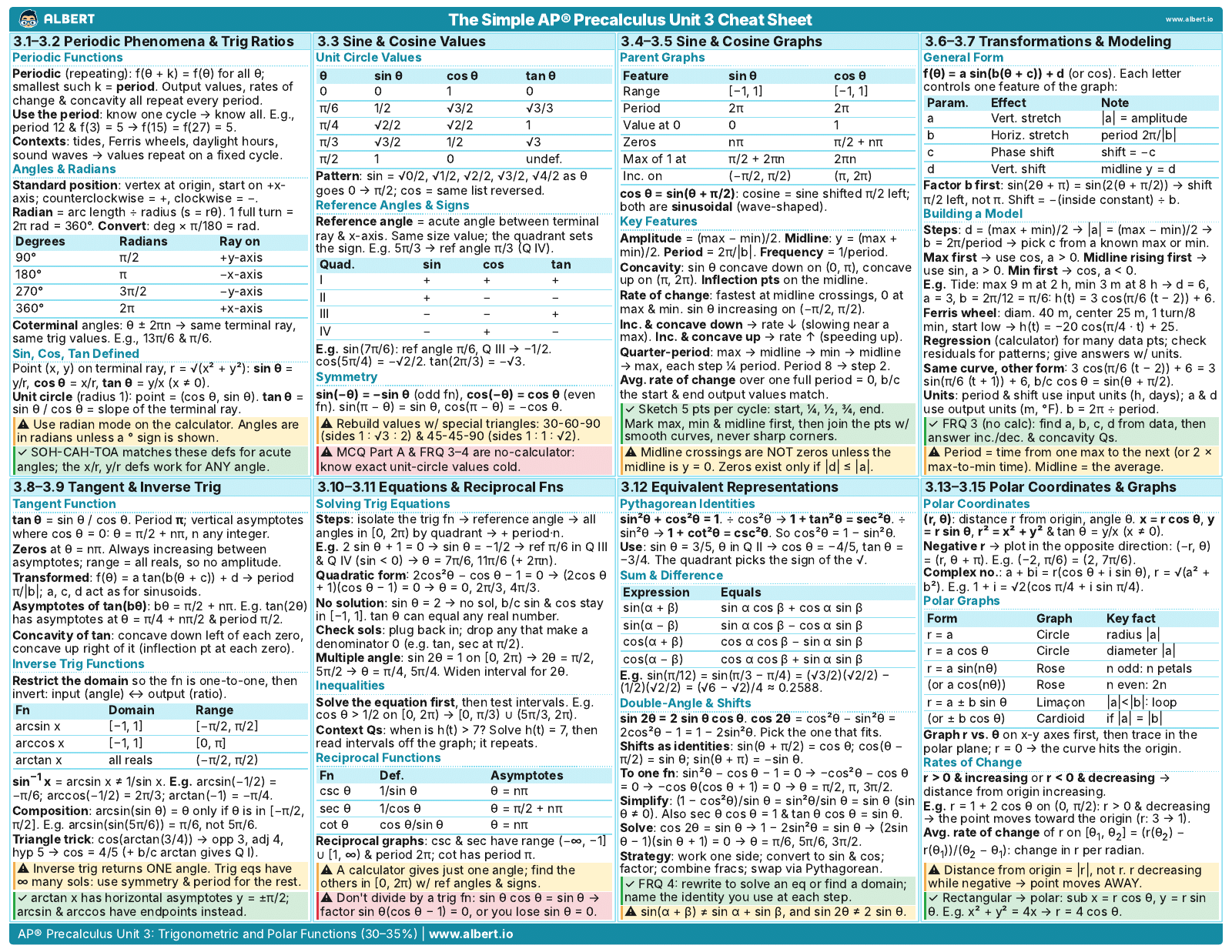
This AP Precalc Unit 3 cheat sheet puts trigonometric and polar functions on one printable page: the unit circle, sinusoidal models, tangent and inverse trig, identities, and polar graphs. Unit 3 carries 30–35% of the AP® Precalculus multiple-choice score, one of the two biggest shares alongside Unit 1. Start with the Simple version for a first pass, then switch to the Ultimate version for full depth.
Practice AP® Precalculus Unit 3 questions on Albert
What’s on the AP Precalc Unit 3 Cheat Sheet?
Both versions follow the same eight cards, in the order the College Board AP® Precalculus course teaches them: periodic phenomena and trig ratios, unit circle values, sine and cosine graphs, transformations and modeling, tangent and inverse trig, equations and reciprocal functions, identities, and polar coordinates.
The Simple version is for students meeting this material for the first time or rebuilding after a rough test. It keeps the core definitions, the unit circle table, the sinusoid parameters, the inverse trig ranges, and one worked example per idea, with a few words of context the first time a term appears.
The Ultimate version is for review in the weeks before the exam. It adds the details that separate a 4 from a 5: general solutions to trig equations, composition traps like arcsin(sin θ), rewriting one sinusoid in several forms, rate-of-change reasoning on polar curves, and more no-calculator examples. Neither version is a reference sheet; each line tells you what to do with a fact, not just what the fact is.
AP® Precalculus Unit 3 at a Glance
Unit 3 has 15 topics. The College Board weights it at 30–35% of the multiple-choice section, and Free-Response Question 3 is built entirely on it. Use this table as your AP® Precalculus Unit 3 review checklist.
| Topic | Name | Focus |
|---|---|---|
| 3.1 | Periodic Phenomena | Period, repeating rates of change and concavity |
| 3.2 | Sine, Cosine, and Tangent | Ratios on a circle of radius r; radians |
| 3.3 | Sine and Cosine Function Values | Exact values, reference angles, signs by quadrant |
| 3.4 | Sine and Cosine Function Graphs | Parent graphs, zeros, extrema, concavity |
| 3.5 | Sinusoidal Functions | Amplitude, midline, period, frequency |
| 3.6 | Sinusoidal Function Transformations | Parameters a, b, c, d |
| 3.7 | Sinusoidal Function Context and Data Modeling | Building and using a periodic model |
| 3.8 | The Tangent Function | Period π, asymptotes, slope of the terminal ray |
| 3.9 | Inverse Trigonometric Functions | Restricted domains and ranges |
| 3.10 | Trigonometric Equations and Inequalities | Solutions in an interval and general solutions |
| 3.11 | The Secant, Cosecant, and Cotangent Functions | Reciprocal functions and their asymptotes |
| 3.12 | Equivalent Representations of Trigonometric Functions | Pythagorean, sum, difference, and double-angle identities |
| 3.13 | Trigonometry and Polar Coordinates | Converting points; complex numbers in polar form |
| 3.14 | Polar Function Graphs | Circles, roses, limaçons, cardioids |
| 3.15 | Rates of Change in Polar Functions | Distance from the origin increasing or decreasing |
Key Concepts in Unit 3: Trigonometric and Polar Functions
Periodic Behavior, Radians, and the Unit Circle (3.1–3.3)
A function is periodic when f(θ + k) = f(θ) for every input, and the smallest such k is the period. The useful consequence is that one full cycle tells you everything: output values, intervals of increase, and concavity all repeat. If a function has period 12 and f(3) = 5, then f(27) = 5 without any more work.
Angles in this course are measured in radians, where a radian is arc length divided by radius. For a point (x, y) on the terminal ray at distance r from the origin, sin θ = y/r, cos θ = x/r, and tan θ = y/x. On the unit circle, r = 1, so the point is simply (cos θ, sin θ), and tan θ is the slope of the terminal ray.
Worked example: find sin(5π/3) and cos(5π/3). The angle 5π/3 lands in Quadrant IV with reference angle 2π − 5π/3 = π/3. In Quadrant IV, sine is negative and cosine is positive, so sin(5π/3) = −√3/2 and cos(5π/3) = 1/2.
Exam tip: Part A of the multiple-choice section and both FRQs in Part B of the free-response section ban calculators. You need the special values at π/6, π/4, and π/3 memorized, plus the quadrant sign rules, so you can produce any multiple of them in seconds.
Sinusoidal Functions and Transformations (3.4–3.7)
Sine and cosine graphs are the same wave shifted by π/2, since cos θ = sin(θ + π/2). Any transformed version is a sinusoidal function, written f(θ) = a sin(b(θ + c)) + d or with cosine. Here |a| is the amplitude, 2π/|b| is the period, −c is the phase shift, and y = d is the midline. Factor b out before reading the shift: sin(2θ + π) is sin(2(θ + π/2)), a shift of π/2 to the left.
The graph’s behavior follows a quarter-period rhythm: max, midline, min, midline, max. Between a minimum and the next midline crossing, the function increases and is concave up, so it rises at an increasing rate. The rate of change is greatest at midline crossings and zero at maxima and minima.
Worked example: a Ferris wheel has a 40 m diameter, its center is 25 m above the ground, it makes one turn every 8 minutes, and a rider boards at the bottom. The midline is d = 25, the amplitude is 20, and the period is 8, so b = 2π/8 = π/4. Starting at a minimum calls for a negative cosine: h(t) = −20 cos(πt/4) + 25. To find when the rider first reaches 35 m, solve −20 cos(πt/4) + 25 = 35, so cos(πt/4) = −1/2 and πt/4 = 2π/3, giving t = 8/3 ≈ 2.67 minutes.
Exam tip: when a model starts at a maximum, use cosine with a > 0; at a minimum, cosine with a < 0; on the midline going up, sine with a > 0. Picking the right base function saves you from solving for a messy phase shift.
Tangent and Inverse Trigonometric Functions (3.8–3.9)
The tangent function, tan θ = sin θ / cos θ, has period π, zeros at multiples of π, and vertical asymptotes wherever cos θ = 0, at θ = π/2 + nπ. It increases on every interval between asymptotes and has no amplitude, since its range is all real numbers. For a tan(b(θ + c)) + d, the period is π/|b|.
Inverse trig functions exist only after the domain is restricted so each output occurs once. Arcsine returns angles in [−π/2, π/2], arccosine in [0, π], and arctangent in (−π/2, π/2). These ranges matter most in compositions: arcsin(sin(5π/6)) is π/6, not 5π/6, because 5π/6 sits outside arcsine’s range.
Worked example: solve tan θ = −1 on [0, 2π). Arctan(−1) gives −π/4, which is outside the interval. Tangent has period π, so add π to get 3π/4 and add 2π to get 7π/4. Both lie in the interval, and those are the solutions.
Exam tip: an inverse function gives you exactly one angle. A multiple-choice item that asks for all solutions in an interval is testing whether you use symmetry and the period to find the rest.
Trig Equations, Inequalities, and Reciprocal Functions (3.10–3.11)
Solving a trig equation follows the same steps every time: isolate the trig function, find the reference angle, place it in every quadrant where the sign is right, and add multiples of the period for general solutions. Equations in quadratic form factor like any quadratic. For inequalities, solve the matching equation first, then use the graph or test values to decide which intervals work.
The reciprocal functions are csc θ = 1/sin θ, sec θ = 1/cos θ, and cot θ = cos θ/sin θ. Each has vertical asymptotes where its denominator is zero, so csc θ and cot θ break at multiples of π and sec θ breaks at π/2 + nπ.
Worked example: solve 2 sin²θ = sin θ on [0, 2π). Move everything to one side and factor: sin θ(2 sin θ − 1) = 0. Then sin θ = 0 gives θ = 0 and π, and sin θ = 1/2 gives θ = π/6 and 5π/6. For the inequality 2 sin θ − 1 ≥ 0 on the same interval, the boundary points are π/6 and 5π/6, and sine is at least 1/2 between them, so the solution is [π/6, 5π/6].
Exam tip: never divide both sides by sin θ or cos θ. In the example above, dividing by sin θ would have thrown away two of the four solutions.
Identities and Equivalent Forms (3.12)
Topic 3.12 asks you to rewrite trig expressions in forms that are easier to solve or analyze. The core tools are the Pythagorean identity sin²θ + cos²θ = 1 (and its versions 1 + tan²θ = sec²θ and 1 + cot²θ = csc²θ), the sum and difference identities for sine and cosine, and the double-angle identities sin 2θ = 2 sin θ cos θ and cos 2θ = cos²θ − sin²θ = 2cos²θ − 1 = 1 − 2sin²θ.
Worked example: solve cos 2θ = cos θ on [0, 2π). Replace cos 2θ with 2cos²θ − 1 so the equation has one function: 2cos²θ − cos θ − 1 = 0, which factors as (2cos θ + 1)(cos θ − 1) = 0. So cos θ = 1 gives θ = 0, and cos θ = −1/2 gives θ = 2π/3 and 4π/3. A sum identity works the same way for exact values: cos(7π/12) = cos(π/3 + π/4) = (1/2)(√2/2) − (√3/2)(√2/2) = (√2 − √6)/4.
Exam tip: choose the version of cos 2θ that matches the rest of the equation. If the other terms are in cosine, use 2cos²θ − 1; if they are in sine, use 1 − 2sin²θ.
Polar Coordinates, Polar Graphs, and Rates of Change (3.13–3.15)
A polar coordinate (r, θ) locates a point by its directed distance from the origin and its angle. Convert with x = r cos θ, y = r sin θ, and r² = x² + y². The same point has many names: (−2, π/6) and (2, 7π/6) are identical, because a negative r points the opposite direction. Complex numbers use the same idea, with a + bi = r(cos θ + i sin θ).
Know the standard polar graphs: r = a is a circle, r = a cos θ is a circle through the origin, r = a sin(nθ) is a rose with n petals when n is odd and 2n when n is even, and r = a + b sin θ is a limaçon with an inner loop when |a| < |b| and a cardioid when |a| = |b|.
Worked example: for r = 2 + 4 sin θ, r = 0 when sin θ = −1/2, at θ = 7π/6 and 11π/6. On (7π/6, 3π/2), r falls from 0 to −2, so r is negative and decreasing. When r is negative and decreasing, |r| grows, so the point is moving away from the origin even though r is going down.
Exam tip: distance from the origin is |r|. The rule is that distance increases when r and its rate of change have the same sign and decreases when they have opposite signs.
How Unit 3 Shows Up on the Exam
From May 2027, the multiple-choice section has 42 questions: 29 without a calculator in 65 minutes and 13 with a graphing calculator in 40 minutes. Unit 3 accounts for 30–35% of that section, so expect around 13 to 15 trig and polar questions. The no-calculator part leans on exact values, graph features, and identities. The calculator part tends to use data and models.
The free-response section has four questions, each with parts (A), (B), and (C). FRQ 3, Modeling a Periodic Context, is all Unit 3: you read a scenario or table, build a sinusoidal function by finding a, b, c, and d, and then reason about where it increases, decreases, and changes concavity. FRQ 4, Symbolic Manipulations, draws on Units 2 and 3 and often asks you to rewrite a trig expression or solve a trig equation. Both are in Part B, where calculators are not permitted. Scorers reward correct values with supporting work and reasoning that names the evidence, such as “the function is increasing because it goes from a minimum to the midline.” The College Board’s AP® Precalculus exam page has the current format and past free-response questions for AP® Precalculus Unit 3 practice. Keep the AP Precalc Unit 3 cheat sheet beside you as you work through them, and mark any line you had to look up.
Common Mistakes in Unit 3
- Reading the phase shift without factoring. In sin(3θ − π), the shift is π/3 right, not π. Factor b out first: sin(3(θ − π/3)).
- Stopping at one solution. Your calculator’s inverse sine gives a single angle. Use the quadrant signs and the period to list every solution in the interval.
- Treating midline crossings as zeros. A sinusoid crosses y = 0 only when its midline is y = 0 or the amplitude is large enough to reach it.
- Dividing by a trig function. Factor instead, or you lose every solution where that function equals zero.
- Using r instead of |r| for distance. When r is negative and decreasing, the point is moving away from the origin. Check the sign of r before you describe distance.
Frequently Asked Questions
Can I use this cheat sheet on the exam?
No. The AP® Precalculus exam does not allow notes, and it does not provide a formula sheet. The AP Precalc Unit 3 cheat sheet is a study tool for review, which is why it includes unit circle values and identities you need to know without help.
Should I start with the Simple or the Ultimate version?
Start with Simple if you are still learning the unit or if trig felt shaky in class. Once you can explain every line without looking, move to Ultimate for the edge cases and extra examples that appear on harder questions.
Do I need to memorize the unit circle?
Yes. Exact values for multiples of π/6 and π/4 come up throughout the no-calculator sections, including FRQ 3 and FRQ 4. Learn the values for the first quadrant and the sign rules, and you can rebuild the rest.
How much polar content is on the AP® Precalculus exam?
Polar coordinates and graphs are three of the unit’s fifteen topics, so they appear less often than sinusoidal modeling. Expect a few multiple-choice questions on converting points, identifying graphs, and deciding whether a point is moving toward or away from the origin.