
Maximize your score with these resources:
- Albert.io ACT® Enhanced Math question banks
- Free ACT® Enhanced Math study guides
- Free ACT® Enhanced Math score calculator
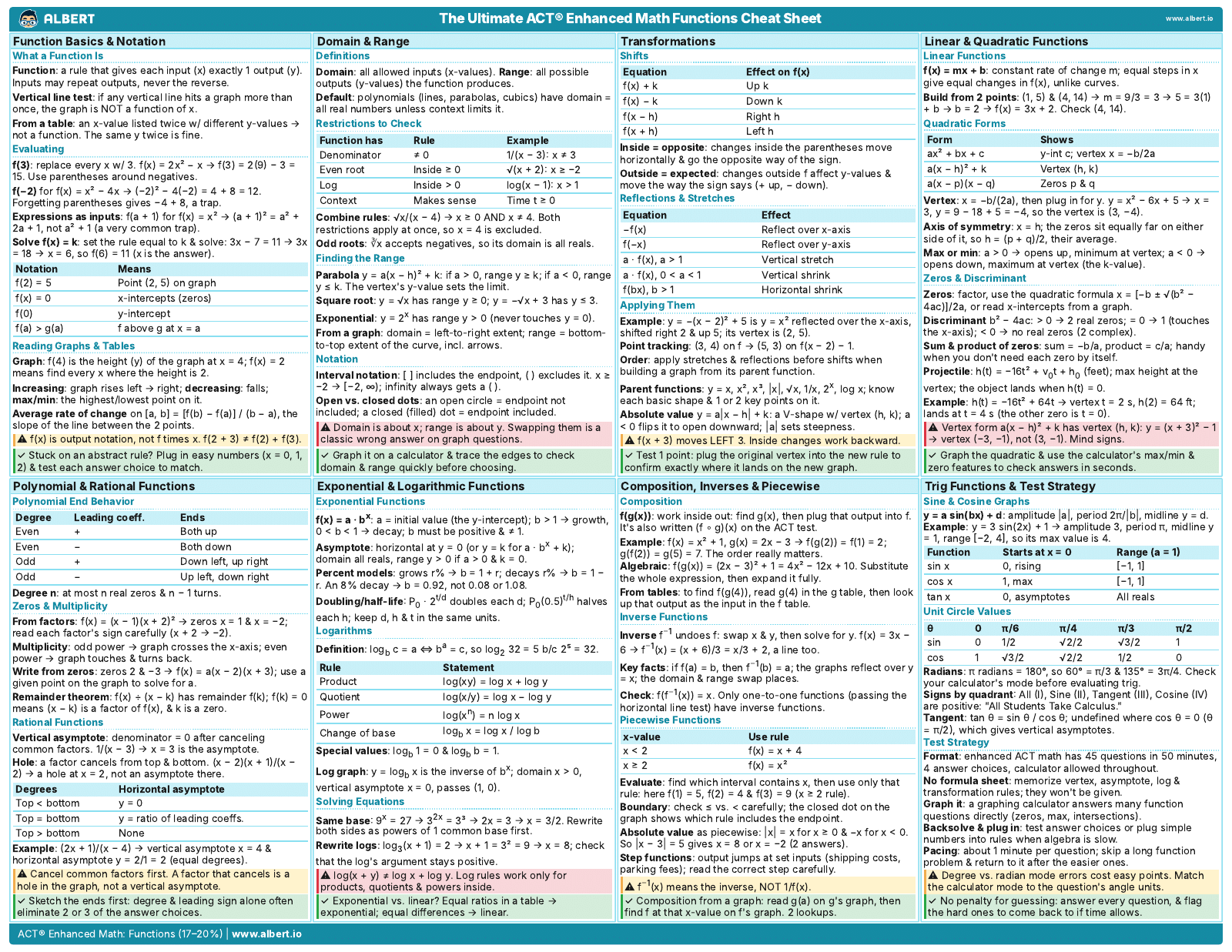
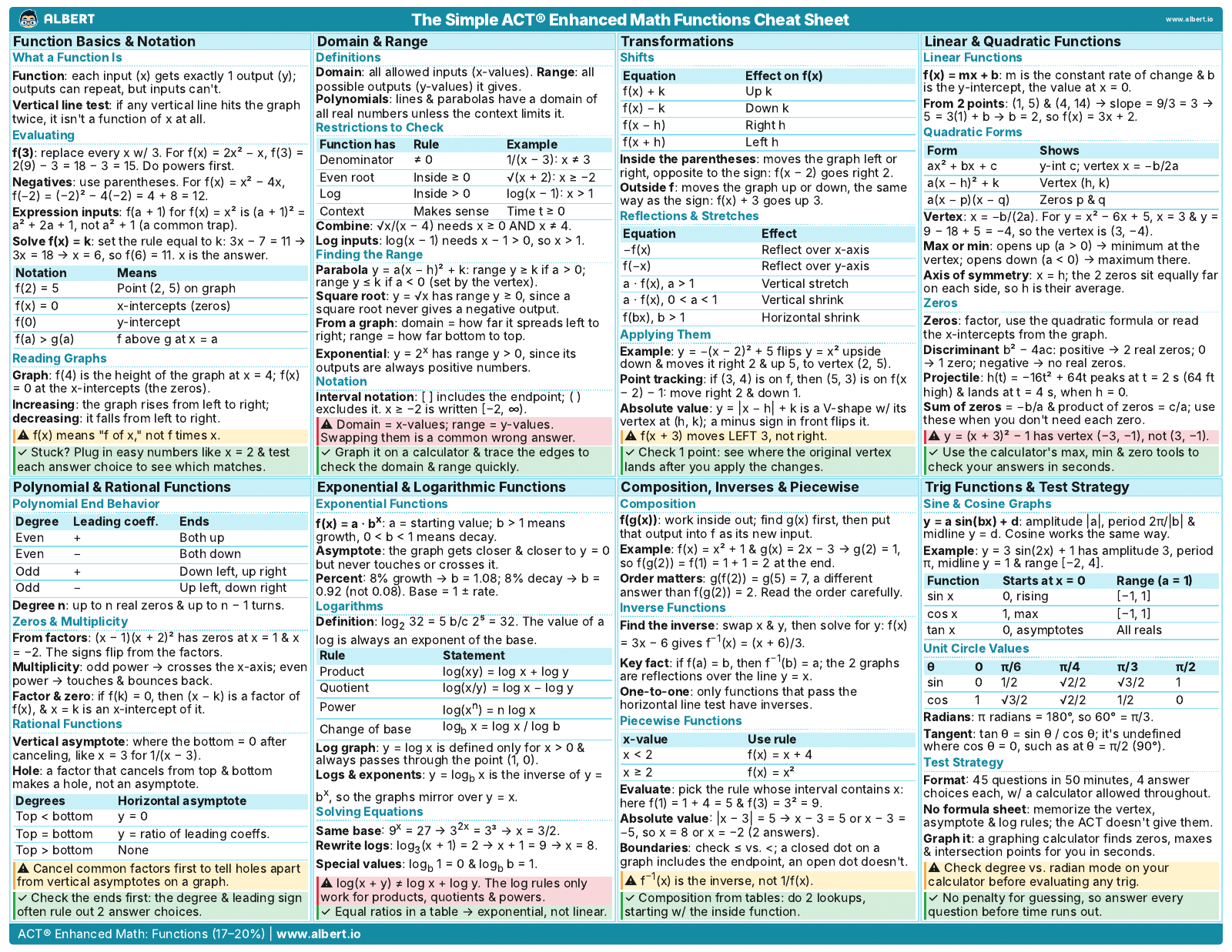
This ACT Math Functions cheat sheet covers function notation, domain and range, transformations, linear and quadratic functions, polynomials and rational functions, exponentials and logarithms, composition and inverses, and trig graphs. Functions make up 17–20% of the ACT® math test. Use the Simple version for a fast review or the Ultimate version for every rule, example, and trap.
Practice ACT® Enhanced Math questions on Albert
What’s on the ACT Math Functions Cheat Sheet?
The sheet covers the Functions reporting category of the enhanced ACT math test, which ACT describes as using function definition, notation, representation, and application, including linear, radical, piecewise, polynomial, and logarithmic functions, along with transformations, composition, and inverses. Each of the eight cards takes one skill group.
The Simple version keeps the core rules with a short example each: evaluating f(x), domain restrictions, the shift and reflection rules, vertex form, end behavior, log basics, composition, inverses, and the shape of sine and cosine graphs.
The Ultimate version adds the details behind the hardest function questions: interval notation, point tracking under transformations, the discriminant and sum and product of zeros, multiplicity, holes vs. asymptotes, doubling and half-life models, piecewise boundaries, unit circle values, and calculator strategies.
ACT Math Functions at a Glance
The enhanced ACT math test has 45 questions in 50 minutes, each with four answer choices, and a calculator is allowed throughout. There’s no formula sheet, so function rules must be memorized. Functions count for 17–20% of the questions, roughly 7 or 8 of the 41 scored questions on a full test, and function skills appear in Algebra and modeling questions too.
| Skill group | What you need to do |
|---|---|
| Function basics and notation | Evaluate f(x), read graphs and tables, and solve f(x) = k. |
| Domain and range | Find restrictions and read domain and range from graphs. |
| Transformations | Shift, reflect, and stretch parent functions. |
| Linear and quadratic functions | Find slopes, vertices, zeros, and maximum or minimum values. |
| Polynomial and rational functions | Describe end behavior, zeros, holes, and asymptotes. |
| Exponential and logarithmic functions | Model growth and decay, use log rules, and solve equations. |
| Composition, inverses, and piecewise | Combine functions, undo them, and evaluate by interval. |
| Trig functions | Read amplitude, period, and midline; know unit circle values. |
Key Concepts in ACT Math Functions
Function Notation, Domain, and Range
A function gives each input exactly one output, and the vertical line test checks this on a graph. To evaluate f(a), replace every x with a, using parentheses around negatives. The domain is every allowed input: denominators can’t be zero, even roots need nonnegative insides, and logs need positive insides. The range is every possible output, which you can often read from a graph or a vertex.
Worked example: For f(x) = x² − 4x, find f(−2). Substitute with parentheses: (−2)² − 4(−2) = 4 + 8 = 12. Writing −2² instead gives −4 + 8 = 4, a common trap answer.
Exam tip: When a function has both a square root and a fraction, apply both restrictions. For √x/(x − 4), the domain is x ≥ 0 and x ≠ 4.
Transformations
Changes outside the function move the graph vertically in the direction of the sign: f(x) + 3 moves up 3. Changes inside the parentheses move it horizontally in the opposite direction: f(x − 2) moves right 2, and f(x + 3) moves left 3. A negative sign outside, −f(x), reflects the graph over the x-axis; a negative inside, f(−x), reflects it over the y-axis.
Worked example: The graph of y = −(x − 2)² + 5 is the parabola y = x² reflected over the x-axis, shifted right 2 and up 5. Its vertex is (2, 5), and it opens downward, so its maximum value is 5.
Exam tip: To check a transformation, track one point. If (3, 4) is on f, then (5, 3) is on f(x − 2) − 1.
Linear and Quadratic Functions
A linear function f(x) = mx + b has a constant rate of change. A quadratic has three useful forms: standard (ax² + bx + c), vertex (a(x − h)² + k), and factored (a(x − p)(x − q)). The vertex is at x = −b/(2a), the parabola opens up when a > 0 and down when a < 0, and the discriminant b² − 4ac tells you how many real zeros exist.
Worked example: A ball’s height is h(t) = −16t² + 64t feet. The vertex is at t = −64/(2 · −16) = 2 seconds, and h(2) = −64 + 128 = 64 feet, the maximum height. The ball lands when h(t) = 0, at t = 4 seconds.
Exam tip: In vertex form, the signs flip: y = (x + 3)² − 1 has its vertex at (−3, −1).
Polynomials and Rational Functions
A polynomial’s end behavior depends on its degree and leading coefficient: even degree with a positive leading coefficient rises on both ends, and odd degree with a positive leading coefficient falls on the left and rises on the right. Zeros come from factors, and multiplicity matters: an odd power crosses the x-axis, while an even power touches and turns back. For rational functions, vertical asymptotes occur where the denominator is zero after canceling, a canceled factor creates a hole, and the degrees of the top and bottom determine the horizontal asymptote.
Worked example: For f(x) = (2x + 1)/(x − 4), the vertical asymptote is x = 4. The degrees of the top and bottom are equal, so the horizontal asymptote is the ratio of leading coefficients, y = 2.
Exam tip: Always cancel common factors first. A factor that cancels is a hole, not an asymptote.
Exponential and Logarithmic Functions
An exponential function f(x) = a · bx starts at a and grows when b > 1 or decays when 0 < b < 1, with a horizontal asymptote at y = 0. A percent increase of r uses base 1 + r, and a decrease uses 1 − r. A logarithm answers “what exponent?”: logb c = a means ba = c. The product, quotient, power, and change-of-base rules let you simplify and solve log expressions.
Worked example: Solve 9x = 27. Write both sides as powers of 3: 32x = 3³, so 2x = 3 and x = 3/2.
Exam tip: log(x + y) is not log x + log y. The log rules apply only to products, quotients, and powers inside the log.
Composition, Inverses, Piecewise, and Trig Functions
For a composition f(g(x)), evaluate the inside function first and use its output as the input to the outside function. An inverse undoes a function: swap x and y and solve for y, and remember that if f(a) = b, then f−1(b) = a. A piecewise function uses different rules on different intervals, so find the interval that contains x before you evaluate. For trig graphs, y = a sin(bx) + d has amplitude |a|, period 2π/|b|, and midline y = d.
Worked example: Let f(x) = x² + 1 and g(x) = 2x − 3. Then g(2) = 1 and f(g(2)) = f(1) = 2. In the other order, f(2) = 5 and g(f(2)) = g(5) = 7. Order changes the answer.
Exam tip: f−1(x) means the inverse function, not 1/f(x).
How Functions Show Up on the ACT
Function questions appear throughout the math test, from evaluating f(3) early on to multi-step questions on transformations, composition, or logarithms later. Many give a graph or table and ask you to read values, identify a transformation, or find a domain or range. Others describe a real situation, such as a projectile, a population, or a phone plan, and ask you to interpret a function model.
Wrong answer choices are often built from predictable mistakes: shifting the wrong direction, flipping the vertex sign, mixing up domain and range, treating a hole as an asymptote, or confusing an inverse with a reciprocal. A graphing calculator helps confirm zeros, maximums, and intersections, but knowing the rules lets you eliminate wrong answers quickly.
Common Mistakes in ACT Functions
- Shifting the wrong way. f(x + 3) moves left 3, not right.
- Dropping parentheses around negative inputs when evaluating f(−2).
- Swapping domain and range. Domain is x-values; range is y-values.
- Calling a canceled factor an asymptote. It’s a hole.
- Reading f−1(x) as 1/f(x). It’s the inverse function.
Frequently Asked Questions
Can I use this cheat sheet on the ACT?
No. You can’t bring notes into the ACT, and the test doesn’t provide a formula sheet. Use the cheat sheet to study and memorize the rules before test day.
Should I start with the Simple or the Ultimate version?
Start with Simple if functions feel unfamiliar or you need a quick refresher. Move to Ultimate once the basics are automatic, since it covers the details behind the harder questions later in the test.
How many Functions questions are on the ACT math test?
Functions make up 17–20% of the math questions, roughly 7 or 8 of the 41 scored questions. Function skills also show up in Algebra, Geometry, and modeling questions.
Do I need to know trig functions for the ACT?
Yes, at a basic level. Know how amplitude, period, and midline appear in sine and cosine graphs, the unit circle values for common angles, and the difference between degree and radian mode on your calculator.
How should I practice ACT function questions?
Mix question types instead of drilling one at a time. Do a short set that includes a graph, a table, a word problem, and a symbolic question, then check every miss against the rule on this cheat sheet. Timing yourself at about a minute per question builds the pace you’ll need on test day.