
Maximize your score with these resources:
- Albert.io ACT® Enhanced Math question banks
- Free ACT® Enhanced Math study guides
- Free ACT® Enhanced Math score calculator
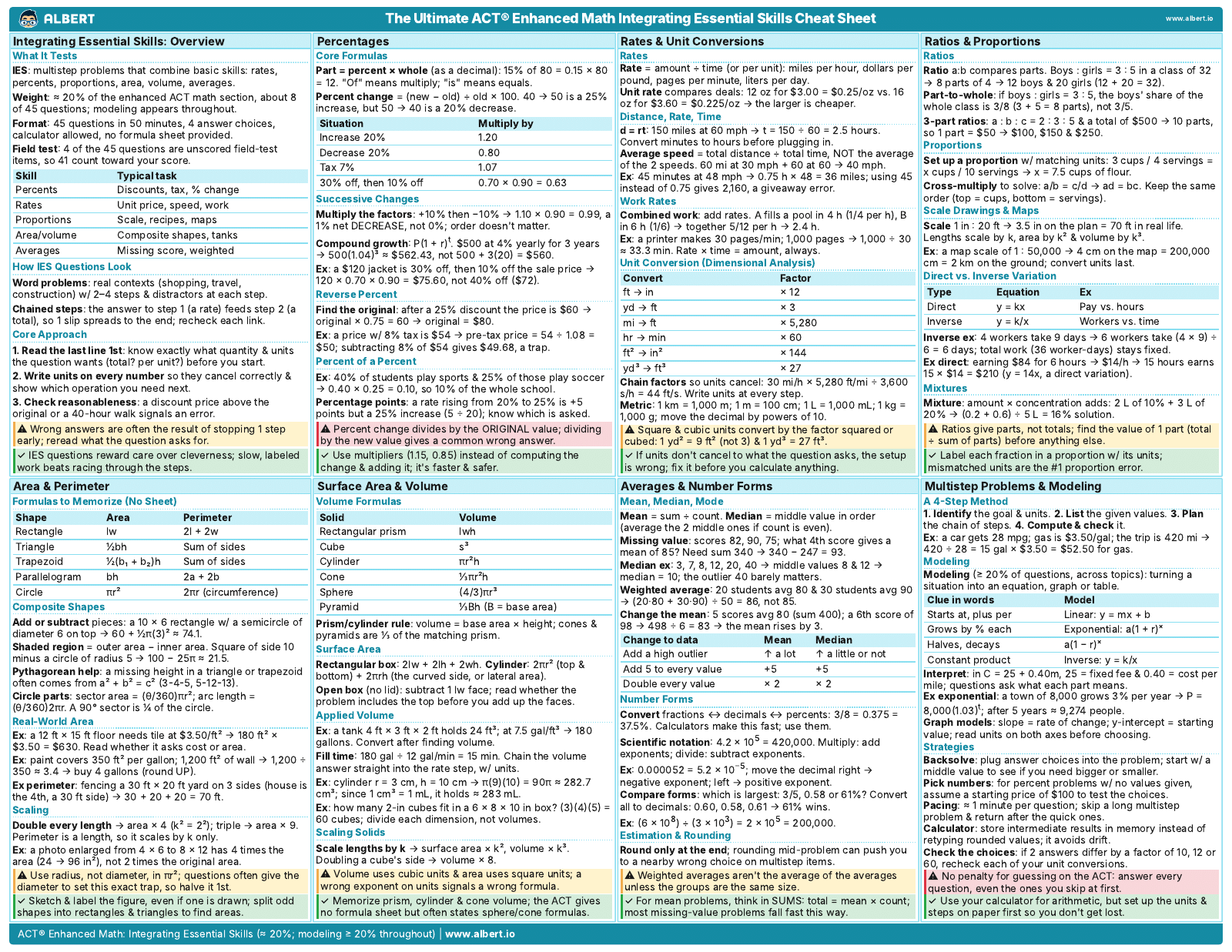
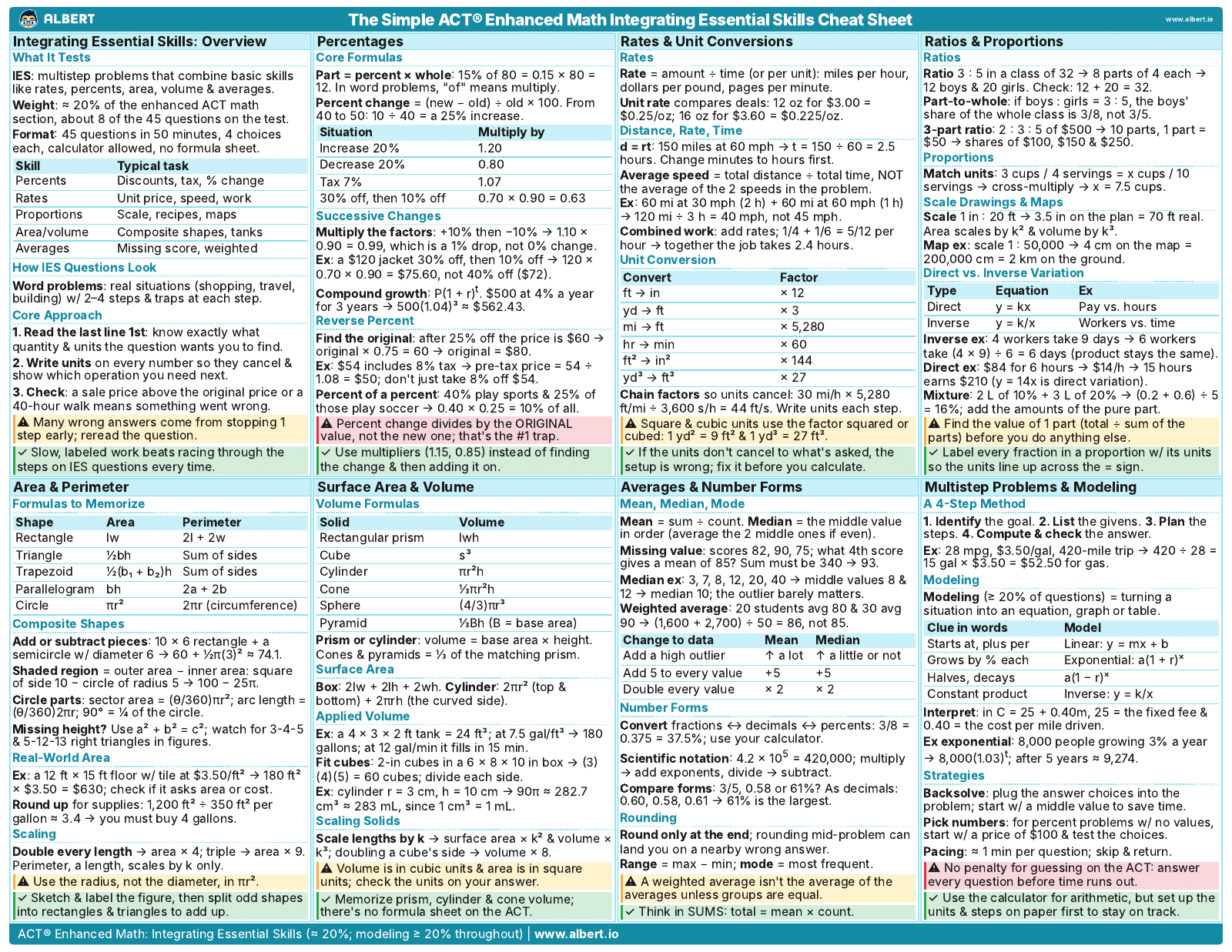
This ACT math Integrating Essential Skills cheat sheet covers the multistep problems that combine everyday math: percentages, rates and unit conversions, ratios and proportions, area and volume, averages, and modeling. On the enhanced ACT® math test, these questions make up about 20% of the section, roughly 8 of 45 questions, and modeling runs through at least 20% of the test. Choose the Simple version for the core formulas or the Ultimate version for every example, trap, and strategy.
Practice ACT® Enhanced Math questions on Albert
What’s on the ACT Integrating Essential Skills Cheat Sheet?
Both versions follow the Integrating Essential Skills reporting category described in ACT’s mathematics test description. Eight cards cover an overview of the category, percentages, rates and unit conversions, ratios and proportions, area and perimeter, surface area and volume, averages and number forms, and multistep problems and modeling.
The Simple version gives you the multipliers for percent increases and decreases, reverse-percent problems, the distance-rate-time formula, a unit conversion table, ratio and proportion setups, the area and volume formulas you must memorize, mean and median rules, and a four-step method for multistep problems.
The Ultimate version adds compound growth, percentage points, work-rate problems, metric conversions, three-part ratios, map scales, direct and inverse variation, mixtures, sectors and arc length, open boxes and fitting cubes, weighted averages, scientific notation, exponential models, and calculator strategy. Start with Simple, then move to Ultimate when you are practicing timed sections.
ACT Integrating Essential Skills at a Glance
| Skill | What you do | Example |
|---|---|---|
| Percentages | Find percents, percent change, and original values | A price after two discounts |
| Rates | Use unit rates, speed, and work rates | Average speed for a round trip |
| Proportions | Scale recipes, maps, and drawings | Map distance to real distance |
| Area and volume | Find areas of composite shapes and volumes of solids | Gallons in a tank |
| Averages | Find means, medians, and missing values | Score needed for a target average |
| Modeling | Turn situations into equations, graphs, or tables | A linear cost model |
The enhanced ACT math test has 45 questions in 50 minutes, four answer choices per question, and a calculator allowed throughout. Four questions are unscored field-test items. No formula sheet is provided, so you need to know the area and volume formulas by heart.
Key Concepts in Integrating Essential Skills
Percentages
Turn percents into multipliers. A 20% increase multiplies by 1.20, a 20% decrease by 0.80, and 7% tax by 1.07. Successive changes multiply: a 30% discount followed by an extra 10% off is 0.70 × 0.90 = 0.63, a 37% total discount, not 40%. Percent change always divides by the original value: going from 40 to 50 is a 25% increase, but going from 50 to 40 is a 20% decrease.
Worked example: A price including 8% tax is $54. The pre-tax price is 54 ÷ 1.08 = $50. Subtracting 8% of $54 gives $49.68, a common wrong answer.
Test tip: When a percent problem gives no starting value, assume $100 and test the answer choices.
Rates and Unit Conversions
A rate compares two quantities, such as miles per hour or dollars per pound. Use distance = rate × time, and convert minutes to hours before you plug in. Average speed is total distance divided by total time, not the average of two speeds. Driving 60 miles at 30 mph and 60 miles at 60 mph takes 3 hours for 120 miles, an average of 40 mph.
For work problems, add rates. If one pipe fills a pool in 4 hours and another in 6 hours, together they fill 1/4 + 1/6 = 5/12 of the pool per hour, so the job takes 2.4 hours. For unit conversions, chain factors so units cancel: 30 mi/h × 5,280 ft/mi ÷ 3,600 s/h = 44 ft/s. Remember that square and cubic units convert by the squared or cubed factor: 1 square yard is 9 square feet.
Ratios and Proportions
A ratio compares parts. If boys to girls is 3 : 5 in a class of 32, there are 8 parts of 4 students each, so 12 boys and 20 girls. The boys’ share of the whole class is 3/8, not 3/5. For proportions, keep units in the same positions: 3 cups / 4 servings = x cups / 10 servings gives x = 7.5 cups.
In direct variation, y = kx, so doubling one quantity doubles the other. In inverse variation, y = k/x, so the product stays constant: if 4 workers take 9 days, 6 workers take 36 ÷ 6 = 6 days.
Area, Perimeter, and Volume
Memorize the area of a rectangle (lw), triangle (½bh), trapezoid (½(b₁ + b₂)h), and circle (πr²), plus circumference (2πr). Break composite shapes into pieces and add or subtract. Volume of a prism or cylinder is base area × height, and a cone or pyramid is one-third of the matching prism.
Worked example: A tank measures 4 ft × 3 ft × 2 ft, so it holds 24 cubic feet. At 7.5 gallons per cubic foot, that is 180 gallons, and a hose pumping 12 gallons per minute fills it in 15 minutes.
When lengths scale by a factor k, area scales by k² and volume by k³. Doubling every side of a cube multiplies its volume by 8.
Averages and Number Forms
Think of averages as sums: total = mean × count. If three scores are 82, 90, and 75 and you need an 85 average over four tests, the total must be 340, so the fourth score must be 93. Weighted averages depend on group size: 20 students averaging 80 and 30 averaging 90 give an overall average of 86, not 85.
Know how to switch between fractions, decimals, and percents, and how to work with scientific notation: multiply by adding exponents and divide by subtracting them.
Multistep Problems and Modeling
Use a four-step method: identify the goal and units, list the given values, plan the chain of steps, then compute and check. Modeling questions ask you to turn a situation into an equation, graph, or table and to interpret its parts. In C = 25 + 0.40m, 25 is a fixed fee and 0.40 is the cost per mile. Growth by a percent each period calls for an exponential model, a(1 + r)ˣ.
Worked example: A car gets 28 miles per gallon, gas costs $3.50 per gallon, and the trip is 420 miles. The car uses 420 ÷ 28 = 15 gallons, so gas costs 15 × $3.50 = $52.50.
How Integrating Essential Skills Shows Up on the ACT
These questions are usually word problems set in real contexts such as shopping, travel, construction, or school. Each takes two to four steps, and wrong answer choices are often the result of stopping one step early or making a unit error along the way. Read the last line of the question first so you know what quantity and units to find, write units on every number, and check whether your answer is reasonable before you bubble it.
Because the ACT has no guessing penalty, answer every question. Spend about a minute per question, skip a long multistep problem on the first pass, and return to it after you finish the quicker ones.
Common Mistakes in Integrating Essential Skills
- Dividing percent change by the new value. Fix: always divide by the original value.
- Averaging two speeds. Fix: divide total distance by total time.
- Using the diameter in πr². Fix: halve the diameter first.
- Converting square or cubic units with a linear factor. Fix: square or cube the conversion factor.
- Stopping one step early. Fix: reread what the question asks for before choosing.
Frequently Asked Questions
Can I use this cheat sheet on the ACT?
No. The ACT doesn’t allow notes or formula sheets. Use the cheat sheet as a study tool so the formulas and methods are memorized before test day.
Should I start with the Simple or the Ultimate version?
Start with the Simple version of the ACT Integrating Essential Skills cheat sheet to learn the core formulas and setups. Move to Ultimate when you want extra examples and the less common problem types.
Can I use a calculator on ACT math?
Yes, a calculator is allowed on the whole math test as long as it meets ACT’s calculator policy. It speeds up arithmetic, but you still need to set up units and steps correctly.
Which formulas should I memorize for these questions?
At minimum: percent change, distance = rate × time, the areas of rectangles, triangles, trapezoids, and circles, circumference, and the volumes of rectangular prisms, cylinders, and cones. Also know that area scales by k² and volume by k³ when lengths scale by k. If a question needs the volume of a sphere or cone, the formula is sometimes given, but don’t count on it.
What is the fastest way to handle percent problems?
Use multipliers. Instead of finding 15% of a price and then adding it, multiply by 1.15. For a discount, multiply by the remaining share, such as 0.85 for 15% off. Chains of changes become a single multiplication.
How many Integrating Essential Skills questions are on the enhanced ACT?
About 20% of the math section, or roughly 8 of the 45 questions. Modeling is reported separately and appears in at least 20% of questions across all topics.