
Maximize your score with these resources:
- Albert.io ACT® Enhanced Math question banks
- Free ACT® Enhanced Math study guides
- Free ACT® Enhanced Math score calculator
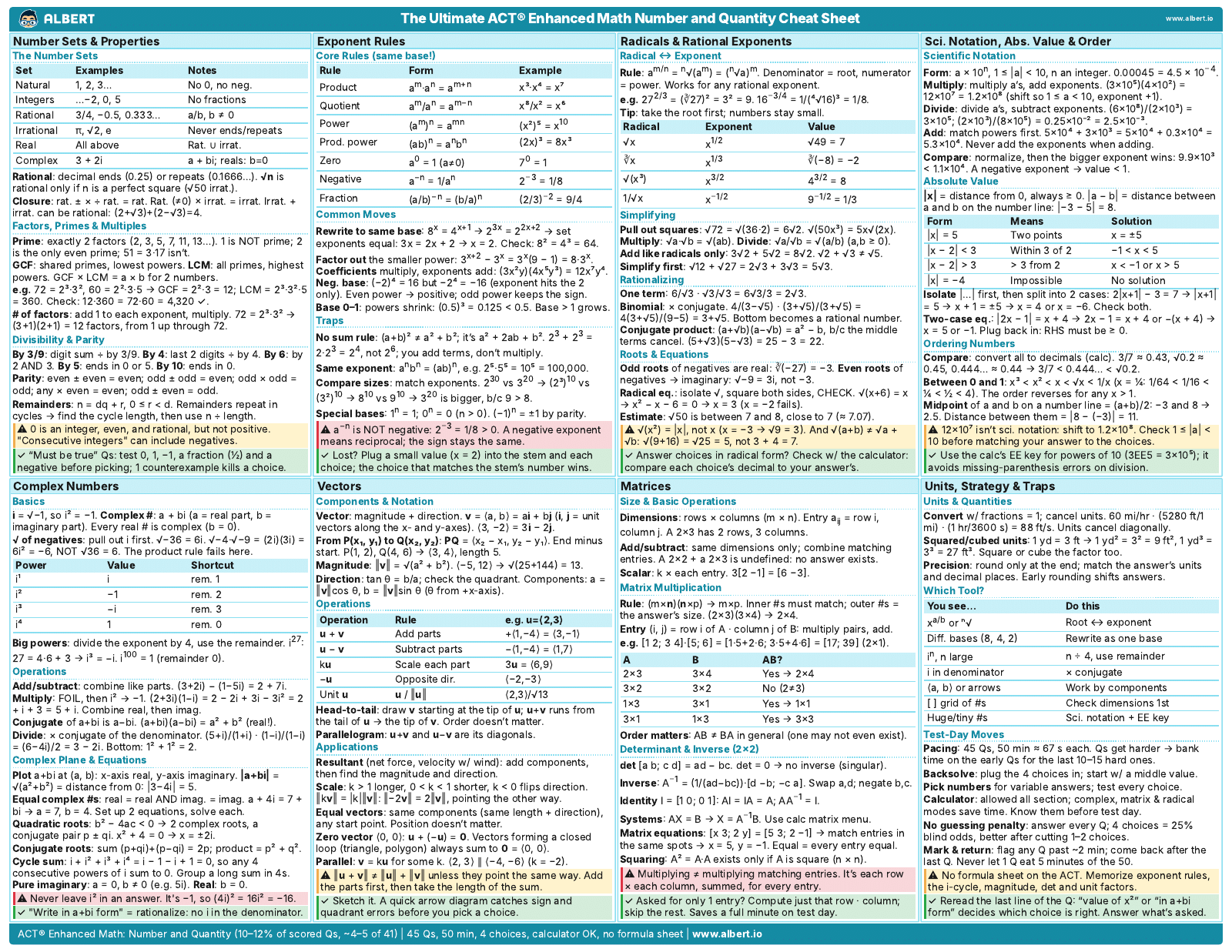
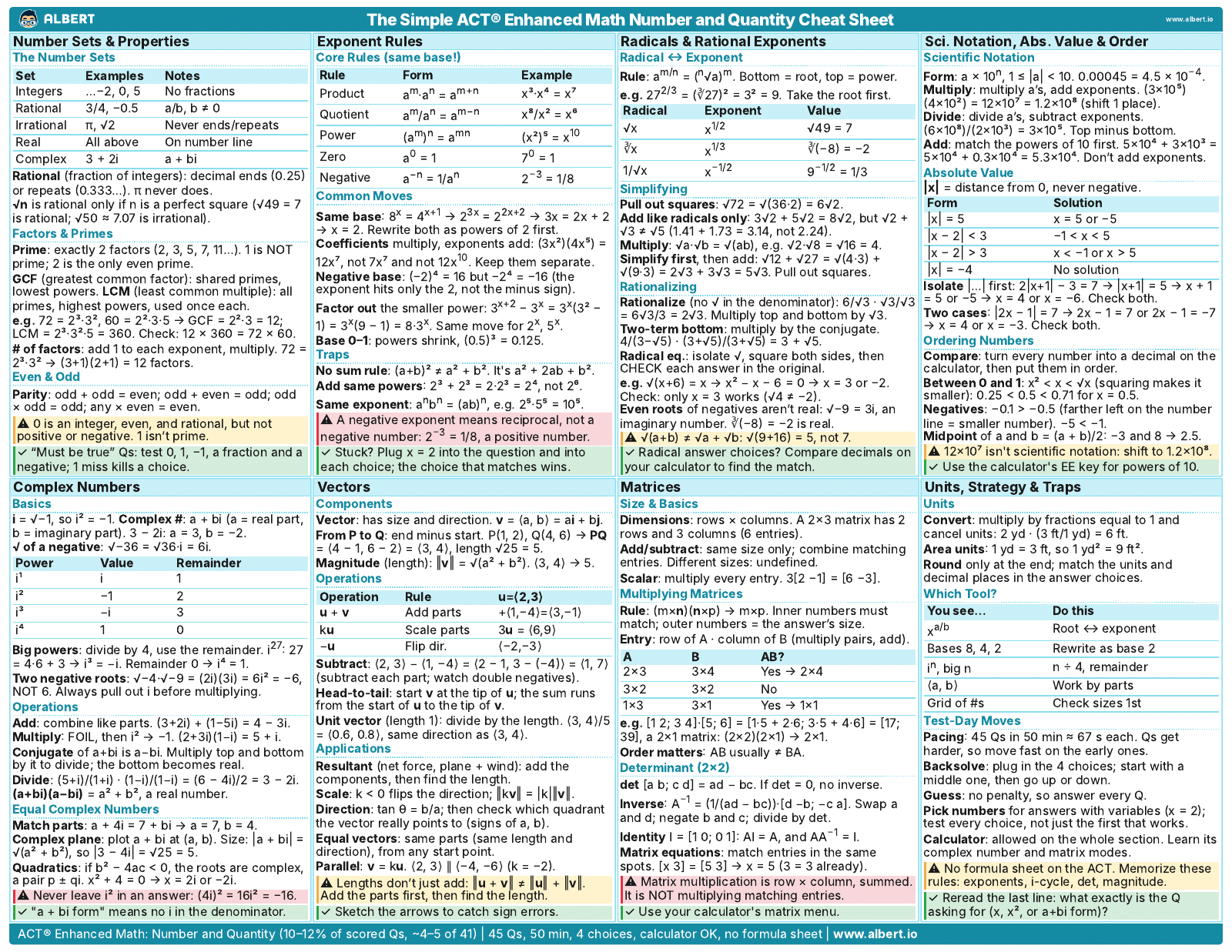
The ACT Math Number and Quantity cheat sheet packs real and complex numbers, exponents, radicals, vectors, and matrices onto one page. Number and Quantity makes up 10–12% of scored ACT Math questions, roughly four or five items per test. Download the Simple version for the core rules or the Ultimate version for every shortcut and trap.
Practice ACT® Enhanced Math questions on Albert
What’s on the ACT Enhanced Math Number and Quantity Cheat Sheet?
This ACT Math Number and Quantity cheat sheet covers the Number and Quantity reporting category of the enhanced ACT® Math section. Both versions use the same eight cards: number sets and properties, exponent rules, radicals and rational exponents, scientific notation with absolute value, complex numbers, vectors, matrices, and a final card on units and test-day strategy.
The Simple version is for students who want the rules they must know cold, each with one short example. Start here if exponent rules or the powers of i still feel shaky. The Ultimate version adds the second layer: factoring out a common power, comparing 230 with 320, rationalizing a binomial denominator, matrix inverses, vector parallelism, and the traps that turn a right method into a wrong answer. If you’re aiming for a 30+ on Math, print the Ultimate version and quiz yourself on every line.
The ACT gives you no formula sheet, so everything on these cards is something you need in memory on test day.
ACT Math Number and Quantity at a Glance
Number and Quantity sits inside Preparing for Higher Mathematics, alongside Algebra, Functions, Geometry, and Statistics and Probability. On the enhanced test you get 45 questions in 50 minutes, four answer choices each, and a calculator is allowed for the whole section.
| Topic group | What you need to do |
|---|---|
| Number sets and properties | Classify numbers, use primes, GCF/LCM, divisibility, and parity |
| Exponents | Apply the product, quotient, power, zero, and negative exponent rules |
| Radicals and rational exponents | Convert between forms, simplify, rationalize, solve radical equations |
| Scientific notation and absolute value | Compute with powers of 10; solve absolute value equations and inequalities |
| Complex numbers | Add, multiply, divide, simplify powers of i |
| Vectors | Find components, magnitude, sums, and scalar multiples |
| Matrices | Check dimensions, multiply, find 2×2 determinants and inverses |
Weight: 10–12% of scored items, about 4–5 questions. That’s a small slice, but these questions are often quick points once you know the rule, which buys time for harder items later in the section.
Key Concepts in Number and Quantity
Exponent Rules and Same-Base Equations
Every exponent rule works only when the bases match. Multiply powers and you add exponents; divide and you subtract; raise a power to a power and you multiply. A negative exponent means reciprocal, and any nonzero base to the zero power equals 1.
The ACT loves equations with different bases that secretly share one. Worked example: solve 8x = 4x+1. Rewrite both sides as powers of 2: 23x = 22x+2. Now the exponents must be equal, so 3x = 2x + 2 and x = 2.
A second move worth knowing is factoring out the smaller power. The expression 3x+2 − 3x becomes 3x(32 − 1) = 8·3x. Students who try to subtract the exponents here get a wrong answer that often appears among the choices.
Exam tip: when the choices are all variable expressions, pick x = 2, evaluate the original expression, and test each choice. It takes 30 seconds and catches sign and exponent errors.
Radicals and Rational Exponents
A rational exponent is a radical in disguise: in am/n, the denominator is the root and the numerator is the power. So 272/3 means “cube root of 27, then square it,” which is 32 = 9. Taking the root first keeps the numbers small.
To simplify a square root, pull out the largest perfect square: √72 = √(36·2) = 6√2. You can only add radicals with the same radicand, so simplify first. Worked example: √12 + √27 = 2√3 + 3√3 = 5√3.
Radical equations need a check step. Solve √(x + 6) = x by squaring: x + 6 = x2, so x2 − x − 6 = 0 and x = 3 or x = −2. Plug both back in. √9 = 3 works, but √4 = 2 doesn’t equal −2, so the only solution is x = 3.
Exam tip: if the choices are in radical form and you aren’t sure your simplification is right, compare decimals on your calculator. 6√2 ≈ 8.485 and √72 ≈ 8.485, so they match.
Scientific Notation and Absolute Value
Scientific notation has the form a × 10n with 1 ≤ |a| < 10. To multiply, multiply the front numbers and add the exponents. Worked example: (3 × 10⁵)(4 × 10²) = 12 × 107. That isn’t in scientific notation yet, so shift the decimal: 1.2 × 10⁸. Many wrong choices stop at the first step.
Absolute value measures distance from zero, so it’s never negative. An equation like |x| = 5 has two answers, and |x| = −4 has none. Inequalities follow a pattern: |x − 2| < 3 means “within 3 of 2,” so −1 < x < 5, while |x − 2| > 3 means x < −1 or x > 5. Always isolate the absolute value before splitting into cases: 2|x + 1| − 3 = 7 becomes |x + 1| = 5, so x = 4 or x = −6.
Exam tip: use your calculator’s EE key for powers of 10. Typing 1.2E8 avoids the parenthesis mistakes that come from typing ×10^8 by hand.
Complex Numbers
The imaginary unit is i = √−1, so i2 = −1. Powers of i repeat every four: i, −1, −i, 1. For a large power, divide the exponent by 4 and use the remainder. Worked example: i27. Since 27 = 4·6 + 3, i27 = i3 = −i.
Multiply complex numbers by FOIL, then replace i2 with −1: (2 + 3i)(1 − i) = 2 − 2i + 3i − 3i2 = 5 + i. To divide, multiply top and bottom by the conjugate of the denominator. Since (a + bi)(a − bi) = a2 + b2, the denominator becomes a real number.
Watch the product of two negative square roots. √−4 · √−9 is (2i)(3i) = 6i2 = −6, not √36 = 6. Convert to i form before multiplying.
Exam tip: when two complex numbers are equal, the real parts match and the imaginary parts match. a + 4i = 7 + bi gives a = 7 and b = 4 with no algebra.
Vectors and Matrices
A vector has both magnitude and direction. Write it in component form ⟨a, b⟩, and find the vector from P to Q by subtracting start from end. Its magnitude is √(a2 + b2). Add vectors by adding matching components, and scale by multiplying each component. Worked example: a plane flies with velocity ⟨300, 0⟩ and wind pushes it ⟨0, −40⟩. The resultant is ⟨300, −40⟩, with speed √(90,000 + 1,600) ≈ 302.7.
For matrices, check dimensions before anything else. You can add only matrices of the same size. You can multiply an m×n matrix by an n×p matrix, and the product is m×p. Each entry is a row of the first matrix times a column of the second, summed: [1 2; 3 4]·[5; 6] = [17; 39]. For a 2×2 matrix [a b; c d], the determinant is ad − bc, and if it equals 0, there’s no inverse.
Exam tip: if a question asks for one entry of a product, compute only that row-times-column pair. Your calculator’s matrix menu handles the rest when the numbers are messy.
How Number and Quantity Shows Up on the Exam
Every ACT Math question is multiple choice with four options, and the section runs roughly easiest to hardest. Number and Quantity items appear throughout. Early ones are often one-step: evaluate 16−3/4, pick the irrational number, or simplify a power of i. Later ones combine steps, such as dividing complex numbers into a + bi form, solving a same-base exponential equation, or reading a matrix product’s dimensions before computing an entry.
Some items are cross-coded as Modeling, so a vector or unit-conversion question may come wrapped in a short real-world setting. Read the last sentence first so you know whether the question wants x, x2, a magnitude, or a specific matrix entry.
Only the bubbled answer is scored, so method doesn’t earn partial credit. That’s why checking matters: plug a solution back in, compare decimals for radical choices, and confirm that scientific notation is properly normalized before you match it to a choice. There’s no penalty for wrong answers, so never leave a question blank.
Common Mistakes in Number and Quantity
- Treating a negative exponent as a negative number. 2−3 is 1/8, which is positive. Fix: read a−n as “1 over an.”
- Distributing an exponent or root over a sum. (a + b)2 ≠ a2 + b2, and √(9 + 16) is 5, not 7. Fix: exponents and roots distribute over multiplication only.
- Leaving i2 in an answer. (4i)2 is −16, not 16i2. Fix: replace i2 with −1 every time it appears.
- Multiplying matrices entry by entry. Matrix multiplication is row times column, summed. Fix: write the dimensions first, then compute.
- Skipping the check on radical and absolute value equations. Squaring can add solutions that don’t work. Fix: plug each answer back into the original equation.
Frequently Asked Questions
Can I use this cheat sheet on the exam?
No. The ACT doesn’t allow notes or reference sheets, and it doesn’t provide a formula sheet for Math. The ACT Math Number and Quantity cheat sheet is a study tool: use it to review, quiz yourself, and spot gaps before test day.
Should I start with the Simple or the Ultimate version?
Start with Simple if you’re still learning the rules or if your Math score is below the mid-20s. Once you can explain every line without looking, move to Ultimate for the shortcuts and traps that separate a 28 from a 33.
How many Number and Quantity questions are on the ACT?
About four or five. Number and Quantity accounts for 10–12% of the scored Math questions on the enhanced ACT.
Do I need to know matrices and vectors for the ACT?
Yes, at a basic level. Expect dimensions, addition, scalar multiplication, matrix products, 2×2 determinants, vector components, magnitude, and vector addition. They show up less often than exponents and complex numbers, but they’re quick points if you know the rules.
Can my calculator handle complex numbers and matrices?
Many permitted graphing calculators can. Check that your model meets the ACT calculator policy and practice its complex and matrix modes before test day, so you aren’t hunting through menus under time pressure.