
Maximize your score with these resources:
- Albert.io ACT® Enhanced Math question banks
- Free ACT® Enhanced Math study guides
- Free ACT® Enhanced Math score calculator
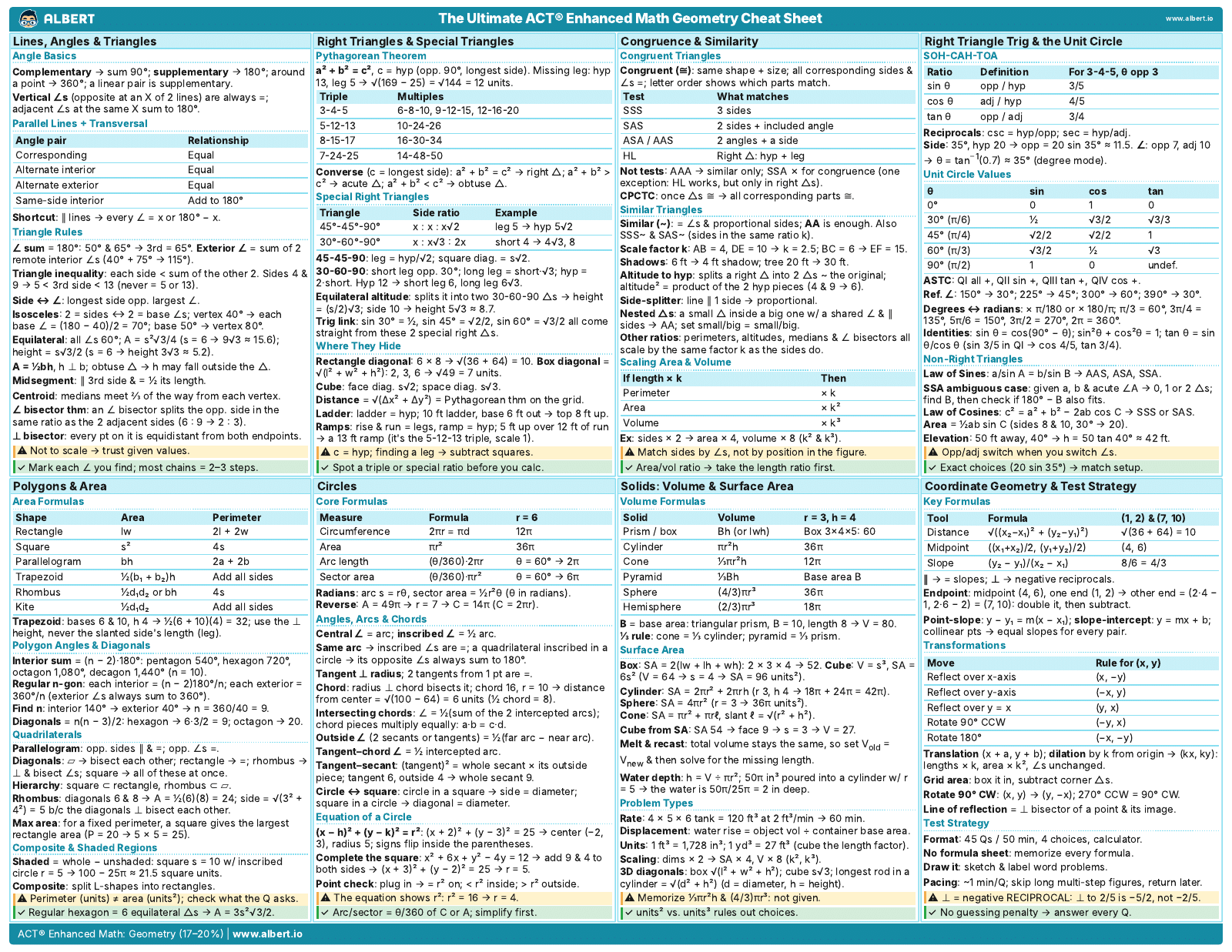
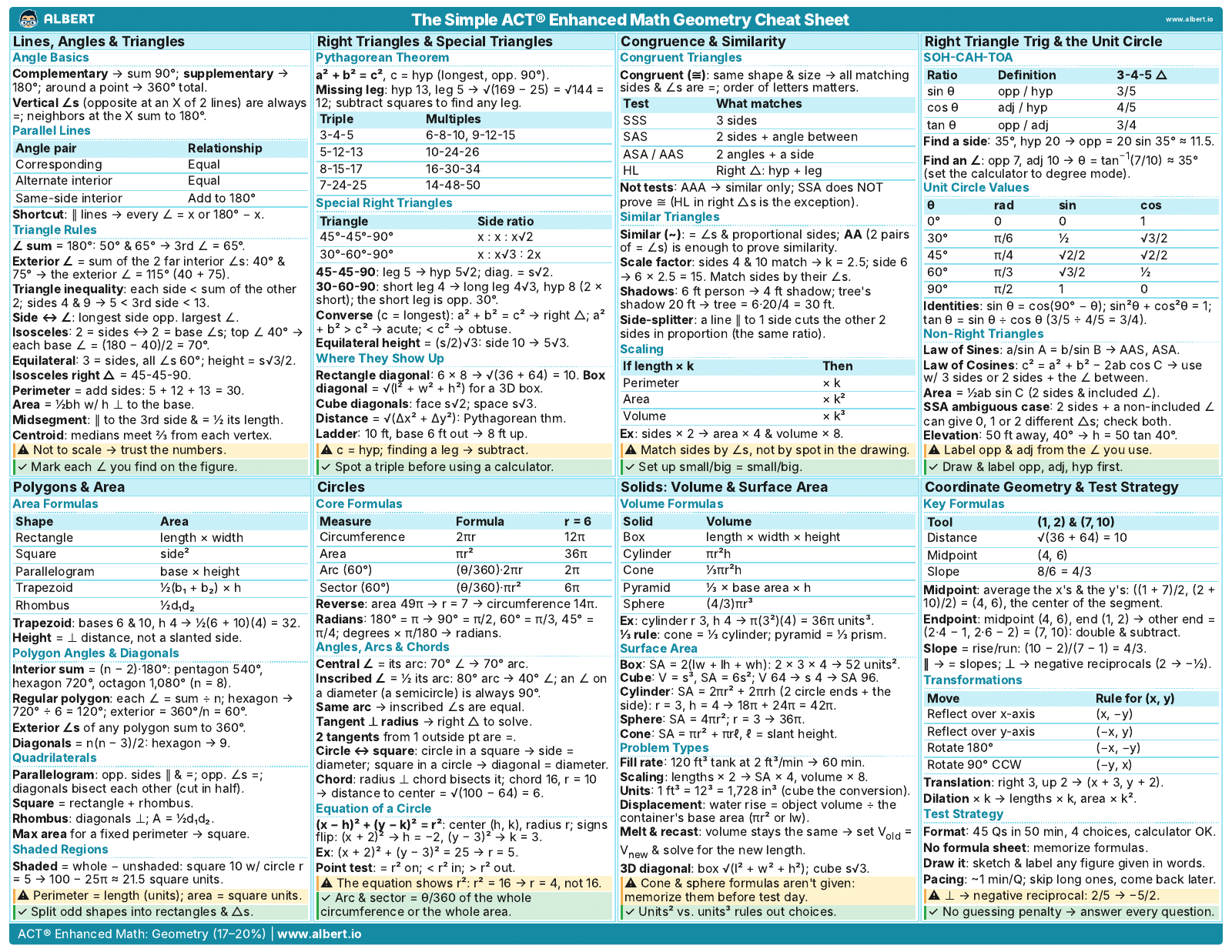
This ACT Math Geometry cheat sheet covers angles and triangles, the Pythagorean theorem and special right triangles, congruence and similarity, right triangle trig, polygons, circles, solids, and coordinate geometry. Geometry makes up 17–20% of the ACT® math test. Use the Simple version for a fast review or the Ultimate version for every formula, example, and trap.
Practice ACT® Enhanced Math questions on Albert
What’s on the ACT Math Geometry Cheat Sheet?
The sheet covers the Geometry reporting category of the enhanced ACT math test, which ACT describes as working with shapes and solids, congruence and similarity, surface area and volume, right triangles and trigonometry, circles, and figures in the coordinate plane. Each of the eight cards takes one skill group.
The Simple version keeps the core rules with a short example each: angle relationships, the triangle angle sum, Pythagorean triples, special right triangles, congruence tests, SOH-CAH-TOA, area and volume formulas, circle formulas, and the distance and midpoint formulas.
The Ultimate version adds the details behind the hardest geometry questions: the exterior angle rule, the converse of the Pythagorean theorem, scaling area and volume by k² and k³, the Law of Sines and Law of Cosines, area with sine, interior and exterior angles of polygons, chords and tangents, completing the square for a circle’s equation, slant height, and transformation rules.
ACT Math Geometry at a Glance
The enhanced ACT math test has 45 questions in 50 minutes, each with four answer choices, and a calculator is allowed throughout. There’s no formula sheet, so every area, volume, and circle formula must be memorized. Geometry counts for 17–20% of the questions, roughly 7 or 8 of the 41 scored questions (4 of the 45 are unscored field-test items).
| Skill group | What you need to do |
|---|---|
| Lines, angles, and triangles | Use parallel line angle pairs, the 180° rule, and isosceles rules. |
| Right and special triangles | Apply the Pythagorean theorem, triples, and 45-45-90 and 30-60-90 ratios. |
| Congruence and similarity | Prove triangles congruent or similar and use scale factors. |
| Right triangle trig | Use sine, cosine, and tangent to find sides and angles. |
| Polygons and area | Find areas, angle sums, and shaded regions. |
| Circles | Find circumference, area, arcs, sectors, and circle equations. |
| Solids | Find volume and surface area of boxes, cylinders, cones, and spheres. |
| Coordinate geometry | Use distance, midpoint, slope, and transformation rules. |
Key Concepts in ACT Math Geometry
Angles and Triangles
Most angle questions use a few rules: supplementary angles add to 180°, vertical angles are equal, and the three angles of a triangle add to 180°. When parallel lines are cut by a transversal, every angle is either equal to x or equal to 180° − x. An exterior angle of a triangle equals the sum of the two interior angles that are not next to it.
Worked example: An isosceles triangle has a vertex angle of 40°. Each base angle is (180 − 40) ÷ 2 = 70°.
Exam tip: Figures are not always drawn to scale. Write each angle you find on the figure and trust the given numbers, not the picture.
The Pythagorean Theorem and Special Right Triangles
In a right triangle, a² + b² = c², where c is the hypotenuse. Common triples such as 3-4-5, 5-12-13, and 8-15-17 (and their multiples) save time. The two special right triangles have fixed side ratios: x : x : x√2 for a 45°-45°-90° triangle and x : x√3 : 2x for a 30°-60°-90° triangle.
Worked example: A 30°-60°-90° triangle has a hypotenuse of 12. The short leg is 6 and the long leg is 6√3.
Exam tip: To find a leg, subtract: b² = c² − a². Adding the squares when c is already known is one of the most common errors.
Congruence and Similarity
Triangles are congruent by SSS, SAS, ASA, AAS, or HL. Triangles are similar when two angles match (AA), and similar triangles have proportional sides. If lengths are multiplied by a scale factor k, area is multiplied by k² and volume by k³.
Worked example: A 6-foot person casts a 4-foot shadow while a tree casts a 20-foot shadow. Setting up tree/20 = 6/4 gives a 30-foot tree.
Exam tip: Match sides by their angles, not by where they sit in the picture. Similar triangles are often flipped or rotated.
Right Triangle Trigonometry
SOH-CAH-TOA gives the three main ratios: sine is opposite over hypotenuse, cosine is adjacent over hypotenuse, and tangent is opposite over adjacent. Use inverse trig to find an angle. For triangles without a right angle, the Law of Sines and the Law of Cosines apply.
Worked example: You stand 50 feet from a building and the angle of elevation to the top is 40°. The height is 50 tan 40°, about 42 feet.
Exam tip: Check that your calculator is in degree mode when the angles are in degrees.
Polygons and Area
Know the area formulas for rectangles, parallelograms (bh), triangles (½bh), and trapezoids (½(b₁ + b₂)h). The interior angles of an n-sided polygon add to (n − 2) × 180°, and the exterior angles of any convex polygon add to 360°.
Worked example: Each interior angle of a regular polygon is 140°, so each exterior angle is 40°. The polygon has 360 ÷ 40 = 9 sides.
Exam tip: For a shaded region, find the area of the whole shape and subtract the unshaded part.
Circles
Circumference is 2πr and area is πr². Arc length and sector area are fractions of those totals: multiply by θ/360. A central angle equals its arc, while an inscribed angle is half its arc. The standard equation of a circle is (x − h)² + (y − k)² = r², with center (h, k) and radius r.
Worked example: x² + 6x + y² − 4y = 12 becomes (x + 3)² + (y − 2)² = 25 after completing the square, so the center is (−3, 2) and the radius is 5.
Exam tip: The equation shows r², not r. A right side of 16 means a radius of 4.
Solids: Volume and Surface Area
Volume formulas to know: box lwh, cylinder πr²h, cone ⅓πr²h, pyramid ⅓Bh, and sphere (4/3)πr³. Surface area adds up all the faces, such as 2(lw + lh + wh) for a box or 2πr² + 2πrh for a cylinder.
Worked example: A cube has a volume of 64, so each side is 4 and the surface area is 6(4²) = 96.
Exam tip: Cone and sphere formulas are not given. Memorize them, especially the ⅓ in the cone formula.
Coordinate Geometry
The distance formula is the Pythagorean theorem on a grid, and the midpoint is the average of the coordinates. Parallel lines have equal slopes, and perpendicular slopes are negative reciprocals. Reflections and rotations follow simple rules, such as (x, y) → (x, −y) for a reflection over the x-axis.
Worked example: For (1, 2) and (7, 10), the distance is √(36 + 64) = 10 and the midpoint is (4, 6).
Exam tip: The slope perpendicular to 2/5 is −5/2, not −2/5. Flip the fraction and change the sign.
How Geometry Shows Up on the ACT
Geometry questions range from one-step angle problems early in the test to multi-step figures with circles, solids, or trig later on. Many are word problems that describe a figure without drawing it, so sketching is a key skill. Others ask about a real-world setting, such as the height of a building, the amount of water in a tank, or the shadow cast by a tree.
Because the calculator is allowed throughout, the hard part is usually setting up the problem, not doing the arithmetic. Answer choices often stay in exact form, such as 5√2 or 36π, so knowing the special triangles and circle formulas helps you work quickly. To see how your practice results translate, try the ACT score calculator.
Common Mistakes in ACT Geometry
- Adding instead of subtracting when finding a leg with the Pythagorean theorem.
- Mixing up radius and diameter, or reading r² in a circle equation as the radius.
- Using a slanted side as the height in a parallelogram, triangle, or trapezoid.
- Scaling area or volume by k instead of k² or k³.
- Labeling opposite and adjacent from the wrong angle in a trig problem.
- Trusting the picture when the figure is not drawn to scale.
Frequently Asked Questions
How many geometry questions are on the ACT?
Geometry makes up 17–20% of the enhanced ACT math test, which works out to roughly 7 or 8 of the 41 scored questions.
Can I use this cheat sheet on the exam?
No. The ACT does not allow notes, and it does not provide a formula sheet. Use this ACT Math Geometry cheat sheet to study before test day so the formulas are already memorized.
What’s the difference between the Simple and Ultimate versions?
The Simple version covers the core formulas and rules with one short example each. The Ultimate version adds harder topics such as the Law of Sines and Law of Cosines, completing the square for circles, polygon angle shortcuts, and transformation rules. Start with the Simple version if you are reviewing, and use the Ultimate version if you are aiming for a top score.
Which geometry formulas should I memorize first?
Start with the Pythagorean theorem, the two special right triangles, SOH-CAH-TOA, the area of a triangle and trapezoid, circle circumference and area, the equation of a circle, and the volume of a cylinder, cone, and sphere. These cover most geometry questions.
Keep Studying
This ACT Math Geometry cheat sheet is one part of a set. For the whole test on one page, see the full ACT Math cheat sheets. When you are ready to practice, Albert’s ACT Math course has hundreds of test-style questions with explanations for every answer.